

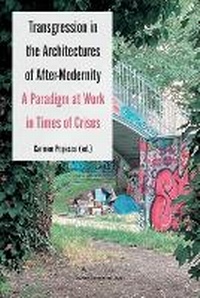
Transgression in the Architectures of After-Modernity
A Paradigm at Work in Times of Crises
Published on 3. September 2025
Book
Paperback/Softback
240 pages
978-94-6270-465-7 (ISBN)
Description
Transgressive acts in architecture as responses to today's ecological, political, economic, and social crises
In architecture, transgressive acts have always been a reality, in spite of rules and canons that have defined the discipline and its extended field. However, in recent decades, their frequency and radicality have surged from rather random, marginal and/or idiosyncratic phenomena. While their sudden rise can be explained as a reaction to the compulsive normativity of modernity, the deeper roots are to be sought elsewhere: the recent waves of transgressiveness are intimately linked to the hypercrisis affecting our world today - spanning ecological, political, economic, and social dimensions, and catalysing fundamental mutations and disorders. Some of these transgressive acts are motivated by a desire to dismantle a malfunctioning system, but more often than not breaking the rules has become an inherent survival tactic amid urgent social challenges. In our era of after-modernity, transgression emerges not just as an act of defiance, but reveals a new paradigm at work - a critical framework for reimagining the built environment, challenging established orders, and advocating for the rights of marginalised populations. Drawing on a rich array of theoretical insights and empirical case studies from multiple countries, this volume provides a unique, forward-looking perspective on transgressive acts in architecture as responses to today's ecological, political, economic, and social crises.
In architecture, transgressive acts have always been a reality, in spite of rules and canons that have defined the discipline and its extended field. However, in recent decades, their frequency and radicality have surged from rather random, marginal and/or idiosyncratic phenomena. While their sudden rise can be explained as a reaction to the compulsive normativity of modernity, the deeper roots are to be sought elsewhere: the recent waves of transgressiveness are intimately linked to the hypercrisis affecting our world today - spanning ecological, political, economic, and social dimensions, and catalysing fundamental mutations and disorders. Some of these transgressive acts are motivated by a desire to dismantle a malfunctioning system, but more often than not breaking the rules has become an inherent survival tactic amid urgent social challenges. In our era of after-modernity, transgression emerges not just as an act of defiance, but reveals a new paradigm at work - a critical framework for reimagining the built environment, challenging established orders, and advocating for the rights of marginalised populations. Drawing on a rich array of theoretical insights and empirical case studies from multiple countries, this volume provides a unique, forward-looking perspective on transgressive acts in architecture as responses to today's ecological, political, economic, and social crises.
More details
Language
English
Place of publication
Leuven
Belgium
Target group
College/higher education
US School Grade: College Graduate Student and over
Product notice
Paperback (trade)
Illustrations
Not illustrated
Dimensions
Height: 234 mm
Width: 156 mm
Thickness: 12 mm
Weight
515 gr
ISBN-13
978-94-6270-465-7 (9789462704657)
Copyright in bibliographic data and cover images is held by Nielsen Book Services Limited or by the publishers or by their respective licensors: all rights reserved.
Schweitzer Classification
Person
Carmen Popescu is professor of architectural history at the Ecole Nationale Superieure d'Architecture Paris Val-de-Seine. Carmen Popescu is professor of architectural history at the Ecole Nationale Superieure d'Architecture Paris Val-de-Seine.
Content
Acknowledgments
Introduction: Speaking Transgression
in Times of Crises
Carmen Popescu
Part One: Recodifying Inhabiting: On So cietal Mutations and Resituating Margins
1 "The Single-Persons Project": Council Housing Beyond the Nuclear Family
Savia Palate
2 The Representability of Interstitial Scenes
Sarah Mills and Simon Baker
3 On Relational Histories of Spatial Law and Transgression
Tiago Castela
4 On Weeds and Hospitality: An Architectural Point of View on (Bio)Diversity
Carmen Popescu
Part Two: Bending Politics: On Moving the Lines
5 Limit(ation)s: Squatting in Naldoeken, Izmir
Guelsuem Baydar, Kivanc Kilinc, and Ahenk Yilmaz
6 Living with the Museum: Uses of Memory and the Normalization of Struggles
Leandro Peredo
7 Climbing Over, Stepping Across: Transgression as Lived Alternative in the Practice of Stalker
Patrick Dueblin
8 Liminality as Transgression: The Urban Ritual of XR
Francesca Romana Dell'Aglio
Part Three: Deviating Theory: On Co ncepts and Devices
9 Transgression-Where Experience Meets with Concept? Tschumi's "Paradox of Architecture" Revisited
Ole W. Fischer
10 Trapping, Dismembering and Crucifying Angels: Tracing the Sacred in Hejduk's Bovisa
Jesse Rafeiro
11 Entwined Spaces of Boredom, Desire, and Transgression
Christian Parreno
About the Authors
Introduction: Speaking Transgression
in Times of Crises
Carmen Popescu
Part One: Recodifying Inhabiting: On So cietal Mutations and Resituating Margins
1 "The Single-Persons Project": Council Housing Beyond the Nuclear Family
Savia Palate
2 The Representability of Interstitial Scenes
Sarah Mills and Simon Baker
3 On Relational Histories of Spatial Law and Transgression
Tiago Castela
4 On Weeds and Hospitality: An Architectural Point of View on (Bio)Diversity
Carmen Popescu
Part Two: Bending Politics: On Moving the Lines
5 Limit(ation)s: Squatting in Naldoeken, Izmir
Guelsuem Baydar, Kivanc Kilinc, and Ahenk Yilmaz
6 Living with the Museum: Uses of Memory and the Normalization of Struggles
Leandro Peredo
7 Climbing Over, Stepping Across: Transgression as Lived Alternative in the Practice of Stalker
Patrick Dueblin
8 Liminality as Transgression: The Urban Ritual of XR
Francesca Romana Dell'Aglio
Part Three: Deviating Theory: On Co ncepts and Devices
9 Transgression-Where Experience Meets with Concept? Tschumi's "Paradox of Architecture" Revisited
Ole W. Fischer
10 Trapping, Dismembering and Crucifying Angels: Tracing the Sacred in Hejduk's Bovisa
Jesse Rafeiro
11 Entwined Spaces of Boredom, Desire, and Transgression
Christian Parreno
About the Authors