

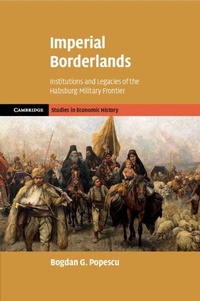
Imperial Borderlands
Institutions and Legacies of the Habsburg Military Frontier
Published on 22. May 2025
Book
Paperback/Softback
331 pages
978-1-009-36518-5 (ISBN)
Description
What are the institutions which govern border spaces and how do they impact long-term economic and social development? This book focuses on the Habsburg military frontier zone which originated in the sixteenth century as an instrument for protecting the empire's southern border against the threat of the Ottoman Empire and which lasted until the 1880s. The book outlines the conditions under which this extractive institution affected development, showing how locals were forced to work as soldiers and exposed to rigid communal property rights, an inflexible labor market, and discrimination when it came to the provision of public infrastructure. While the formal institutions set up during the military colony disappeared, their legacy can be traced in political attitudes and social norms even today with the violence and abuses exercised by the imperial government transformed into distrust in public authorities, limited political involvement, and low social capital.
Reviews / Votes
'A new theory of why states are divided into a core and periphery. Pathbreaking.' James A. Robinson, University of Chicago 'How do empires govern their colonial territories? Which are the consequences of their legal and social institutions for development, democracy and collective trust? In this extremely smart book, Bogdan Popescu exploits a trove of historical and contemporary data on the territories controlled by the Habsburgs to offer a sophisticated examination of imperialism and colonialism.' Carles Boix, Princeton University 'This innovative study illuminates one of the most consequential border zones in world history and traces its institutional legacy into the present day. It also has many wise things to say about extractive institutions more widely.' Sheilagh Ogilvie, University of Oxford 'What are the long-term effects of military colonization on the colonized? Through a detailed study of the Habsburg Empire Bogdan Popescu discovers persistent attitudes and behaviors characteristic of pre-capitalist family and property relations. Anyone interested in European victims of colonization or colonial legacies more generally should read this book.' Jason Wittenberg, University of California, Berkeley 'This thought-provoking book sheds new light on the negative long-run impacts of 'internal' military imperialism on socioeconomic development in central Europe. A well-crafted study.' Mark Dincecco, University of Michigan 'This is a clear, ambitious and well-signposted book which is challenging but rewarding to read.' Cathie Carmichael, European History QuarterlyMore details
Series
Language
English
Place of publication
Cambridge
United Kingdom
Product notice
Paperback (trade)
Illustrations
Worked examples or Exercises
Dimensions
Height: 229 mm
Width: 152 mm
Thickness: 18 mm
Weight
445 gr
ISBN-13
978-1-009-36518-5 (9781009365185)
Copyright in bibliographic data and cover images is held by Nielsen Book Services Limited or by the publishers or by their respective licensors: all rights reserved.
Schweitzer Classification
Other editions
Additional editions
Book
11/2023
Cambridge University Press
€107.50
Shipment within 15-20 days
Person
Dr Bogdan G. Popescu is an Assistant Professor at John Cabot University, Rome, Italy. He completed his Ph.D. in the Department of Political Science at the University of Chicago, held postdoctoral positions at Princeton and Bocconi University, and taught at the University of Oxford.
Content
1. Historical States, Imperialism, and Development; 2. Imperialism and Extractive Institutions: A Theoretical Framework; 3. The Habsburg Military Frontier; 4. Military Colonialism and Economic Development; 5. Colonial Institutions and Social Norms; 6. Lasting Legacies: Political Attitudes and Social Capital; 7. Beyond the Habsburgs; 8. Epilogue.