

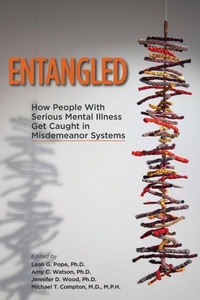
Entangled
How People With Serious Mental Illness Get Caught in Misdemeanor Systems
Published on 21. January 2025
Book
Paperback/Softback
330 pages
978-1-61537-542-4 (ISBN)
Description
People with serious mental illness (SMI) are prominently
and unjustly overrepresented in the criminal legal system. More than
one-third-and in some studies more than two-thirds-of those with SMI have a
lifetime history of arrest. For the first time, a single volume takes a deep
dive into the common behaviors, contexts, and decisions that lead to
misdemeanor arrests.
Contributors representing the fields of
anthropology, social work, criminology, and psychiatry draw on data from a
mixed-method, multisite study (Atlanta, Chicago, New York, and Philadelphia)
to examine how people with SMI become entangled in the criminal legal system
and how failure to resolve underlying issues-such as underfunded social and
mental health service systems and the shortage of affordable housing-plays a
role.
Divided into three distinct sections, Entangled: How People
With Serious Mental Illness Get Caught in Misdemeanor Systems
* Provides a historical perspective on how social, mental health,
and criminal legal system policies have imperiled individuals with SMI and
demonstrates the contexts that shape decision-making across misdemeanor
systems.
* Looks at specific misdemeanor charges that have traditionally
been common for people with SMI, including criminal trespass, shoplifting,
obstruction and resisting arrest, and misdemeanor assault and battery, with
insight into the factors behind such charges.
* Reviews necessary
reforms and policy advances in the criminal legal system and the mental
health crisis response system and advocates for a multisystem approach that
emphasizes racial equity.
In each chapter, data-based clinical
vignettes illustrate scenarios in which people with SMI have been arrested
on misdemeanor charges, heightening the clinical relevance of the
information. Key points summarize the main takeaways in every chapter and
help readers retain important concepts.
Offering a thorough and
nuanced description of current challenges as well as a vision of a better
future, Entangled encourages readers to be part of crafting solutions
to help individuals with mental illness-especially serious mental
illness-embrace a life of recovery, hope, empowerment, and integration.
and unjustly overrepresented in the criminal legal system. More than
one-third-and in some studies more than two-thirds-of those with SMI have a
lifetime history of arrest. For the first time, a single volume takes a deep
dive into the common behaviors, contexts, and decisions that lead to
misdemeanor arrests.
Contributors representing the fields of
anthropology, social work, criminology, and psychiatry draw on data from a
mixed-method, multisite study (Atlanta, Chicago, New York, and Philadelphia)
to examine how people with SMI become entangled in the criminal legal system
and how failure to resolve underlying issues-such as underfunded social and
mental health service systems and the shortage of affordable housing-plays a
role.
Divided into three distinct sections, Entangled: How People
With Serious Mental Illness Get Caught in Misdemeanor Systems
* Provides a historical perspective on how social, mental health,
and criminal legal system policies have imperiled individuals with SMI and
demonstrates the contexts that shape decision-making across misdemeanor
systems.
* Looks at specific misdemeanor charges that have traditionally
been common for people with SMI, including criminal trespass, shoplifting,
obstruction and resisting arrest, and misdemeanor assault and battery, with
insight into the factors behind such charges.
* Reviews necessary
reforms and policy advances in the criminal legal system and the mental
health crisis response system and advocates for a multisystem approach that
emphasizes racial equity.
In each chapter, data-based clinical
vignettes illustrate scenarios in which people with SMI have been arrested
on misdemeanor charges, heightening the clinical relevance of the
information. Key points summarize the main takeaways in every chapter and
help readers retain important concepts.
Offering a thorough and
nuanced description of current challenges as well as a vision of a better
future, Entangled encourages readers to be part of crafting solutions
to help individuals with mental illness-especially serious mental
illness-embrace a life of recovery, hope, empowerment, and integration.
More details
Language
English
Place of publication
VA
United States
Target group
Professional and scholarly
US School Grade: College Graduate Student and over
Product notice
Paperback (trade)
Illustrations
12 Line drawings, black and white; 7 Tables, unspecified
Dimensions
Height: 228 mm
Width: 152 mm
Thickness: 18 mm
Weight
454 gr
ISBN-13
978-1-61537-542-4 (9781615375424)
Copyright in bibliographic data and cover images is held by Nielsen Book Services Limited or by the publishers or by their respective licensors: all rights reserved.
Schweitzer Classification
Other editions
Additional editions

Leah G. Pope | Amy C. Watson | Jennifer D. Wood
Entangled
How People With Serious Mental Illness Get Caught in Misdemeanor Systems
E-Book
11/2024
American Psychiatric Association Publishing
€53.99
Available for download
Persons
Leah G. Pope, Ph.D., is an Associate Professor of
Clinical Behavioral Medicine in the Department of Psychiatry at Columbia
University's Vagelos College of Physicians and Surgeons and a Research
Scientist at New York State Psychiatric Institute in New York
City.
Amy C. Watson, Ph.D., is a Professor in the School of
Social Work at Wayne State University in Detroit.
Jennifer D. Wood,
Ph.D., is a Professor of Criminal Justice and Vice Provost for
Faculty Affairs at Temple University in Philadelphia.
Michael T.
Compton, M.D., M.P.H., is a Professor of Psychiatry at Columbia
University's Vagelos College of Physicians and Surgeons and a Research
Psychiatrist at New York State Psychiatric Institute in New York City.
Clinical Behavioral Medicine in the Department of Psychiatry at Columbia
University's Vagelos College of Physicians and Surgeons and a Research
Scientist at New York State Psychiatric Institute in New York
City.
Amy C. Watson, Ph.D., is a Professor in the School of
Social Work at Wayne State University in Detroit.
Jennifer D. Wood,
Ph.D., is a Professor of Criminal Justice and Vice Provost for
Faculty Affairs at Temple University in Philadelphia.
Michael T.
Compton, M.D., M.P.H., is a Professor of Psychiatry at Columbia
University's Vagelos College of Physicians and Surgeons and a Research
Psychiatrist at New York State Psychiatric Institute in New York City.
Content
Foreword
Preface
Acknowledgments
Part 1:
Understanding Misdemeanor Systems, Contexts, and Decision-Making
Chapter
1. Introduction: The System, the Process, the Contexts: Misdemeanor Arrests
Among People With Serious Mental Illness
Chapter 2. Using System Maps to
Understand Entanglement and Guide Change
Chapter 3. Decision-Making
Contexts of Misdemeanor Charges
Chapter 4. Common Themes and Tensions:
Misdemeanor System Perspectives on Managing Behaviors of People With Serious
Mental Illness
Part 2: Common Types of Misdemeanor Charges for People
With Serious Mental Illness
Chapter 5. Being in the Wrong Place:
Criminal Trespass and Criminal Legal Entanglement
Chapter 6. A $25
T-Shirt from the Bargain Store: Shoplifting and Criminal Legal System
Entanglement
Chapter 7. Noncooperation With Officers and Using "Fighting
Words": Obstruction and Related Misdemeanor Charges
Chapter 8. "That's
scary because now they're showing violence": Simple Assault Charges and
Criminal Legal System Entanglement
Part 3: Toward Reform and System
Improvements
Chapter 9: The Current Era of Multifaceted Criminal Legal
System Reform
Chapter 10. Reform in an Era of Mental Health and Crisis
Services Innovation
Chapter 11. Equity in Mental Health and Criminal
Legal Reform
Preface
Acknowledgments
Part 1:
Understanding Misdemeanor Systems, Contexts, and Decision-Making
Chapter
1. Introduction: The System, the Process, the Contexts: Misdemeanor Arrests
Among People With Serious Mental Illness
Chapter 2. Using System Maps to
Understand Entanglement and Guide Change
Chapter 3. Decision-Making
Contexts of Misdemeanor Charges
Chapter 4. Common Themes and Tensions:
Misdemeanor System Perspectives on Managing Behaviors of People With Serious
Mental Illness
Part 2: Common Types of Misdemeanor Charges for People
With Serious Mental Illness
Chapter 5. Being in the Wrong Place:
Criminal Trespass and Criminal Legal Entanglement
Chapter 6. A $25
T-Shirt from the Bargain Store: Shoplifting and Criminal Legal System
Entanglement
Chapter 7. Noncooperation With Officers and Using "Fighting
Words": Obstruction and Related Misdemeanor Charges
Chapter 8. "That's
scary because now they're showing violence": Simple Assault Charges and
Criminal Legal System Entanglement
Part 3: Toward Reform and System
Improvements
Chapter 9: The Current Era of Multifaceted Criminal Legal
System Reform
Chapter 10. Reform in an Era of Mental Health and Crisis
Services Innovation
Chapter 11. Equity in Mental Health and Criminal
Legal Reform