


The English Studies Book
An Introduction to Language, Literature and Culture
2nd Edition
Published on 25. April 2002
Book
Hardback
444 pages
978-0-415-25709-1 (ISBN)
Description
The English Studies Book is uniquely designed to support students and teachers working across the full range of language, literature and culture. Combining the functions of study guide, critical dictionary and text anthology, it has rapidly established itself as a core text on a wide variety of degree programmes nationally and internationally.
Revised and updated throughout, features of the second edition include:
* a new prologue addressing changes and challenges in English Studies
* substantial entries on over 100 key critical and theoretical terms, from 'absence' and 'author' to 'text' and 'versification' - with new entries on 'creative writing', 'travel writing' and 'translation'
* practical introductions to all the major theoretical approaches, with new sections on aesthetics, ethics, ecology and sexuality
* a rich anthology of literary and related texts from Anglo-Saxon to Afro-Caribbean, with fresh selections representing the sonnet, haiku, slave narratives and science fiction, and with additional texts by Elizabeth Barrett Browning, Charles Darwin, Ian McEwan, Margaret Atwood, Amy Tan and others
* handy frameworks and checklists for close reading, research, essay writing and other textual activities, including use of the Internet.
Revised and updated throughout, features of the second edition include:
* a new prologue addressing changes and challenges in English Studies
* substantial entries on over 100 key critical and theoretical terms, from 'absence' and 'author' to 'text' and 'versification' - with new entries on 'creative writing', 'travel writing' and 'translation'
* practical introductions to all the major theoretical approaches, with new sections on aesthetics, ethics, ecology and sexuality
* a rich anthology of literary and related texts from Anglo-Saxon to Afro-Caribbean, with fresh selections representing the sonnet, haiku, slave narratives and science fiction, and with additional texts by Elizabeth Barrett Browning, Charles Darwin, Ian McEwan, Margaret Atwood, Amy Tan and others
* handy frameworks and checklists for close reading, research, essay writing and other textual activities, including use of the Internet.
Reviews / Votes
'A marvellously compact, all round guide to English, written primarily with the undergraduate in mind but suitable for everyone with an interest in the language. Seriously academic textbooks rarely make for interesting, accessible reading for the rest of us, but this is one very welcome exception.' - Writing Maga zine'Useful to teachers as a handbook to the changing nature of English Literature, and a source of classroom activities' - English and Media Magazine
More details
Edition
2nd New edition
Language
English
Place of publication
London
United Kingdom
Publishing group
Taylor & Francis Ltd
Target group
College/higher education
Professional and scholarly
Undergraduate
Edition type
New edition
Dimensions
Height: 246 mm
Width: 152 mm
Weight
907 gr
ISBN-13
978-0-415-25709-1 (9780415257091)
Copyright in bibliographic data is held by Nielsen Book Services Limited or its licensors: all rights reserved.
Schweitzer Classification
Other editions
New editions
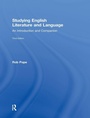
Book
01/2012
3rd Edition
Routledge
€242.00
Shipment within 15-20 days
Additional editions
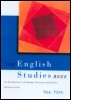
Book
04/2002
2nd Edition
Routledge
€48.46
Article exhausted; check for reprint
Previous edition
Person
Rob Pope is Professor of English Studies at Oxford Brookes University and a National Teaching Fellow.
Content
Prologue. Change and Challenge Today Crossing borders, establishing boundaries; Texts in contexts, literature and history; Seeing through theory; Technologizing the subject: actual and virtual communities; English Literature and Creative Writing; English still spells EFL, ESL, ESP, EAP; The shaping of things to come ... Part One. Introduction to English Studies 1.1 Which 'Englishes? 1.2 One English language, literature, culture - or many? 1.3 Summary: one and many 1.4 Activities, reading 1.5 How studied? 1.6 Summary: pasts, presents and futures 1.7 Activities, discussion, reading 1.8 Fields of Study 1.9 Summary: keeping on course and making your own way Part Two. Theoretical Positions and Practical Approaches: 2.1 Getting some initial bearings 2.2 Theory in practice - a working model 2.3 Practical Criticism and (old) New Criticism 2.4 Formalism into Functionalism 2.5 Psychological approaches 2.6 Marxism, Cultural Materialism and New Historicism 2.7 Feminism, Gender and Sexuality 2.8 Poststructuralism and Postmodernism 2.9 Postcolonialism and multiculturalism 2.10 Towards a new eclecticism: Ethics, Aesthetics, Ecology ...? Part Three. Common Topics: Absence and presence, gaps and silences, centres and margins; Accent and dialect; Addresser, address, addressee; Aesthetics and pleasure, art and beauty; Author and authority; Auto/biography and travel writing: self and other; Bibles, holy books and myths; Canon and classic; Character and characterisation; Comedy and tragedy, carnival and the absurd; Creative writing, creativity and re-creation; Difference and similarity, preference and re-valuation; Drama and theatre, film and TV; Foreground, background and point of view Genre and kinds of text; Image, imagery and imagination; Narrative in story and history: novel, news and film; Poetry and word-play; Realism and representation: fiction, fact, faction and metafiction; Speech and conversation, monologue and dialogue; Standards and standardisation, varieties and variation; Subject and agent, role and identity; Text, context and intertextuality Translation and translation studies; Versification: rhythm, metre and rhyme; Writing and; reading, response and re-writing; Your own modifications and additions Part Four. Textual Activities and Learning Strategies: 4.1 Overview of textual activities 4.2 Frameworks and checklists for close reading 4.3 Writing and research from essays to the Internet 4.4 Alternative modes of critical and creative writing Part Five. Anthology of Sample Texts: 5.1 Poetry, song and performance 5.2 Prose fiction, life-writing and news5.3 Drama - scripts and transcripts, monologue and dialogue 5.4 Intertextual clusters Part Six. Glossary of Grammatical and Linguistic Terms. Appendices: A Maps of Britain, the USA and the World B A chronology of English language, literature, culture, communication and media C English and or as other educational subjects D An alphabet of speech sounds Bibliography Relevant journals and useful addresses Index