

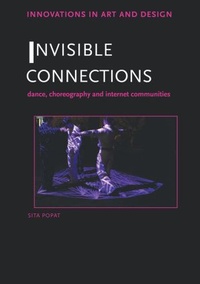
Invisible Connections
Dance, Choreography and Internet Communities
1st Edition
Published on 11. February 2010
Book
Paperback/Softback
188 pages
978-0-415-57632-1 (ISBN)
Description
The first and only book to focus on dance on the Internet, Sita Popat's fascinating Invisible Connections examines how Internet and communication technologies offer dance and theatre new platforms for creating and performing work, and how opportunities for remote interaction and collaboration are available on a scale never before imaginable.
Drawing upon the work of practioners and theorists in the arts, communications and technology theorists and , Invisible Connections makes special reference to Popat's series of Internet-based choreography projects from with online communities around the globe, and explores:
* methods by which such technologies can facilitate creative collaborations between performers and viewers
* how sharing creative processes between online communities can enrich the artistic palette and provide arts-based learning
* how the Cartesian duality of the mind-body split is challenged by the physicality of dancing and choreography together online.
With its dual aspect approach, from the author as an artist/researcher and the appendix being written by a software designer, the historical perspective on performance on the internet coupled with the writing makes this a must read book for any student of performance, dance or communication studies.
Drawing upon the work of practioners and theorists in the arts, communications and technology theorists and , Invisible Connections makes special reference to Popat's series of Internet-based choreography projects from with online communities around the globe, and explores:
* methods by which such technologies can facilitate creative collaborations between performers and viewers
* how sharing creative processes between online communities can enrich the artistic palette and provide arts-based learning
* how the Cartesian duality of the mind-body split is challenged by the physicality of dancing and choreography together online.
With its dual aspect approach, from the author as an artist/researcher and the appendix being written by a software designer, the historical perspective on performance on the internet coupled with the writing makes this a must read book for any student of performance, dance or communication studies.
More details
Series
Language
English
Place of publication
London
United Kingdom
Publishing group
Taylor & Francis Ltd
Target group
College/higher education
Illustrations
13 s/w Photographien bzw. Rasterbilder, 2 s/w Zeichnungen, 1 s/w Tabelle
1 Tables, black and white; 2 Line drawings, black and white; 13 Halftones, black and white
Dimensions
Height: 246 mm
Width: 174 mm
Weight
350 gr
ISBN-13
978-0-415-57632-1 (9780415576321)
Copyright in bibliographic data and cover images is held by Nielsen Book Services Limited or by the publishers or by their respective licensors: all rights reserved.
Schweitzer Classification
Other editions
Additional editions
Book
11/2005
1st Edition
Routledge
€215.41
Shipment within 15-20 days
E-Book
11/2005
Routledge
€64.49
Available for download
E-Book
11/2005
Routledge
€64.49
Available for download
Person
Sita Popat is Lecturer in Dance at the University of Leeds. Her research interests focus on performance and new technologies, and she is Associate Editor of the International Journal of Performance Arts and Digital Media . Her internet choreography projects have been recognised by the European Commission as an outstanding use of online communications.
Content
Introduction: Invisible Connections: Beyond the Proscenium Arch Section 1: Creativity and Interactivity for Online Collaborations Chapter 1. Creativity and Devising Chapter 2. Interacting Online Chapter 3. Choreography with Internet Communities Section 2: Three Online Choreography Projects Chapter 4. Three Online Choreography Projects Chapter 5. Three Projects: Choreographic Processes Chapter 6. Three Projects: Bridging the Cartesian Divide Section 3:Future Directions Chapter 7. Applications in Theatre and Performance Chapter 8. Future Directions Appendix A: Technical Issues Kris Popat Bibliography