

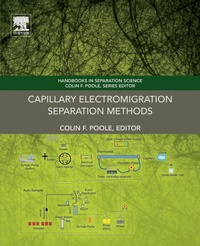
Capillary Electromigration Separation Methods
Published on 14. April 2018
Book
Paperback/Softback
626 pages
978-0-12-809375-7 (ISBN)
Description
Capillary Electromigration Separation Methods is a thorough, encompassing reference that not only defines the concept of contemporary practice, but also demonstrates its implementation in laboratory science. Chapters are authored by recognized experts in the field, ensuring that the content reflects the latest developments in research. Thorough, comprehensive coverage makes this the ideal reference for project planning, and extensive selected referencing facilitates identification of key information. The book defines the concept of contemporary practice in capillary electromigration separation methods, also discussing its applications in small mass ions, stereoisomers, and proteins.
More details
Series
Language
English
Place of publication
United States
Target group
Professional and scholarly
Analytical chemists primarily; pharmaceutical scientists, food scientists and instructors teaching related coursework comprise the secondary audience.
Product notice
Paperback (trade)
Dimensions
Height: 236 mm
Width: 195 mm
Thickness: 32 mm
Weight
1279 gr
ISBN-13
978-0-12-809375-7 (9780128093757)
Copyright in bibliographic data and cover images is held by Nielsen Book Services Limited or by the publishers or by their respective licensors: all rights reserved.
Schweitzer Classification
Other editions
Additional editions
Colin F. Poole
Capillary Electromigration Separation Methods
E-Book
04/2018
Elsevier
€133.00
Available for download
Person
Colin F. Poole was born and educated in the United Kingdom receiving a B.Sc. in Chemistry from the University of Leeds (1971) followed by graduate studies at the University of Bristol, MSc. in analytical chemistry (1972), and Ph.D. with Prof. E. D. Morgan at the University of Keele (1975) on the analysis of insect moulting hormones. Since 1980 he has been at the Department of Chemistry, Wayne State University, Detroit, Michigan, USA , except for 1995-1996, spent as the Governors' Lecturer and Professor of Analytical Chemistry at Imperial College of Science, Technology & Medicine, London, in the United Kingdom. He is a former Science Advisor to the US Food and Drug Administration, a position he occupied for 25 years. Professor Poole has broad interests in the separation and detection of small molecules in biological, environmental, and food samples using a range of sample preparation, chromatographic and data analysis tools. He is the co-author of over 400 papers, 20 books, an editor of Journal of Chromatography A and a member of the editorial boards of 5 other analytical chemistry journals. .
Content
1. Milestones in the development of capillary electromigration methods
2. Theoretical principles of capillary electromigration methods
3. Column technology for capillary electromigration methods
4. Capillary electrophoresis in organic solvents (Non-aqueous capillary electrophoresis)
5. Micellar and microemulsion electrokinetic chromatography
6. Capillary gel and sieving electrophoresis
7. Capillary isoelectric focusing
8. Capillary isotachophoresis
9. Capillary electrochromatography
10. Method development
11. Instrument platforms for capillary electromigration methods
12. Coupling of capillary electromigration techniques to mass spectrometry
13. Preconcentration and multidimensional techniques for capillary electromigration methods
14. Separation of proteins (proteomics)
15. Separation of small mass ions
16. Separation of carbohydrates and oligosaccharides
17. Separation of cells and particles using capillary electromigration methods
18. Clinical chemistry applications of capillary electromigration methods
19. Biopharmaceutical applications of capillary electromigration methods
20. Neuroscience applications of capillary electromigration separation methods
21. Food science applications of capillary electromigration methods
22. Applications of capillary electromigration methods for physicochemical measurements
2. Theoretical principles of capillary electromigration methods
3. Column technology for capillary electromigration methods
4. Capillary electrophoresis in organic solvents (Non-aqueous capillary electrophoresis)
5. Micellar and microemulsion electrokinetic chromatography
6. Capillary gel and sieving electrophoresis
7. Capillary isoelectric focusing
8. Capillary isotachophoresis
9. Capillary electrochromatography
10. Method development
11. Instrument platforms for capillary electromigration methods
12. Coupling of capillary electromigration techniques to mass spectrometry
13. Preconcentration and multidimensional techniques for capillary electromigration methods
14. Separation of proteins (proteomics)
15. Separation of small mass ions
16. Separation of carbohydrates and oligosaccharides
17. Separation of cells and particles using capillary electromigration methods
18. Clinical chemistry applications of capillary electromigration methods
19. Biopharmaceutical applications of capillary electromigration methods
20. Neuroscience applications of capillary electromigration separation methods
21. Food science applications of capillary electromigration methods
22. Applications of capillary electromigration methods for physicochemical measurements