

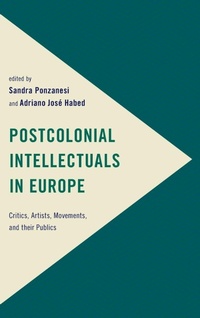
Postcolonial Intellectuals in Europe
Critics, Artists, Movements, and their Publics
Published on 31. August 2018
Book
Hardback
362 pages
978-1-78660-412-5 (ISBN)
Description
Postcolonial intellectuals have engaged with and deeply impacted upon European society since the figure of the intellectual emerged at the beginning of the nineteenth century. Yet a critical assessment and overview of their influential roles is long overdue, particularly in the light of contemporary debates in Europe and beyond.
This book offers an innovative take on the role of intellectuals in Europe through a postcolonial lens and, in doing so, questions the very definition of "public intellectual," on the one hand, and the meaning of such a thing as "Europe," on the other. It does so not only by offering portraits of charismatic figures such as Stuart Hall, Jacques Derrida, Antonio Gramsci, Frantz Fanon, and Hannah Arendt, among others, but also by exploring their lasting legacies and the many dialogues they have generated. The notion of the 'classic' intellectual is further challenged by bringing to the fore artists, writers, and activists, as well as social movements, networks, and new forms of mobilization and collective engagement that are part of the intellectual scene.
This book offers an innovative take on the role of intellectuals in Europe through a postcolonial lens and, in doing so, questions the very definition of "public intellectual," on the one hand, and the meaning of such a thing as "Europe," on the other. It does so not only by offering portraits of charismatic figures such as Stuart Hall, Jacques Derrida, Antonio Gramsci, Frantz Fanon, and Hannah Arendt, among others, but also by exploring their lasting legacies and the many dialogues they have generated. The notion of the 'classic' intellectual is further challenged by bringing to the fore artists, writers, and activists, as well as social movements, networks, and new forms of mobilization and collective engagement that are part of the intellectual scene.
Reviews / Votes
Here postcolonial perspectives sequence into a heterogeneity of cultural and political practices that rework the archives of the West in another key, critically challenging the continuing colonial formation of thepresent. -- Iain Chambers, author of <i>Postcolonial Interruptions, Unauthorised Modernities</i> Postcolonial Intellectuals in Europe offers a refreshing new set of perspectives on the engagement of intellectuals in questions of colonial history and postcolonial politics in contemporary Europe. Far from acquiescing to the oft-repeated affirmation that the intellectual is dead, the volume displays the reinvention and reinvigoration of intellectual work in the twenty-first century at the same time as it lucidly articulates its ambiguities and tensions. -- Jane Hiddleston, Professor of Literatures in French, University of Oxford Ponzanesi and Habed have given us that rare gift in trying times: a wide-ranging and broadly comparative examination of the significance of the work of postcolonial scholars and public thinkers in debates on the various problems that afflict Europe today. Providing us with signposts and fresh research agendas, Postcolonial Intellectuals in Europe will prove to be one of the most innovative volumes on the question of postcolonial scholarship in a very long time. -- Ato Quayson, Professor of English, University of Toronto This is a fascinating and timely book. Anticolonial Lebanese princes and West Indian revolutionary black Marxists, thinkers like Arendt and Derrida and contemporary social movements, artistic activists and writers like Rushdie stage engaging and often displacing dialogues across the pages of Postcolonial Intellectuals in Europe. And the "postcolonial intellectual" becomes a prism that allows us to rethink at the same time both "Europe" and "the postcolonial." Opening up new angles on a politics of liberation in these hard times. -- Sandro Mezzadra, Associate Professor of Political Theory, University of BolognaMore details
Language
English
Place of publication
United Kingdom
Publishing group
Bloomsbury Publishing PLC
Target group
Professional and scholarly
US School Grade: From College Senior to College Graduate Student
Illustrations
12 b/w photos; 5 graphs;
Dimensions
Height: 235 mm
Width: 157 mm
Thickness: 26 mm
Weight
741 gr
ISBN-13
978-1-78660-412-5 (9781786604125)
Copyright in bibliographic data and cover images is held by Nielsen Book Services Limited or by the publishers or by their respective licensors: all rights reserved.
Schweitzer Classification
Other editions
Additional editions
Sandra Ponzanesi | Adriano Jose Habed
Postcolonial Intellectuals in Europe
Critics, Artists, Movements, and Their Publics
E-Book
08/2018
1st Edition
Rowman & Littlefield International
€40.49
Available for download
Person
Sandra Ponzanesi is Professor of Gender and Postcolonial Studies, Department of Media and Culture Studies, Utrecht University, The Netherlands.
Adriano Jose Habed is a doctoral student in Political Philosophy and Gender Studies at the Department of Human Sciences, University of Verona, Italy, and the Department of Media and Culture Studies, Utrecht University, The Netherlands.
Adriano Jose Habed is a doctoral student in Political Philosophy and Gender Studies at the Department of Human Sciences, University of Verona, Italy, and the Department of Media and Culture Studies, Utrecht University, The Netherlands.
Content
Preface: Postcolonial Intellectuals: Universal, Specific, or Transversal?
Engin Isin / Intervention: Thinking Academic Freedom in Gendered Postcoloniality,
Gayatri Chakravorty Spivak / Introduction: Postcolonial Intellectuals, European Publics, Adriano Jose Habed and Sandra Ponzanesi / PART 1: Portraits of the Intellectual / 1. Antonio Gramsci and Anti-colonial Internationalism, Neelam Srivastava / 2. Talking about a Revolution. C.L.R. James and Frantz Fanon, Jamila M. H. Mascat / 3. Edward Said's Enduring Legacy: Disciplining Criticism, Pal Ahluwalia / 4. Feminisms of Colour in the Company of Stuart Hall, Yasmin Gunaratnam / PART 2: Reinterpretations and Dialogues / 5. Before Postcolonialism: Shakib Arslan's Response to Colonialism in the Interwar Years, Mehdi Sajid / 6. Hannah Arendt and Postcolonial Thought, Christopher J. Lee / 7. Jacques Derrida's Three Moments of Postcoloniality and the Challenge of Settler Colonialism, Muriam Haleh Davis / 8. Rosi Braidotti and Paul Gilroy: Questions of Memory and
Engin Isin / Intervention: Thinking Academic Freedom in Gendered Postcoloniality,
Gayatri Chakravorty Spivak / Introduction: Postcolonial Intellectuals, European Publics, Adriano Jose Habed and Sandra Ponzanesi / PART 1: Portraits of the Intellectual / 1. Antonio Gramsci and Anti-colonial Internationalism, Neelam Srivastava / 2. Talking about a Revolution. C.L.R. James and Frantz Fanon, Jamila M. H. Mascat / 3. Edward Said's Enduring Legacy: Disciplining Criticism, Pal Ahluwalia / 4. Feminisms of Colour in the Company of Stuart Hall, Yasmin Gunaratnam / PART 2: Reinterpretations and Dialogues / 5. Before Postcolonialism: Shakib Arslan's Response to Colonialism in the Interwar Years, Mehdi Sajid / 6. Hannah Arendt and Postcolonial Thought, Christopher J. Lee / 7. Jacques Derrida's Three Moments of Postcoloniality and the Challenge of Settler Colonialism, Muriam Haleh Davis / 8. Rosi Braidotti and Paul Gilroy: Questions of Memory and