

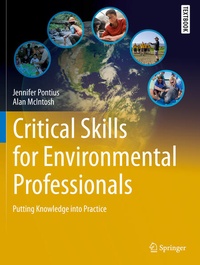
Critical Skills for Environmental Professionals
Putting Knowledge into Practice
Published on 17. December 2020
Book
Paperback/Softback
XV, 188 pages
978-3-030-28544-9 (ISBN)
Description
This textbook focuses on a set of skills-based learning outcomes common among undergraduate environmental programs. It covers critical scientific skills and ways of thinking that bridge the gap between the knowledge-based content of introductory environmental textbooks and the professional skills students of the environment need to succeed in both their academic programs and professional careers. This emphasis on skills is gaining more traction among academic programs across the country as they shift focus from knowledge delivery to learning outcomes and professional competencies. The book features clear methodological frameworks, engaging practice exercises, and a range of assessment case studies suitable for use across academic levels. For introductory levels, this text uses guided practice exercises to expose students to the skills they will need to master. At the capstone level, this text allows students to apply the knowledge they have gained to real-world issues and to evaluate their competency in key programmatic learning outcomes.
A detailed answer key with rubrics customized for specific questions and sample answers at various competency levels is available to verified course instructors. Access to these answer key resources can be obtained by contacting the Springer Textbook Team at Textbooks@springer.com
A detailed answer key with rubrics customized for specific questions and sample answers at various competency levels is available to verified course instructors. Access to these answer key resources can be obtained by contacting the Springer Textbook Team at Textbooks@springer.com
More details
Product info
Book
Series
Edition
1st ed. 2020
Language
English
Place of publication
Cham
Switzerland
Publishing group
Springer International Publishing
Target group
College/higher education
Professional and scholarly
Illustrations
106
60 farbige Tabellen, 10 s/w Abbildungen, 106 farbige Abbildungen
60 Tables, color; 106 Illustrations, color; 10 Illustrations, black and white; XV, 188 p. 116 illus., 106 illus. in color.
Dimensions
Height: 279 mm
Width: 210 mm
Thickness: 11 mm
Weight
578 gr
ISBN-13
978-3-030-28544-9 (9783030285449)
DOI
10.1007/978-3-030-28542-5
Schweitzer Classification
Other editions
Additional editions
Jennifer Pontius | Alan McIntosh
Critical Skills for Environmental Professionals
Putting Knowledge into Practice
Book
12/2019
Springer
€90.94
Shipment within 7-9 days
Persons
Jennifer Pontius: Professor Pontius is a research ecologist with the US Forest Service Northern Research Station, a Research Assistant Professor of remote sensing and applied statistics at the University of Vermont, Director of the Environmental Science Program at the Rubenstein School of Environment and Natural Resources and Principal Investigator of the Vermont Monitoring Cooperative and the McIntire Stennis Forest Health and Climate Change Research Umbrella. Her primary research interests focus on scaling plot-based forest health relationships to a landscape-scale using remote sensing and GIS modeling.
Alan McIntosh: After receiving his PhD in limnology at Michigan State University, Professor McIntosh taught at Purdue University and Rutgers University before joining the School of Natural Resources at the University of Vermont. He served as Director of the Vermont Water Resources and Lake Studies Center, and he chaired the Environmental Sciences Program in the school from 1995 until 2013. He taught a number of environmental courses, including the introductory environmental science class each semester during that period.
Alan McIntosh: After receiving his PhD in limnology at Michigan State University, Professor McIntosh taught at Purdue University and Rutgers University before joining the School of Natural Resources at the University of Vermont. He served as Director of the Vermont Water Resources and Lake Studies Center, and he chaired the Environmental Sciences Program in the school from 1995 until 2013. He taught a number of environmental courses, including the introductory environmental science class each semester during that period.
Content
Chapter 1: Introduction.- Chapter 2: Navigating Scientific Literature.- Chapter 3: The Scientific Method in Environmental Science.- Chapter 4: Establishing Cause-Effect Connections.- Chapter 5: Critical Thinking.- Chapter 6: Systems Thinking.- Chapter 7: Interdisciplinary Frameworks.- Chapter 8: Socio-ecological systems: The Human Connection.- Chapter 9: Working Across Scales: Time.- Chapter 10: Working Across Scales: Space.- Chapter 11: Thinking Outside the Box.- Chapter 12: Translating Science: communicating like a professional.- Chapter 13: Ecological Justice.