

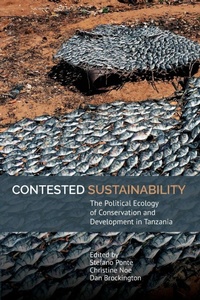
Contested Sustainability
The Political Ecology of Conservation and Development in Tanzania
Published on 26. July 2022
Book
Paperback/Softback
344 pages
978-1-84701-322-4 (ISBN)
Description
Richly detailed and timely study on conservation, development and sustainability in Tanzania.
Provides valuable insights into the successes and failures of the management and governance of wildlife, forestry and coastal resources.
Responding to the urgent need to examine the outcome of interventions in governing natural resources, this book analyses different types of sustainability partnerships - with donors, governments, business, NGOs and other actors, and, crucially, assesses which result in better livelihood and environmental outcomes.
The contributors, from a range of disciplines, compare 'more complex' partnerships to relatively 'simpler', more traditional top-down and centralized management systems and to location where sustainability partnerships are not in place. Within-sector comparisons allow a fine-tuned analysis that is formed of historical, location and resource-specific issues, which can be used as input for resource-specific policy and partnership design. Experiences and lessons can be drawn from comparisons across the three different sectors, which can be applied to natural resource governance more broadly.
This book is openly available in digital formats under Creative Commons license CC BY-NC-ND.
Provides valuable insights into the successes and failures of the management and governance of wildlife, forestry and coastal resources.
Responding to the urgent need to examine the outcome of interventions in governing natural resources, this book analyses different types of sustainability partnerships - with donors, governments, business, NGOs and other actors, and, crucially, assesses which result in better livelihood and environmental outcomes.
The contributors, from a range of disciplines, compare 'more complex' partnerships to relatively 'simpler', more traditional top-down and centralized management systems and to location where sustainability partnerships are not in place. Within-sector comparisons allow a fine-tuned analysis that is formed of historical, location and resource-specific issues, which can be used as input for resource-specific policy and partnership design. Experiences and lessons can be drawn from comparisons across the three different sectors, which can be applied to natural resource governance more broadly.
This book is openly available in digital formats under Creative Commons license CC BY-NC-ND.
Reviews / Votes
A successful attempt to explore the power dynamics regulating multistakeholder partnerships for resource utilization. It makes one understand how capital agents take advantage of the fact that African governments do not have adequate resources to unlock the value trapped in their abundant natural resources. * H-NET * Contested Sustainability responds to the urgent need in writings on conservation, sustainability, and development to attend more thoughtfully, systematically, and innovatively to how politics structures sustainability outcomes at multiple levels. This brilliant collection is required reading for students, scholars, and researchers globally. * Professor Arun Agrawal, School for Environment and Sustainability, University of Michigan * An insightful and highly accessible book that meticulously uncovers the complexity of partnerships touted as crucial for achieving sustainability. It challenges us all to interrogate sustainability networks and their environmental and socio-economic outcomes. -- Maano Ramutsindela * University of Cape Town * Impels all actors to read, reflect and interrogate the design of decentralization and devolution models and reassess their delivery strategy. -- Isilda Nhantumbo * Micaia Foundation * A substantial contribution to evidence and analysis of complex natural resource governance in the Global South. -- Fiona Nunan * University of Birmingham * A rich mixture of field research, presentations and discussions in meetings in Europe and Tanzania, this book is a treasure to be taken seriously. -- Chris Maina Peter * University of Dar es Salaam * This is an absolute gem of a book! The impressive and highly readable culmination of a six-year, interdisciplinary research project, it provides a fascinating insight into the dynamics, legitimacy, and environmental and livelihood impacts of complex sustainability partnerships across three sectors in Southwest Tanzania. The collaborative research approach presents in-depth case studies and sophisticated comparative analysis of rich quantitative and qualitative data that give a nuanced perspective on the question whether more stakeholder involvement is always better. A must-read for scholars interested in conservation, development, and livelihood improvements in the Global South. -- Janina Grabs * Esade Business School * An important contribution to the field ... as well as governance partnerships, the book provides valuable insights into the successes and failures of the management of wildlife, forests and coastal resources. -- J. Terrence McCabe * University of Colorado Boulder *More details
Series
Language
English
Place of publication
Oxford
United Kingdom
Target group
Professional and scholarly
Product notice
Paperback (trade)
Illustrations
44 colour, 20 b/w illus.
Dimensions
Height: 234 mm
Width: 156 mm
Thickness: 22 mm
Weight
775 gr
ISBN-13
978-1-84701-322-4 (9781847013224)
Copyright in bibliographic data and cover images is held by Nielsen Book Services Limited or by the publishers or by their respective licensors: all rights reserved.
Schweitzer Classification
Persons
Stefano Ponte is Professor of International Political Economy at Copenhagen Business School. His books include Farmers and Markets in Tanzania: How Market Reforms Affect Rural Livelihoods in Africa (2002), and co-editing The Green Economy in the Global South (2017). Christine Noe is an Associate Professor of Human Geography at the University of Dar es Salaam. She is a contributor to David Potts (ed), Tanzanian Development (James Currey, 2019). Her research is on conservation and development politics. Dan Brockington is a Research Professor at ICTA, Universitat Autonoma de Barcelona. He is author of Fortress Conservation (James Currey, 2002), and, with Stefano Ponte, co-edited The Green Economy in the Global South (2017). His research covers the social impacts of conservation and long term livelihood change in East Africa. Caleb Gallemore holds a Ph.D. in Geography from The Ohio State University and is an assistant professor in the International Affairs Program at Lafayette College in the United States. His research interests include land-use telecoupling, world cities, environmental policy networks, and social theory. Kelvin Joseph Kamnde holds an MSc degree in Geo-information science and earth observation from ITC university of Twente Netherlands. He is currently enrolled in the PhD programme at the University of Dar es Salaam, where is he also an Assistant Lecturer. Kelvin has broad experience in applying GIS and RS in planning, monitoring and assessment of natural resources, service provision, climate observations, hazard, risk assessment and prediction. He is an expert in spatial tracking, spatial modellings for resources state assessment and predictions, and in the creation of spatial databases and web databases. Lasse Folke Henriksen is Associate Professor at the Department of Business and Politics, Copenhagen Business School where he teaches economic sociology, international political economy and new fancy research methods. As a trained sociologist he has mainly worked on the role of experts and professions in new and hybrid forms of transnational economic and environmental governance but he is also more broadly interested in how the global economy is governed. Mette Fog Olwig is Associate Professor in International Development Studies at Roskilde University in Denmark. Her research centres on the social and political dimensions of climate change, natural disasters, sustainability, natural resource management and the development sector. Opportuna Kweka is Senior Lecturer in the Department of Geography at the University of Dar es Salaam. She teaches economic and population geography, migration and environmental studies. Dr Kweka works on natural resource governance, energy, extractive industries, and the role of the state and local communities in decision-making. Rasul A. Minja is Senior Lecturer at the Department of Political Science and Public Administration, University of Dar es Salaam. His main research interests include regional integration, regional security, governance and legitimacy issues related to natural resource extraction and management, extractive industry and human rights observance, and election management. He has published work on regional integration, community policing, election management, regional security, civil-military relations, local government elections and participatory democracy. Robert Eliakim Katikiro is Senior Lecturer at the Department of Agricultural Economics and Business of the University of Dar es Salaam. His current research interests include fisheries governance, blue economy process, marine conservation, valuation of marine ecosystem services, small-scale fisheries, sustainable food systems, marine litter, marine social science research, fishing rights, fishing activities led by women, maritime sector workers and social science theory based on coastal and marine empiricism. Pilly Silvano is Assistant Lecturer at the Department of Geography, University of Dar es Salaam, where she has just completed her PhD. Her areas of interest are gender, community-based natural resource governance, conservation and sustainable forest management. Ruth Wairimu John is Assistant Lecturer at the Department of Geography, the Open University of Tanzania. She holds a Master of Arts in Geography and Environmental Management from the University of Dar es Salaam, where she is also currently completing her PhD. She teaches Introduction to Population Studies and Natural Resources Management. She is interested in sustainability of natural resources and community participation in natural resources management.
Content
PART I: ISSUES, BACKGROUND, AND METHODS
1 New partnerships for sustainability
Stefano Ponte, Christine Noe, and Dan Brockington
2 Conservation and development in Tanzania: Background, history, and recent developments
Christine Noe, Asubisye Mwamfupe, Opportuna Kweka, Ruth Warimu John, Pilly Silvano, Faraja Daniel Namkesa, Robert Eliakim Katikiro, Rasul Ahmed Minja, Mette Fog Olwig, Dan Brockington, and Stefano Ponte
3 Design and Methodology
Stefano Ponte, Christine Noe, Asubisye Mwamfupe, Opportuna Kweka, Kelvin Joseph Kamde, Mette Fog Olwig, Dan Brockington, Lasse Folke Henriksen, Ruth Warimu John, Pilly Silvano, Faraja Daniel Namkesa, Robert Eliakim Katikiro, Rasul Ahmed Minja, and Caleb Gallemore
PART II: SECTORAL ANALYSIS
4 Sustainability partnerships in the wildlife sector in southeast Tanzania
Christine Noe, RuthWarimu John, and Dan Brockington
5 Sustainability partnerships in the forestry sector in southeast Tanzania
Asubisye Mwamfupe, Mette Fog Olwig, Pilly Silvano, Dan Brockington, and Lasse Folke Henriksen
6 Sustainability partnerships in the coastal resources sector in southeast Tanzania
Opportuna Kweka, RobertEliakim Katikiro, Faraja Daniel Namkesa, Rasul Ahmed Minja, and Stefano Ponte
PART III: COMPARATIVE ANALYSIS
7 The legitimacy of sustainability partnerships in southeast Tanzania
Rasul Ahmed Minja, Stefano Ponte, Asubisye Mwamfupe, and Christine Noe
8 The governance complexity of sustainability partnerships in southeast Tanzania: Institutional and network components
Lasse Folke Henriksen, Caleb Gallemore, Ruth Warimu John, Faraja Daniel Namkesa, and Pilly Silvano
9 The environmental impacts of sustainability partnerships in southeast Tanzania
Caleb Gallemore, Kelvin Joseph Kamde, Lasse Henriksen, and Dan Brockington
10 The livelihood impacts of sustainability partnerships in southeast Tanzania
Caleb Gallemore, Kelvin Joseph Kamde, Asubisye Mwamfupe, Lasse Folke Henriksen, and Dan Brockington
11 Contested sustainability
Dan Brockington, Christine Noe, and Stefano Ponte
1 New partnerships for sustainability
Stefano Ponte, Christine Noe, and Dan Brockington
2 Conservation and development in Tanzania: Background, history, and recent developments
Christine Noe, Asubisye Mwamfupe, Opportuna Kweka, Ruth Warimu John, Pilly Silvano, Faraja Daniel Namkesa, Robert Eliakim Katikiro, Rasul Ahmed Minja, Mette Fog Olwig, Dan Brockington, and Stefano Ponte
3 Design and Methodology
Stefano Ponte, Christine Noe, Asubisye Mwamfupe, Opportuna Kweka, Kelvin Joseph Kamde, Mette Fog Olwig, Dan Brockington, Lasse Folke Henriksen, Ruth Warimu John, Pilly Silvano, Faraja Daniel Namkesa, Robert Eliakim Katikiro, Rasul Ahmed Minja, and Caleb Gallemore
PART II: SECTORAL ANALYSIS
4 Sustainability partnerships in the wildlife sector in southeast Tanzania
Christine Noe, RuthWarimu John, and Dan Brockington
5 Sustainability partnerships in the forestry sector in southeast Tanzania
Asubisye Mwamfupe, Mette Fog Olwig, Pilly Silvano, Dan Brockington, and Lasse Folke Henriksen
6 Sustainability partnerships in the coastal resources sector in southeast Tanzania
Opportuna Kweka, RobertEliakim Katikiro, Faraja Daniel Namkesa, Rasul Ahmed Minja, and Stefano Ponte
PART III: COMPARATIVE ANALYSIS
7 The legitimacy of sustainability partnerships in southeast Tanzania
Rasul Ahmed Minja, Stefano Ponte, Asubisye Mwamfupe, and Christine Noe
8 The governance complexity of sustainability partnerships in southeast Tanzania: Institutional and network components
Lasse Folke Henriksen, Caleb Gallemore, Ruth Warimu John, Faraja Daniel Namkesa, and Pilly Silvano
9 The environmental impacts of sustainability partnerships in southeast Tanzania
Caleb Gallemore, Kelvin Joseph Kamde, Lasse Henriksen, and Dan Brockington
10 The livelihood impacts of sustainability partnerships in southeast Tanzania
Caleb Gallemore, Kelvin Joseph Kamde, Asubisye Mwamfupe, Lasse Folke Henriksen, and Dan Brockington
11 Contested sustainability
Dan Brockington, Christine Noe, and Stefano Ponte