

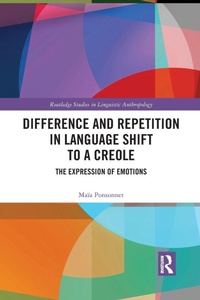
Difference and Repetition in Language Shift to a Creole
The Expression of Emotions
1st Edition
Published on 30. June 2021
Book
Paperback/Softback
196 pages
978-1-032-08816-7 (ISBN)
Description
In today's global commerce and communication, linguistic diversity is in steady decline across the world as speakers of smaller languages adopt dominant forms. While this phenomenon, known as 'language shift', is usually regarded as a loss, this book adopts a different angle and addresses the following questions:
What difference does using a new language make to the way speakers communicate in everyday life?
Can the grammatical and lexical architectures of individual languages influence what speakers express?
In other words, to what extent does adopting a new language alter speakers' day-to-day communication practices, and in turn, perhaps, their social life and world views?
To answer these questions, this book studies the expression of emotions in two languages on each side of a shift: Kriol, an English-based creole spoken in northern Australia, and Dalabon (Gunwinyguan, non-Pama-Nyungan), an Australian Aboriginal language that is being replaced by Kriol.
This volume is the first to explore the influence of the formal properties of language on the expression of emotions, as well as the first description of the linguistic encoding of emotions in a creole language. The cross-disciplinary approach will appeal to linguists, psychologists, anthropologists and other social scientists.
What difference does using a new language make to the way speakers communicate in everyday life?
Can the grammatical and lexical architectures of individual languages influence what speakers express?
In other words, to what extent does adopting a new language alter speakers' day-to-day communication practices, and in turn, perhaps, their social life and world views?
To answer these questions, this book studies the expression of emotions in two languages on each side of a shift: Kriol, an English-based creole spoken in northern Australia, and Dalabon (Gunwinyguan, non-Pama-Nyungan), an Australian Aboriginal language that is being replaced by Kriol.
This volume is the first to explore the influence of the formal properties of language on the expression of emotions, as well as the first description of the linguistic encoding of emotions in a creole language. The cross-disciplinary approach will appeal to linguists, psychologists, anthropologists and other social scientists.
More details
Series
Language
English
Place of publication
London
United Kingdom
Publishing group
Taylor & Francis Ltd
Target group
College/higher education
Postgraduate
Illustrations
19 s/w Abbildungen
19 Illustrations, black and white
Dimensions
Height: 234 mm
Width: 156 mm
Thickness: 11 mm
Weight
307 gr
ISBN-13
978-1-032-08816-7 (9781032088167)
Copyright in bibliographic data and cover images is held by Nielsen Book Services Limited or by the publishers or by their respective licensors: all rights reserved.
Schweitzer Classification
Other editions
Additional editions
Book
10/2019
1st Edition
Routledge
€206.10
Shipment within 10-20 days
E-Book
10/2019
1st Edition
Routledge
€60.49
Available for download
E-Book
10/2019
1st Edition
Routledge
€60.49
Available for download
Person
Maia Ponsonnet is an anthropological linguist currently based at The University of Western Australia in Perth. She holds a PhD in Linguistics from the Australian National University (Canberra, 2014), with additional background in Philosophy (PhD Universite Paris-8, 2005). She has extensive experience working with speakers of Indigenous languages in communities of inland Arnhem Land, in the Top End of Australia. In line with her combined linguistic, philosophical and anthropological interests, Maia Ponsonnet's research concerns the role of language in humans' lives, and in particular how language may channel or modify people's experience and management of emotions.
Content
1. Introduction 2. Emotions 3. Linguistic Context and Methods 4. Emotion Lexica: Different Forms, Same Meanings 5. Highly Conventionalized Prosodic Contours: Same Forms, Different Meanings 6. Evaluative Morphology: Replacing Absent Linguistic Resources 7. Figurative Language: A Difference 8. Figurative Language Beyond Conventions: Different Language, Same Concepts