

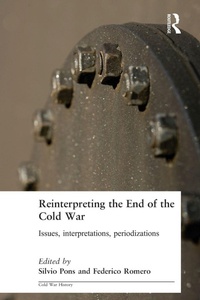
Reinterpreting the End of the Cold War
Issues, Interpretations, Periodizations
1st Edition
Published on 9. December 2004
Book
Paperback/Softback
248 pages
978-0-7146-8492-5 (ISBN)
Description
As the activities of individuals, organizations, and nations increasingly occur in cyberspace, the security of those activities is becoming a growing concern. Political, economic and military leaders must manage and reduce the level of risk associated with threats from hostile states, malevolent nonstate actors such as organized terrorist groups or individual hackers, and high-tech accidents. The impact of the information technology revolution on warfare, global stability, governance, and even the meaning of existing security constructs like deterrence is significant. These essays examine the ways in which the information technology revolution has affected the logic of deterrence and crisis management, definitions of peace and war, democratic constraints on conflict, the conduct of and military organization for war, and the growing role of the private sector in providing security. This book was previously published as a special issue of the journal Contemporary Security Policy.
More details
Series
Language
English
Place of publication
London
United Kingdom
Publishing group
Taylor & Francis Ltd
Target group
College/higher education
Professional and scholarly
Dimensions
Height: 234 mm
Width: 156 mm
Thickness: 14 mm
Weight
383 gr
ISBN-13
978-0-7146-8492-5 (9780714684925)
Copyright in bibliographic data and cover images is held by Nielsen Book Services Limited or by the publishers or by their respective licensors: all rights reserved.
Schweitzer Classification
Other editions
Additional editions
Silvio Pons | Federico Romero
Reinterpreting the End of the Cold War
Issues, Interpretations, Periodizations
E-Book
08/2014
1st Edition
Routledge
€67.49
Available for download
Silvio Pons | Federico Romero
Reinterpreting the End of the Cold War
Issues, Interpretations, Periodizations
E-Book
08/2014
1st Edition
Routledge
€67.49
Available for download
Silvio Pons | Federico Romero
Reinterpreting the End of the Cold War
Issues, Interpretations, Periodizations
Book
12/2004
1st Edition
Routledge
€231.70
Shipment within 10-20 days
Persons
Silvio Pons is Professor of East European History at Rome University "Tor Vergata" (Rome II) and Director of the Gramsci Foundation, Rome. He is the author of Stalin and the Inevitable War 1936-1941 (London, Frank Cass, 2002). He has edited the Italian edition of Georgi Dimitrov's Diary (Torino, Einaudi, 2002).
Federico Romero (Ph.D. in History, Torino 1977) has taught U.S. and International History at the London School of Economics, the College of Europe, the Universities of Bologna and Florence. A specialist on US-European relations in the post-war reconstruction and the Cold War, he has published extensively in Italy and in the U.S. His most recent works deal with the strategies and culture of U.S. foreign policy in the 20th century. He is currently working on a book on the conceptual paradigms of Italy's international relations and a book of essays about European views of the U.S.
Federico Romero (Ph.D. in History, Torino 1977) has taught U.S. and International History at the London School of Economics, the College of Europe, the Universities of Bologna and Florence. A specialist on US-European relations in the post-war reconstruction and the Cold War, he has published extensively in Italy and in the U.S. His most recent works deal with the strategies and culture of U.S. foreign policy in the 20th century. He is currently working on a book on the conceptual paradigms of Italy's international relations and a book of essays about European views of the U.S.
Content
1. Introduction: Security in the Information Technology Age Part 1: Managing Conflict in the Information Age 2. Integrated Security: A strategic response to anonymity and the problem of the few 3. Revolution's End: Information technology and crisis management Part 2: Organization and Conduct of Warfare in the Information Age 4. Wars of Disruption: International competition and information technology-driven military organizations 5. The Strategy and Tactics of Information Warfare 6. Part 3: Governance in the Information Age 7.Information Warfare and Democratic Accountability 8. Information Warfare and Domestic Threats to American Security Part 4: Private Sector Incentives for Managing Security 10. Rewarding IT Security in the Marketplace Part 5: Concluding Reflections 11. Thinking About New Security Paradigms