

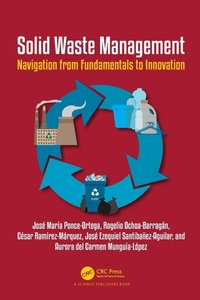
Solid Waste Management
Navigation from Fundamentals to Innovation
1st Edition
Published on 11. August 2025
Book
Hardback
292 pages
978-1-032-82635-6 (ISBN)
Description
Solid Waste Management: Navigation from Fundamentals to Innovation is a compendium that unravels the complexities of waste management. It traverses the historical backdrop of waste management practices and ushers in a realm where sustainability and cutting-edge technologies converge to tackle the escalating challenges of waste disposal and treatment. This book serves a diverse readership, i.e. students, researchers, educators, and practitioners. It has an interdisciplinary approach and provides a holistic view of the field, blending theory with actionable strategies, and infusing the narrative with innovative solutions.
With a focus on sustainability, it underscores the integration of emerging technologies, such as AI and IoT, in optimizing waste management systems. It equips readers with the knowledge to navigate the intricacies of the industry and fosters the adoption of efficient, sustainable waste practices. As we stand on the brink of environmental exigencies, this book calls for action in a more responsible and forward-thinking manner to managing the byproducts of our civilization.
With a focus on sustainability, it underscores the integration of emerging technologies, such as AI and IoT, in optimizing waste management systems. It equips readers with the knowledge to navigate the intricacies of the industry and fosters the adoption of efficient, sustainable waste practices. As we stand on the brink of environmental exigencies, this book calls for action in a more responsible and forward-thinking manner to managing the byproducts of our civilization.
More details
Language
English
Place of publication
London
United Kingdom
Publishing group
Taylor & Francis Ltd
Target group
College/higher education
Professional and scholarly
Academic and Postgraduate
Illustrations
66 farbige Zeichnungen, 78 s/w Tabellen, 5 s/w Abbildungen, 78 farbige Abbildungen, 12 Farbfotos bzw. farbige Rasterbilder, 5 s/w Zeichnungen
78 Tables, black and white; 66 Line drawings, color; 5 Line drawings, black and white; 12 Halftones, color; 78 Illustrations, color; 5 Illustrations, black and white
Dimensions
Height: 260 mm
Width: 183 mm
Thickness: 21 mm
Weight
770 gr
ISBN-13
978-1-032-82635-6 (9781032826356)
Copyright in bibliographic data and cover images is held by Nielsen Book Services Limited or by the publishers or by their respective licensors: all rights reserved.
Schweitzer Classification
Other editions
Additional editions
Jose Maria Ponce-Ortega | Rogelio Ochoa-Barragan | Cesar Ramirez-Marquez
Solid Waste Management
Navigation from Fundamentals to Innovation
E-Book
08/2025
CRC Press
€73.99
Available for download
Jose Maria Ponce-Ortega | Rogelio Ochoa-Barragan | Cesar Ramirez-Marquez
Solid Waste Management
Navigation from Fundamentals to Innovation
E-Book
08/2025
CRC Press
€73.99
Available for download
Persons
Jose Maria Ponce-Ortega is a Professor at the Chemical Engineering Department, Universidad Michoacana de San Nicolas de Hidalgo, Mexico. He obtained his PhD (2023) and Master's (2003) degrees in Chemical Engineering from the Institute of Technology of Celaya, Mexico. He was a postdoctoral researcher at Texas A&M University, USA, and as a visiting scholar at Carnegie Mellon University, USA. He is a full professor at the Universidad Michoacana de San Nicolas de Hidalgo, and is a member of the National Research System of Mexico. The research interest of Dr Ponce-Ortega cover optimization of chemical processes, sustainable design, energy, mass, water and property integration and supply chain optimization. He has published more than 300 papers, 3 books and 50 book chapters. He has supervised 25 PhD and 40 Master's students. He also has 15 funded research projects for about $US 1,000,000.00. Dr Ponce-Ortega is a member of the editorial board of the Clean Technologies and Environmental Policy Journal, and of the Process Integration and Optimization for Sustainability Journal. He is also a subject editor in the Journal of Sustainable Production and Consumption.
Rogelio Ochoa-Barragan has a PhD (2023) and Master's Degrees (2020) in Chemical Engineering from the Michoacana University of San Nicolas de Hidalgo, Mexico. His research is focused on process optimization, energy network management, social justice, and machine learning. His research has been presented at 11 international and regional conferences, he currently has 9 published scientific articles, and has participated in the writing of 15 books.
Cesar Ramirez-Marquez is a Postdoctoral Fellow at the Chemical Engineering Department, Universidad Michoacana de San Nicolas de Hidalgo, Mexico. He has a PhD from the University of Guanajuato (Mexico) in 2020. Currently published contributions focus on the production of materials for the solar energy industry and base chemicals in the chemical industry. He has published more than 60 journal papers, 10 book chapters, has presented his work at more than 20 international/regional conferences, and has registered 4 patents.
Jose Ezequiel Santibanez-Aguilar has a PhD in Chemical Engineering from the Universidad Michoacana de San Nicolas de Hidalgo, Mexico. He is member level 1 of the Mexican Research System. Currently, he is full time Professor at Tecnologico de Monterrey, Mexico. His expertise covers mathematical model developing for the design of supply chains considering various criteria for sustainability such as life cycle analysis, generation of jobs, waste recycling and processing and financial risk. His research focuses on strategies to solve multi-objective formulations and making decision approaches. He has authored and co-authored more than 30 papers in journals such as Applied Energy, Journal of Cleaner Production, ACS Sustainable Chemistry and Engineering, Renewable and Sustainable Energy Reviews, Waste Management, AIChE Journal, etc. Furthermore, he has written several book chapters. His research has got more than 1300 citations with h and i10 indexes equal to 18 and 25 respectively.
Aurora del Carmen Munguia-Lopez Assistant Professor in the Department of Chemical and Biological Engineering at the University at Buffalo, State University of New York. Previously, she served as a postdoctoral researcher in the Department of Chemical and Biological Engineering at the University of Wisconsin-Madison, USA. She holds BSc and MSc degrees from the Technical Institute of Celaya and a PhD in Chemical Engineering from the University of Michoacan in Mexico. Her research interests include mathematical optimization, sustainability, social justice, and process modeling. Dr Munguia-Lopez has published papers in over 20 journals and conferences and a book chapter. She has presented her work at several recognized conferences. She has supervised 2 graduate and 3 undergraduate students. Aurora is also passionate about fostering diversity, equity, and inclusion in STEM.
Rogelio Ochoa-Barragan has a PhD (2023) and Master's Degrees (2020) in Chemical Engineering from the Michoacana University of San Nicolas de Hidalgo, Mexico. His research is focused on process optimization, energy network management, social justice, and machine learning. His research has been presented at 11 international and regional conferences, he currently has 9 published scientific articles, and has participated in the writing of 15 books.
Cesar Ramirez-Marquez is a Postdoctoral Fellow at the Chemical Engineering Department, Universidad Michoacana de San Nicolas de Hidalgo, Mexico. He has a PhD from the University of Guanajuato (Mexico) in 2020. Currently published contributions focus on the production of materials for the solar energy industry and base chemicals in the chemical industry. He has published more than 60 journal papers, 10 book chapters, has presented his work at more than 20 international/regional conferences, and has registered 4 patents.
Jose Ezequiel Santibanez-Aguilar has a PhD in Chemical Engineering from the Universidad Michoacana de San Nicolas de Hidalgo, Mexico. He is member level 1 of the Mexican Research System. Currently, he is full time Professor at Tecnologico de Monterrey, Mexico. His expertise covers mathematical model developing for the design of supply chains considering various criteria for sustainability such as life cycle analysis, generation of jobs, waste recycling and processing and financial risk. His research focuses on strategies to solve multi-objective formulations and making decision approaches. He has authored and co-authored more than 30 papers in journals such as Applied Energy, Journal of Cleaner Production, ACS Sustainable Chemistry and Engineering, Renewable and Sustainable Energy Reviews, Waste Management, AIChE Journal, etc. Furthermore, he has written several book chapters. His research has got more than 1300 citations with h and i10 indexes equal to 18 and 25 respectively.
Aurora del Carmen Munguia-Lopez Assistant Professor in the Department of Chemical and Biological Engineering at the University at Buffalo, State University of New York. Previously, she served as a postdoctoral researcher in the Department of Chemical and Biological Engineering at the University of Wisconsin-Madison, USA. She holds BSc and MSc degrees from the Technical Institute of Celaya and a PhD in Chemical Engineering from the University of Michoacan in Mexico. Her research interests include mathematical optimization, sustainability, social justice, and process modeling. Dr Munguia-Lopez has published papers in over 20 journals and conferences and a book chapter. She has presented her work at several recognized conferences. She has supervised 2 graduate and 3 undergraduate students. Aurora is also passionate about fostering diversity, equity, and inclusion in STEM.
Content
Preface. SECTION I. FUNDAMENTALS OF SOLID WASTE MANAGEMENT. 1. Introduction to Solid Waste Management. 2. Processing Technologies for Municipal Solid Waste. 3. Planning for Waste Management Optimization. SECTION II: SUSTAINABLE WASTE UTILIZATION AND PLANNING. 4. Optimal Planning for Sustainable Solid Waste Utilization. 5. Planning for Reuse of Municipal Solid Waste. 6. Strategic Planning for Municipal Solid Waste Management. 7. Financial Risk Analysis in Waste Management. 8. Optimization Framework for Solid Waste Management. SECTION III: CHALLENGES AND INNOVATIONS IN WASTE MANAGEMENT. 9. Optimal Waste Management during the COVID-19 Pandemic. 10. Hybrid Machine Learning-Mathematical Programming Approach. Appendix. Index.