

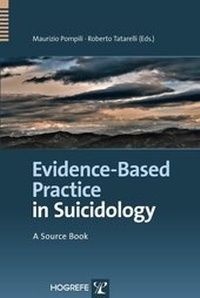
Evidence-Based Practice in Suicidology
A Source Book
1st Edition
Published on 24. December 2010
Book
Hardback
XIII, 384 pages
978-0-88937-383-9 (ISBN)
Description
An innovative and long overdue book by the world's leading researchers and practitioners, describing what really works in suicide prevention, the evidence for particular approaches, where the gaps are in our knowledge, and how we can fill them.
Suicide rates have increased by 60% worldwide in the past 45 years, with deaths by suicide projected to reach 1.5 million by the year 2020. Despite millions being spent on suicide prevention activities, little is known about their effectiveness: As the US Suicide Prevention Action Network (SPAN) reported, "The single greatest obstacle to the effective prevention of suicide is the lack of evaluation research."
Evidence-based medicine involves the conscientious, explicit, and judicious use of current best evidence in making decisions about the care of individual patients - which means integrating individual clinical expertise with the best available external clinical evidence from systematic research.
This substantive and authoritative volume shows for the first time how evidence-based approaches can be used in suicide prevention - as well as where evidence is lacking and how we might obtain it. Leading researchers and practitioners describe what really works in suicide prevention, the evidence for and against particular approaches, both in general terms (such as by means of hotlines, restriction of means, psychopharmocology) and for specific disorders (such as schizophrenia, personality disorder), and make specific recommendations about where we go from here.
Reviews / Votes
"This is the book we have all been waiting for. It provides answers to the key questions in suicidology: What is our evidence-base? And how can we translate research findings into effective suicide prevention interventions and practices? The expert contributors bring clarity into the field, describing the current research evidence as well as showing us how to interpret it and apply it in clinical and prevention settings. This book brings suicidology into the 21st century and also sets an agenda for its future directions. It is a must-read for everyone concerned with helping individuals at risk of suicidal behaviors." Morton M. Silverman, MD, Senior Advisor, Suicide Prevention Resource Center, Newton, MA, Senior Medical Advisor, The Jed Foundation, New York, NY, Assistant Clinical Professor of Psychiatry, University of Colorado at Denver, Denver, CO "Evidence-based methods have, over recent decades, enabled us to prune the vineyard of suicidology. Read this book to see how the field looks today, trimmed back and flourishing as never before. It will show you much of what we know (and what we don't know) about suicide, and take you to the cutting edge." John T. Maltsberger, MD, Associate Clinical Professor of Psychiatry, Harvard Medical School, Boston, MAMore details
Edition
1st edition 2010
Language
English
Place of publication
Toronto
Canada
Target group
College/higher education
Psychiatrists, psychologists, counselors, sociologists, and public health workersconcerned with suicide and its prevention.
Product notice
sewn/stitched
Dimensions
Height: 22.9 cm
Width: 15.3 cm
Weight
750 gr
ISBN-13
978-0-88937-383-9 (9780889373839)
Schweitzer Classification
Other editions
Additional editions
E-Book
12/2010
1st Edition
Hogrefe Publishing
€61.99
Available for download
Content
Part 1: The Framework 1. Foreword, Muir Gray 2. Evidence-Based Suicidology: What We Need and What We Need to Know, Maurizio Pompili 3. Evidence-Based Medicine in Mental Health: General Principles, Delia Cimpean, Robert Drake 4. Enhancing Suicide Risk Assessment Through Evidence-Based Psychiatry, Robert I. Simon 5. The World Health Organization: Approach to Evidence-Based Suicide Prevention, Diego De Leo Part 2: Evidence-Based Strategies for Suicide Prevention 6. Evidence-Based Suicide Prevention Strategies: An Overview, J. John Mann, Dianne Currier 7. Evidence-Based Psychotherapy with Suicidal People: A Systematic Review, Antoon A. Leenaars 8. Evidence-Based Psychosocial Interventions: What is the Evidence? James R. Rogers, Teri L. Madura, Jennifer L. Hardy 9. Evidence-Based Suicide Prevention by Helplines: A Meta-Analysis, David Lester 10. Suicide Prevention Programs Through Education in the Community and in the Frame of Healthcare, Konstantinos N. Fountoulakis, Zoltan Rihmer 11. Evidence-Based Interventions for Preventing Suicide in Youths, Maurizio Pompili, Marco Innamorati, Paolo Girardi, Roberto Tatarelli, David Lester 12. Suicide Prevention in Late Life: Is There Sound Evidence for Practice? Marco Innamorati, Maurizio Pompili, Mario Amore, Gianluca Serafini, Antonino Tamburello, David Lester 13. Evidence-Based Suicide Prevention by Lethal Methods Restriction, David Lester 14. Psychopharmacology for Suicide Prevention, Ross J. Baldessarini, Leonardo Tondo Part 3: Evidence-Based Approaches for Specific Disorders and Behaviors 15. Risk is Not Static Over the Lifespan: Accurately Accounting for Suicide Prevalence in Major Mental Illness, John Michael Bostwick 16. Edvidence-Based Approaches for Reducing Suicide Risk in Major Affective Disorders, Isaac Sakinofsky 17. Evidence-Based Treatment for Reducing Suicide Risk in Schizophrenia, Herbert Y. Meltzer 18. Evidence-Based Approach to Suicide Risk in First Episode Psychosis, Merete Nordentoft 19. Reducing Suicide Risk in Personality Disorders: The State of Current Evidence, Joel Paris Part 4: Where Do We Go From Here? 20. Perspectives in Suicide Research and Prevention: A Commentary, Alan L. Berman 21. Where is More Evidence Needed? Research Priorities in Suicidology, David Lester