

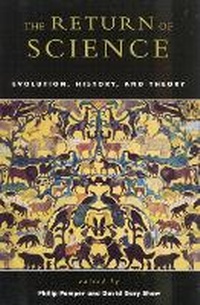
The Return of Science
Evolution, History, and Theory
Published on 14. May 2002
Book
Hardback
320 pages
978-0-7425-2160-5 (ISBN)
Description
Social scientists, philosophers, and mathematicians have adapted evolutionary theory for use in a variety of disciplines for several decades, but until now historians have lagged behind. In The Return of Science, several distinguished historians join prominent scholars from a wide range of disciplines to debate the applications of evolutionary theory to cultural, social, economic, and political phenomena. The contributors offer original theoretical approaches and deal with issues such as the benefits, limits, and dangers of using evolutionary theory in the social sciences, the problem of defining units of evolution, the use of mathematics in historical study, and the appropriateness of chaos theory in historical study. Originally published as part of the journal History and Theory, these revised and updated essays are a valuable resource for historiographers.
More details
Language
English
Place of publication
United States
Publishing group
Bloomsbury Publishing Plc
Dimensions
Height: 235 mm
Width: 156 mm
Thickness: 23 mm
Weight
531 gr
ISBN-13
978-0-7425-2160-5 (9780742521605)
Copyright in bibliographic data and cover images is held by Nielsen Book Services Limited or by the publishers or by their respective licensors: all rights reserved.
Schweitzer Classification
Persons
Philip Pomper is William F. Armstrong Professor of History at Wesleyan University. David Gary Shaw is associate professor of history at Wesleyan University.
Content
Chapter 1 An Interdisciplinary Paradigm Shift Chapter 2 History and the Scientific World View Chapter 3 A Brief History of Evolution Chapter 4 Evolving toward History Chapter 5 Human Nature and History Chapter 6 Evolutionary Theory and Group Selection: The Question of Warfare Chapter 7 Evolutionary Theory of History Chapter 8 Darwinizing History: The Evolution of Power in Russia Chapter 9 On the Role of Mathematical Biology in Contemporary Historiography Chapter 10 History, Differential Inclusions, and Narrative Chapter 11 Does Culture Evolve? Chapter 12 On the Problem of Laws in Nature and History: A Comparison