

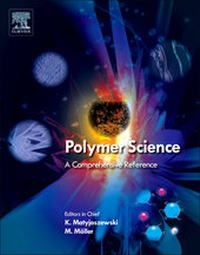
Polymer Science: A Comprehensive Reference
Elsevier (Publisher)
2nd Edition
Published on 2. June 2012
Book
7760 pages
978-0-444-53349-4 (ISBN)
Description
The progress in polymer science is revealed in the chapters of Polymer Science: A Comprehensive Reference, Ten Volume Set. In Volume 1, this is reflected in the improved understanding of the properties of polymers in solution, in bulk and in confined situations such as in thin films. Volume 2 addresses new characterization techniques, such as high resolution optical microscopy, scanning probe microscopy and other procedures for surface and interface characterization. Volume 3 presents the great progress achieved in precise synthetic polymerization techniques for vinyl monomers to control macromolecular architecture: the development of metallocene and post-metallocene catalysis for olefin polymerization, new ionic polymerization procedures, and atom transfer radical polymerization, nitroxide mediated polymerization, and reversible addition-fragmentation chain transfer systems as the most often used controlled/living radical polymerization methods. Volume 4 is devoted to kinetics, mechanisms and applications of ring opening polymerization of heterocyclic monomers and cycloolefins (ROMP), as well as to various less common polymerization techniques. Polycondensation and non-chain polymerizations, including dendrimer synthesis and various "click" procedures, are covered in Volume 5. Volume 6 focuses on several aspects of controlled macromolecular architectures and soft nano-objects including hybrids and bioconjugates. Many of the achievements would have not been possible without new characterization techniques like AFM that allowed direct imaging of single molecules and nano-objects with a precision available only recently. An entirely new aspect in polymer science is based on the combination of bottom-up methods such as polymer synthesis and molecularly programmed self-assembly with top-down structuring such as lithography and surface templating, as presented in Volume 7. It encompasses polymer and nanoparticle assembly in bulk and under confined conditions or influenced by an external field, including thin films, inorganic-organic hybrids, or nanofibers. Volume 8 expands these concepts focusing on applications in advanced technologies, e.g. in electronic industry and centers on combination with top down approach and functional properties like conductivity. Another type of functionality that is of rapidly increasing importance in polymer science is introduced in volume 9. It deals with various aspects of polymers in biology and medicine, including the response of living cells and tissue to the contact with biofunctional particles and surfaces. The last volume is devoted to the scope and potential provided by environmentally benign and green polymers, as well as energy-related polymers. They discuss new technologies needed for a sustainable economy in our world of limited resources.
Reviews / Votes
"Polymer Science: A Comprehensive Reference provides complete and up-to-date coverage of the most important contemporary aspects and fundamental concepts of polymer science. It will become the indispensable reference not only for polymer scientists but also for all researchers in disciplines related to macromolecular systems." --Excerpt from Foreword, Jean-Marie Lehn, ISIS-Universite de Strasbourg, Strasbourg, France, Nobel Prize Laureate in ChemistryMore details
Language
English
Place of publication
Oxford
United Kingdom
Publishing group
Elsevier Science & Technology
Target group
Professional and scholarly
The work will be suitable for graduate students and above studying the subfield of materials science concerned with polymers. It may also be applicable to chemists, chemical engineers, materials scientists, polymer scientists, environmental scientists and biologists in academia and government or corporate research labs.
Dimensions
Height: 281 mm
Width: 222 mm
ISBN-13
978-0-444-53349-4 (9780444533494)
Copyright in bibliographic data and cover images is held by Nielsen Book Services Limited or by the publishers or by their respective licensors: all rights reserved.
Schweitzer Classification
Other editions
New editions
Additional editions
E-Book
05/2014
2nd Edition
Elsevier
from
€4,150.00
Available for download
Persons
Martin Moeeller is Professor of Textile and Macromolecular Chemistry and Director of DWI at RWTH Aachen University. His research interests include polymers, structure-property relationships and self organization of macromolecules, surface modification and activation, formation of functional nanostructures and organic - inorganic hybrid structures. Prior to working at RWTH Aachen University, Moeeller was professor at the University of Ulm and University of Twente. He is a member of Deutsche Akademie der Technikwissenschaften (acatech) and of the Academy of Sciences of the State of North-Rhine Westphalia. Krzysztof Matyjaszewski is J.C. Warner University Professor of Natural Sciences and director of Center for Macromolecular Engineering at Carnegie Mellon University and also Adjunct Professor at the Polish Academy of Sciences. His research interests include controlled/living radical polymerization, catalysis, environmental chemistry, and advanced materials for optoelectronic and biomedical applications. Matyjaszewski is the editor of Progress in Polymer Science and Central European Journal of Chemistry and a member of US National Academy of Engineering, Polish Academy of Sciences and Russian Academy of Sciences.
Content
Polymer Science: A Comprehensive Reference includes over 250 chapters across several key areas of Polymer Science. These include Basic Concepts and Polymer Properties, Polymer Characterization, Chain Polymerization of Vinyl Monomers, Ring-opening polymerization and special polymerization processes, Polycondensation, Macromolecular Architectures and Soft Nano-objects, Nanostructured Polymer Materials and Thin Films, Polymers for Advanced Functional Materials, Polymers in Biology and Medicine, Polymers for a Sustainable Environment and Green Energy.