

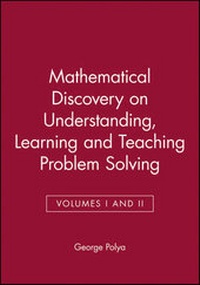
Mathematical Discovery on Understanding, Learning and Teaching Problem Solving, Volumes I and II
Published on 29. April 1981
Book
Paperback/Softback
464 pages
978-0-471-08975-9 (ISBN)
Description
A unique, heuristic approach to mathematical discovery and problem solving
This combined edition of Mathematical Discovery: On Understanding, Learning and Teaching Problem Solving is unique among mathematics texts. Espousing a heuristic approach to mathematical problem solving, the text may be followed sequentially or according to instructors' individualized curricula. Beginning with a discussion of patterns and practical approaches to problem solving, the book then presents examples from various branches of math and science to help students discover how to solve problems on their own - an invaluable skill for the classroom and beyond.
This combined edition of Mathematical Discovery: On Understanding, Learning and Teaching Problem Solving is unique among mathematics texts. Espousing a heuristic approach to mathematical problem solving, the text may be followed sequentially or according to instructors' individualized curricula. Beginning with a discussion of patterns and practical approaches to problem solving, the book then presents examples from various branches of math and science to help students discover how to solve problems on their own - an invaluable skill for the classroom and beyond.
More details
Other editions
Previous edition

Georg Polya
Mathematical Discovery: v. 2
Book
12/1962
Wiley
€11.88
Article exhausted; check for reprint
Person
George Polya was a Hungarian mathematician. He was a professor of mathematics from 1914 to 1940 at ETH Zuerich and from 1940 to 1953 at Stanford University. He made fundamental contributions to combinatorics, number theory, numerical analysis and probability theory.
Content
PATTERNS.
The Pattern of Two Loci.
The Cartesian Pattern.
Recursion.
Superposition.
TOWARD A GENERAL METHOD.
Problems.
Widening the Scope.
Solutions.
Appendix.
Bibliography.
Index.
The Pattern of Two Loci.
The Cartesian Pattern.
Recursion.
Superposition.
TOWARD A GENERAL METHOD.
Problems.
Widening the Scope.
Solutions.
Appendix.
Bibliography.
Index.