

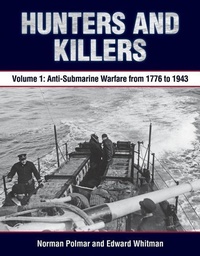
Hunters and Killers
Volume 1: Anti-Submarine Warfare from 1776 to 1943
Will be published approx. on 31. December 2015
Book
Hardback
224 pages
978-1-59114-689-6 (ISBN)
Description
Hunters and Killers is the first comprehensive history of all aspects of anti-submarine warfare (ASW) from its beginnings in the 18th century through the important role of present anti-submarine systems and operations. Published in two volumes, the work discusses anti-submarine warfare operations in World War I, World War II, the Cold War, and today. In addition to tactical and strategic narratives of major ASW campaigns, the work covers the evolution of ASW sensors, weapons, platforms, and tactics.
This first volume looks at the often ignored reaction to the earliest submersible attack on British warships in 1776 to the first, primitive ASW actions of World War I. World War I saw the Germans use U-boats to devastate British shipping, nearly driving the country out of the war. Here the authors look at the development of the innovative, but rudimentary sensors and weapons that the Allies used to counter the U-boat threats in the Atlantic and Mediterranean theaters.
Still, the U-boats were never completely defeated in the Great War, and the ensuing chapters about the two decades between the world wars narrate the development of sonar, radar, and ASW ships, as well as changing political attitudes toward undersea warfare.
The remainder of the first volume covers the first half of World War II's Battle of the Atlantic, from September 1939 to the U-boat crisis in the spring of 1943. This section discusses the influence of intelligence, gained mainly through cryptography, on the Battle of the Atlantic.
Polmar and Whitman have created a thorough, well-researched reference for anyone interested in the development of ASW.
This first volume looks at the often ignored reaction to the earliest submersible attack on British warships in 1776 to the first, primitive ASW actions of World War I. World War I saw the Germans use U-boats to devastate British shipping, nearly driving the country out of the war. Here the authors look at the development of the innovative, but rudimentary sensors and weapons that the Allies used to counter the U-boat threats in the Atlantic and Mediterranean theaters.
Still, the U-boats were never completely defeated in the Great War, and the ensuing chapters about the two decades between the world wars narrate the development of sonar, radar, and ASW ships, as well as changing political attitudes toward undersea warfare.
The remainder of the first volume covers the first half of World War II's Battle of the Atlantic, from September 1939 to the U-boat crisis in the spring of 1943. This section discusses the influence of intelligence, gained mainly through cryptography, on the Battle of the Atlantic.
Polmar and Whitman have created a thorough, well-researched reference for anyone interested in the development of ASW.
Reviews / Votes
"With two authors such as Polmar and Whitman, readers are treated to a succinct, well-written historical assessment of the technical achievements in ASW. Each volume includes a series of page-length sidebar biographies of important personalities-usually flag-rank officers-whose great contributions, either operational or technical, advanced the field of ASW. These two books offer a textbook history of ASW development for historians as well as present-day military members." - Naval Aviation News"Norman Polmar and Edward Whitman have risen to the challenge in their second volume on ASW history, Hunters and Killers, Vol. 2: Anti-Submarine Warfare from 1943. Focusing on ASW warfare beginning with the turn of the tide in the Second World War and tracing key developments throughout the Cold War, they present an enjoyable study of technological innovation, personalities and events to capture the imagination." - The Northern Mariner
"If you want encyclopedic information on anti-submarine warfare (ASW) as well as a good read, then Hunters and Killers, Volume 1 and 2 are the books for you." - Journal of Military History
More details
Language
English
Place of publication
Annopolis
United States
Product notice
Cloth over boards
Illustrations
31 b-w photos, 4 maps, 1 figure
Dimensions
Height: 284 mm
Width: 217 mm
Thickness: 20 mm
Weight
878 gr
ISBN-13
978-1-59114-689-6 (9781591146896)
Copyright in bibliographic data and cover images is held by Nielsen Book Services Limited or by the publishers or by their respective licensors: all rights reserved.
Schweitzer Classification
Persons
Norman Polmar is an analyst, consultant, and author specializing in naval, aviation, and science and technology issues. He has been a consultant or advisor on naval-related issues to three U.S. senators, the Speaker of the House, and the Deputy Counselor to the President, as well as to the director of the Los Alamos National Laboratory. He has written or coauthored more than 50 published books and numerous articles on naval, aviation, technology, and intelligence subjects.
Edward Whitman studied electrical engineering at the Massachusetts Institute of Technology and later earned a PhD in that field from the University of Maryland, USA. During his 40-year Navy civilian career, Dr. Whitman held senior management positions in various Navy and Department of Defense organizations, including the Sixth Fleet, Defense Advanced Projects Agency, and Office of the Secretary of the Navy. After retiring from the Department of the Navy in 1998, Dr. Whitman was the senior editor of the magazine Undersea Warfare for five years.
Edward Whitman studied electrical engineering at the Massachusetts Institute of Technology and later earned a PhD in that field from the University of Maryland, USA. During his 40-year Navy civilian career, Dr. Whitman held senior management positions in various Navy and Department of Defense organizations, including the Sixth Fleet, Defense Advanced Projects Agency, and Office of the Secretary of the Navy. After retiring from the Department of the Navy in 1998, Dr. Whitman was the senior editor of the magazine Undersea Warfare for five years.