

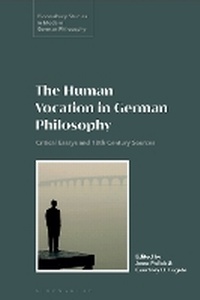
The Human Vocation in German Philosophy
Critical Essays and 18th Century Sources
Published on 23. February 2023
Book
Hardback
360 pages
978-1-350-16607-3 (ISBN)
Description
In 18th-century Germany philosophers were occupied with questions of who we are and what we should be. Can the individual fulfill its vocation or is this possible only for humanity as a whole? Is significant progress towards perfection in any way possible for me or just for me as part of humanity? By following the origin and nature of these debates, this collection sheds light on the vocation of humanity in early German philosophy.
Featuring translations of Spalding's Contemplation on the Vocation of the Human Being in its first version from 1748 and an extended translation of Abbt's and Mendelssohn's epistolary discussion around the Doubts and the Oracle from 1767, newly-commissioned chapters cover Johann Gottfried Herder's inherently cultural concept of the human being, Immanuel Kant's transformative interplay of moral and natural aspects, and the notion of metempsychosis in Fichte's work inspired by two neglected philosophers, Gotthold Ephraim Lessing and Johann Georg Schlosser. Opening further lines of inquiry, contributors address questions about the adaptations of Spalding's work that focus on the vocation of women as wife, mother or citizen.
Exploring the multitude of ways 18th-century German thinkers understand our position in the world, this volume captures major changes in metaphysics and anthropology and enriches current debates within modern philosophy.
Featuring translations of Spalding's Contemplation on the Vocation of the Human Being in its first version from 1748 and an extended translation of Abbt's and Mendelssohn's epistolary discussion around the Doubts and the Oracle from 1767, newly-commissioned chapters cover Johann Gottfried Herder's inherently cultural concept of the human being, Immanuel Kant's transformative interplay of moral and natural aspects, and the notion of metempsychosis in Fichte's work inspired by two neglected philosophers, Gotthold Ephraim Lessing and Johann Georg Schlosser. Opening further lines of inquiry, contributors address questions about the adaptations of Spalding's work that focus on the vocation of women as wife, mother or citizen.
Exploring the multitude of ways 18th-century German thinkers understand our position in the world, this volume captures major changes in metaphysics and anthropology and enriches current debates within modern philosophy.
Reviews / Votes
The 18th century debate about the vocation of human being gave shape and direction to later philosophy. Yet the debate, especially its early phases, remain curiously under-researched. With its translation of original sources and ten newly commissioned essays by leading scholars in the field, this volume represents a valuable addition to our understanding of the Enlightenment, Idealism, and beyond. * Kristin Gjesdal, Professor of Philosophy, Temple University, USA * This volume is essential reading for anyone interested in the perennial questions of what we are and who we ought to become. The lucid translations and erudite discussions of texts on the human vocation are a major contribution to studies in classical German philosophy. * John Walsh, Assistant Professor of Philosophy, Martin Luther University of Halle-Wittenberg, Germany * This volume does an excellent job of capturing the German Enlightenment's fascination with life's meaning, understood in terms of the human vocation. With translations of source materials and a collection of related essays, this book will interest anyone who has ever wondered about the human being's place in the world. * Reed Winegar, Associate Professor of Philosophy, Fordham University, USA *More details
Series
Language
English
Place of publication
London
United Kingdom
Publishing group
Bloomsbury Publishing PLC
Target group
College/higher education
Dimensions
Height: 160 mm
Width: 238 mm
Thickness: 26 mm
Weight
700 gr
ISBN-13
978-1-350-16607-3 (9781350166073)
Copyright in bibliographic data and cover images is held by Nielsen Book Services Limited or by the publishers or by their respective licensors: all rights reserved.
Schweitzer Classification
Other editions
Additional editions
Anne Pollok | Courtney D. Fugate
The Human Vocation in German Philosophy
Critical Essays and 18th Century Sources
E-Book
01/2023
1st Edition
Bloomsbury Academic
€46.49
Available for download
Persons
Anne Pollok is Research Associate (tenured) at the Johannes Gutenberg University of Mainz, Germany.
Courtney D. Fugate is Associate Professor of Philosophy at Florida State University, USA.
Courtney D. Fugate is Associate Professor of Philosophy at Florida State University, USA.
Content
Note on the Translations and Acknowledgments
Notes on Contributors
List of Abbreviations
Introduction: Defining the Dynamics of Being: How the Bestimmungsfrage became a Driving Force in German Enlightenment and Beyond, Anne Pollok (University of South Carolina, USA)
Part I: Translations
1. Johann Joachim Spalding: Contemplation on the Vocation of the Human Being (1748), translated by Courtney Fugate, (American University of Beirut, Lebanon)
2. Thomas Abbt and Moses Mendelssohn: Doubt and Oracle On the Human Vocation, plus Excerpts from their Correspondence, 1756-1766, translated by Anne Pollok (University of South Carolina, USA)
Part II: Essays
3. The Place of the Human Being in the World: Johann Joachim Spalding on Religion and Philosophy as a Way of Life, Laura Anna Macor (Oxford University, UK)
4. Between Spalding and Fichte: The Vocation of the Human Being in Mendelssohn and Kant, Guenter Zoeller (Ludwig Maximilian University of Munich, Germany)
5. Reinhard Brandt: Excerpt from The Human Vocation in Kant, translated by Courtney Fugate (American University of Beirut, Lebanon) and Anne Pollok (University of South Carolina, USA)
6. Kant on the Human Vocation, Allen Wood (Stanford University, USA and Indiana University, USA)
7. Understanding the Vocation of the Human Being Through the Kantian Sublime, Giulia Milli (University of Genoa, Italy)
8. 'It will be well': Isaak Iselin on the Self-Realization of Humanity in History, Ansgar Lyssy (Ludwig Maximilian University of Munich, Germany)
9. Whose Vocation? Which Man?: A.W. Rehberg on Vocation of Man and Political Theory, Michael Gregory (University of Groningen, the Netherlands)
10. Religious Anthropology and Pluralism: Herder on the Bildung of Humanity, Niels Wildschut (University of Vienna, Austria)
11. The Doctrine of Palingenesis in Fichte's Vocation of the Human Being, David W. Wood (KU Leuven, Belgium)
12. The Vocation of Philosophy: Hegel on "Speculative" Science and the Human Good, Brady Bowman (Pennsylvania State University, USA)
Bibliography
Index
Notes on Contributors
List of Abbreviations
Introduction: Defining the Dynamics of Being: How the Bestimmungsfrage became a Driving Force in German Enlightenment and Beyond, Anne Pollok (University of South Carolina, USA)
Part I: Translations
1. Johann Joachim Spalding: Contemplation on the Vocation of the Human Being (1748), translated by Courtney Fugate, (American University of Beirut, Lebanon)
2. Thomas Abbt and Moses Mendelssohn: Doubt and Oracle On the Human Vocation, plus Excerpts from their Correspondence, 1756-1766, translated by Anne Pollok (University of South Carolina, USA)
Part II: Essays
3. The Place of the Human Being in the World: Johann Joachim Spalding on Religion and Philosophy as a Way of Life, Laura Anna Macor (Oxford University, UK)
4. Between Spalding and Fichte: The Vocation of the Human Being in Mendelssohn and Kant, Guenter Zoeller (Ludwig Maximilian University of Munich, Germany)
5. Reinhard Brandt: Excerpt from The Human Vocation in Kant, translated by Courtney Fugate (American University of Beirut, Lebanon) and Anne Pollok (University of South Carolina, USA)
6. Kant on the Human Vocation, Allen Wood (Stanford University, USA and Indiana University, USA)
7. Understanding the Vocation of the Human Being Through the Kantian Sublime, Giulia Milli (University of Genoa, Italy)
8. 'It will be well': Isaak Iselin on the Self-Realization of Humanity in History, Ansgar Lyssy (Ludwig Maximilian University of Munich, Germany)
9. Whose Vocation? Which Man?: A.W. Rehberg on Vocation of Man and Political Theory, Michael Gregory (University of Groningen, the Netherlands)
10. Religious Anthropology and Pluralism: Herder on the Bildung of Humanity, Niels Wildschut (University of Vienna, Austria)
11. The Doctrine of Palingenesis in Fichte's Vocation of the Human Being, David W. Wood (KU Leuven, Belgium)
12. The Vocation of Philosophy: Hegel on "Speculative" Science and the Human Good, Brady Bowman (Pennsylvania State University, USA)
Bibliography
Index