

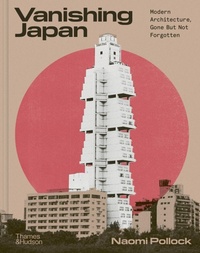
Vanishing Japan
Modern Architecture, Gone But Not Forgotten
Will be published approx. on 20. August 2026
Book
Hardback
304 pages
978-0-500-02828-5 (ISBN)
Description
A visual celebration and record in duotone of Japan's demolished post-war architectural gems and a look at why they've been torn down.
As in other countries, not every mid-century modern building in Japan can or even deserves to be saved. Yet a swathe of these works - those that achieved new architectural milestones and those that became landmarks in the public eye - warrant international attention. Vanishing Japan is the first book to shine a light on these gems, becoming an important record of buildings that have already been lost and making their memory available to a wide, global audience.
The book focuses on some ninety buildings demolished since 2000, while the introduction, afterword and 'deep dive' interludes provide additional context. The project selection features beloved theatres, shopping centres and offices built between the 1950s and 1970s, with select examples from the 1980s and 1990s as well. While many of these buildings were in Tokyo and Osaka, the book draws on examples from all over the country, charting the once recognizable local landmarks that continue to inspire as examples of architectural innovation.
High real-estate values, cost and improvements to construction techniques in a country plagued by earthquakes are just some of the reasons that buildings regularly get torn down in Japan. This and more is explored in this smart, accessible book designed in elegant duotone that will have readers look at their own built environment in a different light.
As in other countries, not every mid-century modern building in Japan can or even deserves to be saved. Yet a swathe of these works - those that achieved new architectural milestones and those that became landmarks in the public eye - warrant international attention. Vanishing Japan is the first book to shine a light on these gems, becoming an important record of buildings that have already been lost and making their memory available to a wide, global audience.
The book focuses on some ninety buildings demolished since 2000, while the introduction, afterword and 'deep dive' interludes provide additional context. The project selection features beloved theatres, shopping centres and offices built between the 1950s and 1970s, with select examples from the 1980s and 1990s as well. While many of these buildings were in Tokyo and Osaka, the book draws on examples from all over the country, charting the once recognizable local landmarks that continue to inspire as examples of architectural innovation.
High real-estate values, cost and improvements to construction techniques in a country plagued by earthquakes are just some of the reasons that buildings regularly get torn down in Japan. This and more is explored in this smart, accessible book designed in elegant duotone that will have readers look at their own built environment in a different light.
More details
Language
English
Place of publication
London
United Kingdom
Illustrations
169 Halftones, duotone
Dimensions
Height: 242 mm
Width: 190 mm
ISBN-13
978-0-500-02828-5 (9780500028285)
Copyright in bibliographic data and cover images is held by Nielsen Book Services Limited or by the publishers or by their respective licensors: all rights reserved.
Schweitzer Classification
Person
Naomi Pollock is an American architect who writes about Japanese design and architecture. She is the author of Nuno: Visionary Japanese Textiles, Japanese Design Since 1945 and The Japanese House Since 1945, published by Thames & Hudson. She lived and worked in Japan for over thirty years.