

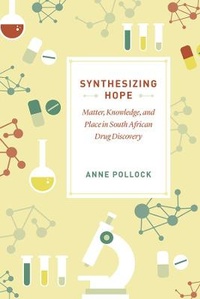
Synthesizing Hope
Matter, Knowledge, and Place in South African Drug Discovery
Published on 10. May 2019
Book
Hardback
208 pages
978-0-226-62904-9 (ISBN)
Description
Synthesizing Hope opens up the material and social world of pharmaceuticals by focusing on an unexpected place: iThemba Pharmaceuticals. Founded in 2009 with a name taken from the Zulu word for hope, the small South African startup with an elite international scientific board was tasked with drug discovery for tuberculosis, HIV, and malaria. Anne Pollock uses this company as an entry point for exploring how the location of the scientific knowledge production matters, not only for the raw materials, production, licensing, and distribution of pharmaceuticals but also for the making of basic scientific knowledge.
Consideration of this case exposes the limitations of global health frameworks that implicitly posit rich countries as the only sites of knowledge production. Analysis of iThemba identifies the problems inherent in global north/south divides at the same time as it highlights what is at stake in who makes knowledge and where. It also provides a concrete example for consideration of the contexts and practices of postcolonial science, its constraints, and its promise.
Synthesizing Hope explores the many legacies that create conditions of possibility for South African drug discovery, especially the specific form of settler colonialism characterized by apartheid and resource extraction. Paying attention to the infrastructures and laboratory processes of drug discovery underscores the materiality of pharmaceuticals from the perspective of their makers, and tracing the intellectual and material infrastructures of South African drug discovery contributes new insights about larger social, political, and economic orders.
Consideration of this case exposes the limitations of global health frameworks that implicitly posit rich countries as the only sites of knowledge production. Analysis of iThemba identifies the problems inherent in global north/south divides at the same time as it highlights what is at stake in who makes knowledge and where. It also provides a concrete example for consideration of the contexts and practices of postcolonial science, its constraints, and its promise.
Synthesizing Hope explores the many legacies that create conditions of possibility for South African drug discovery, especially the specific form of settler colonialism characterized by apartheid and resource extraction. Paying attention to the infrastructures and laboratory processes of drug discovery underscores the materiality of pharmaceuticals from the perspective of their makers, and tracing the intellectual and material infrastructures of South African drug discovery contributes new insights about larger social, political, and economic orders.
More details
Language
English
Place of publication
Chicago
United States
Publishing group
The University of Chicago Press
Product notice
sewn/stitched
Cloth over boards
Illustrations
7 halftones
Dimensions
Height: 229 mm
Width: 152 mm
ISBN-13
978-0-226-62904-9 (9780226629049)
Copyright in bibliographic data and cover images is held by Nielsen Book Services Limited or by the publishers or by their respective licensors: all rights reserved.
Schweitzer Classification
Other editions
Additional editions
E-Book
05/2019
1st Edition
University of Chicago Press
from
€25.20
Available for download
Person
Anne Pollock is professor of global health and social medicine at King's College London. She is the author of Medicating Race: Heart Disease and Durable Preoccupations with Difference.