

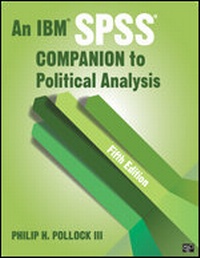
An IBM SPSS (R) Companion to Political Analysis
5th Edition
Published on 26. January 2016
Book
Paperback/Softback
240 pages
978-1-5063-0579-0 (ISBN)
Description
In Philip H. Pollock's An IBM SPSS (R) Companion to Political Analysis, students dive headfirst into actual political data and work with a software tool that prepares them for future political science research. Students learn by doing with fresh guided examples, new annotated screenshots, step-by-step instructions, and exercises that reflect current scholarly debates in American political behavior and comparative politics.
Compatible with all releases of SPSS (12.0 and later), the all-new Fifth Edition includes 53 new or revised exercises. Two new datasets (NES 2012 and GSS 2012) and two revised datasets (on the 50 states and on 167 countries of the world) feature an expanded number of variables to provide greater latitude for performing original analysis.
Compatible with all releases of SPSS (12.0 and later), the all-new Fifth Edition includes 53 new or revised exercises. Two new datasets (NES 2012 and GSS 2012) and two revised datasets (on the 50 states and on 167 countries of the world) feature an expanded number of variables to provide greater latitude for performing original analysis.
Reviews / Votes
"Pollock's workbook is a wonderful companion to any research methods course. It pairs nicely with other textbooks and reading material, and provides students with interesting datasets and detailed explanations on how to analyze data within SPSS. An invaluable guide for faculty and students alike it made my job teaching the class easier, but more importantly, it made my course better." -- Wesley Hussey "This book is an indispensable asset to any professor who teaches students about the foundations of quantitative analysis. Pollock sets the standard for providing in depth, accessible instruction on how to use SPSS to analyze data in political science." -- Brian Frederick "An IBM SPSS (R) Companion to Political Analysis complements The Essentials of Political Analysis and provides clear instruction for SPSS. The text is very accessible to students and uses interesting, varied, and lively examples. The four data sets - 2012 GSS, 2012 ANES, a 50 state dataset, and a 167 country dataset - engage students with a range of interests." -- Gary CopelandMore details
Edition
5th Revised edition
Language
English
Place of publication
Washington
United States
Publishing group
SAGE Publications Inc
Target group
College/higher education
Edition type
Revised edition
Dimensions
Height: 279 mm
Width: 216 mm
Weight
577 gr
ISBN-13
978-1-5063-0579-0 (9781506305790)
Copyright in bibliographic data and cover images is held by Nielsen Book Services Limited or by the publishers or by their respective licensors: all rights reserved.
Schweitzer Classification
Other editions
New editions
Philip H. Pollock | Barry Clayton Edwards
An IBM (R) SPSS (R) Companion to Political Analysis
Book
10/2019
6th Edition
CQ Press
€94.28
Article exhausted; check for reprint
Previous edition
Philip H. Pollock
An SPSS Companion to Political Analysis
Book
09/2011
4th Edition
CQ Press
€68.27
Article exhausted; check for reprint
Person
Philip H. Pollock III is a professor of political science at the University of Central Florida. He has taught courses in research methods at the undergraduate and graduate levels for more than thirty years. His main research interests are American public opinion, voting behavior, techniques of quantitative analysis, and the scholarship of teaching and learning. His recent research has been on the effectiveness of Internet-based instruction. Pollock's research has appeared in the American Journal of Political Science, Social Science Quarterly, and the British Journal of Political Science. Recent scholarly publications include articles in Political Research Quarterly, the Journal of Political Science Education, and PS: Political Science and Politics.
Content
Getting Started
Downloading the Datasets
SPSS Full Version and SPSS Student Version: What Is the Difference?
Notes
Chapter 1 Introduction to SPSS
The Data Editor
A Must-Do: Setting Options for Variable Lists
The Viewer
Exercises
Chapter 2 Descriptive Statistics
Interpreting Measures of Central Tendency and Variation
Describing Nominal Variables
Describing Ordinal Variables
Describing Interval Variables
Obtaining Case-level Information with Case Summaries
Exercises
Notes
Chapter 3 Transforming Variables
Using Recode
Using Visual Binning
Using Compute
Exercises
Notes
Chapter 4 Making Comparisons
Cross-tabulation Analysis
Mean Comparison Analysis
Graphing Relationships
Exercises
Notes
Chapter 5 Making Controlled Comparisons
Cross-tabulation Analysis with a Control Variable
Graphing Relationships with a Control Variable
Mean Comparison Analysis with a Control Variable
Exercises
Notes
Chapter 6 Making Inferences about Sample Means
Descriptives and One-Sample T Test
Independent-Samples T Test
Exercises
Notes
Chapter 7 Chi-square and Measures of Association
Analyzing an Ordinal-level Relationship
Analyzing an Ordinal-level Relationship with a Control Variable
Analyzing a Nominal-level Relationship with a Control Variable
Exercises
Notes
Chapter 8 Correlation and Linear Regression
Correlation and Bivariate Regression
Scatterplots
Multiple Regression
Exercises
Notes
Chapter 9 Dummy Variables and Interaction Effects
Regression with Dummy Variables
Interaction Effects in Multiple Regression
Using Compute for Interaction Variables
Exercises
Notes
Chapter 10 Logistic Regression
Using Regression -> Binary Logistic
Logistic Regression with Multiple Independent Variables
Working with Predicted Probabilities: Models with One Independent Variable
Working with Predicted Probabilities: Models with Multiple Independent Variables
Exercises
Notes
Chapter 11 Doing Your Own Political Analysis
Five Doable Ideas
Inputting Data
Writing It Up
Notes
Downloading the Datasets
SPSS Full Version and SPSS Student Version: What Is the Difference?
Notes
Chapter 1 Introduction to SPSS
The Data Editor
A Must-Do: Setting Options for Variable Lists
The Viewer
Exercises
Chapter 2 Descriptive Statistics
Interpreting Measures of Central Tendency and Variation
Describing Nominal Variables
Describing Ordinal Variables
Describing Interval Variables
Obtaining Case-level Information with Case Summaries
Exercises
Notes
Chapter 3 Transforming Variables
Using Recode
Using Visual Binning
Using Compute
Exercises
Notes
Chapter 4 Making Comparisons
Cross-tabulation Analysis
Mean Comparison Analysis
Graphing Relationships
Exercises
Notes
Chapter 5 Making Controlled Comparisons
Cross-tabulation Analysis with a Control Variable
Graphing Relationships with a Control Variable
Mean Comparison Analysis with a Control Variable
Exercises
Notes
Chapter 6 Making Inferences about Sample Means
Descriptives and One-Sample T Test
Independent-Samples T Test
Exercises
Notes
Chapter 7 Chi-square and Measures of Association
Analyzing an Ordinal-level Relationship
Analyzing an Ordinal-level Relationship with a Control Variable
Analyzing a Nominal-level Relationship with a Control Variable
Exercises
Notes
Chapter 8 Correlation and Linear Regression
Correlation and Bivariate Regression
Scatterplots
Multiple Regression
Exercises
Notes
Chapter 9 Dummy Variables and Interaction Effects
Regression with Dummy Variables
Interaction Effects in Multiple Regression
Using Compute for Interaction Variables
Exercises
Notes
Chapter 10 Logistic Regression
Using Regression -> Binary Logistic
Logistic Regression with Multiple Independent Variables
Working with Predicted Probabilities: Models with One Independent Variable
Working with Predicted Probabilities: Models with Multiple Independent Variables
Exercises
Notes
Chapter 11 Doing Your Own Political Analysis
Five Doable Ideas
Inputting Data
Writing It Up
Notes