

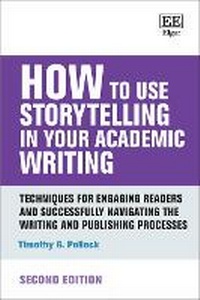
How to Use Storytelling in Your Academic Writing
Techniques for Engaging Readers and Successfully Navigating the Writing and Publishing Processes: Second Edition
2nd Edition
Published on 4. February 2025
Book
Paperback/Softback
256 pages
978-1-0353-2590-0 (ISBN)
Description
Good writing skills and habits are critical for scholarly success. Every article is a story, and employing effective storytelling techniques enhances scholars' abilities to share their insights and ideas, increasing the impact of their research.
In this timely second edition, Tim Pollock draws on fiction and non-fiction writing tools and techniques to help academic authors enhance the clarity, presentation and flow of their scholarly work. With new chapters focusing on the intricacies of writing developmental reviews and dissertations, the second edition of How to Use Storytelling in Your Academic Writing provides comprehensive discussions illustrating the structural and stylistic factors involved in effective storytelling and how to apply them in writing each section of an academic article. The second edition also expands on important topics such as managing the co-authoring, writing and review processes.
This book is an invaluable resource for academics across business disciplines, particularly those in management-related sectors such as organizational behavior, organization theory, business and management history and corporate governance. It is also useful to those in adjacent social science disciplines such as sociology, psychology and economics.
In this timely second edition, Tim Pollock draws on fiction and non-fiction writing tools and techniques to help academic authors enhance the clarity, presentation and flow of their scholarly work. With new chapters focusing on the intricacies of writing developmental reviews and dissertations, the second edition of How to Use Storytelling in Your Academic Writing provides comprehensive discussions illustrating the structural and stylistic factors involved in effective storytelling and how to apply them in writing each section of an academic article. The second edition also expands on important topics such as managing the co-authoring, writing and review processes.
This book is an invaluable resource for academics across business disciplines, particularly those in management-related sectors such as organizational behavior, organization theory, business and management history and corporate governance. It is also useful to those in adjacent social science disciplines such as sociology, psychology and economics.
Reviews / Votes
'In this timely and updated second edition of How to Use Storytelling in Your Academic Writing: Techniques for Engaging Readers and Successfully Navigating the Writing and Publishing Processes, Professor Tim Pollock draws on fiction and non-fiction writing tools and techniques to help academic authors enhance the clarity, presentation and flow of their scholarly work. With new chapters focusing on the intricacies of writing developmental reviews and dissertations, the second edition of How to Use Storytelling in Your Academic Writing provides comprehensive discussions illustrating the structural and stylistic factors involved in effective storytelling and how to apply them in writing each section of an academic article. The second edition also expands on important topics such as managing the co-authoring, writing and review processes.' -- James A. Cox, Midwest Book Review 'For researchers, finding the truth has always been a method taught to everyone, and reporting it has been an art known only by the few. Thanks to this book, research has now become more democratic, because the reader learns how to use storytelling tools methodically for reporting research.' -- Henrich R. Greve, Rudolf and Valeria Maag Chaired Professor of Entrepreneurship, INSEAD and former Editor, Administrative Science Quarterly 'The most interesting ideas and the most diligent designs fall flat if we can't showcase them for the reader. Pollock shows us how-while also giving tips for making the process more efficient and enjoyable. This book is essential for any scholar and should be required reading when training doctoral students.' -- Jason A. Colquitt, University of Notre Dame, USA and former Editor, Academy of Management Journal 'If you want your scholarly work to be read, admired, and remembered, you should dive into this book. Tim Pollock has done us an immense service. By integrating classical concepts from the narrative and dramatic arts, along with numerous juicy examples from the world of academic writing, Pollock provides us a fun, valuable story about storytelling.' -- Donald C. Hambrick, The Pennsylvania State University, USAMore details
Series
Edition
2nd edition
Language
English
Place of publication
Cheltenham
United Kingdom
Target group
Professional and scholarly
College/higher education
Dimensions
Height: 234 mm
Width: 156 mm
ISBN-13
978-1-0353-2590-0 (9781035325900)
Copyright in bibliographic data and cover images is held by Nielsen Book Services Limited or by the publishers or by their respective licensors: all rights reserved.
Schweitzer Classification
Other editions
Previous edition
Timothy G. Pollock
How to Use Storytelling in Your Academic Writing
Techniques for Engaging Readers and Successfully Navigating the Writing and Publishing Processes
Book
07/2021
Edward Elgar Publishing
€57.14
Article exhausted; check for reprint
Person
Timothy G. Pollock, Haslam Chair in Business, Distinguished Professor of Entrepreneurship and Kinney Family Faculty Research Fellow, Haslam College of Business, University of Tennessee-Knoxville, USA
Content
Contents
About the author
Preface to the second edition
1 Introduction: think like a storyteller
2 Structuring a story
3 Storytelling tools
4 The building blocks of storytelling: words, sentences and
paragraphs
5 Introductions, titles and abstracts
6 Theory and hypotheses
7 Methods and results
8 Discussion section
9 What's different about qualitative articles, theory articles
and book chapters
10 The writing process
11 The co-authoring process
12 Navigating the review process
13 Writing developmental reviews
14 Writing a dissertation
15 Other kinds of writing
16 Conclusion
References
Index
About the author
Preface to the second edition
1 Introduction: think like a storyteller
2 Structuring a story
3 Storytelling tools
4 The building blocks of storytelling: words, sentences and
paragraphs
5 Introductions, titles and abstracts
6 Theory and hypotheses
7 Methods and results
8 Discussion section
9 What's different about qualitative articles, theory articles
and book chapters
10 The writing process
11 The co-authoring process
12 Navigating the review process
13 Writing developmental reviews
14 Writing a dissertation
15 Other kinds of writing
16 Conclusion
References
Index