

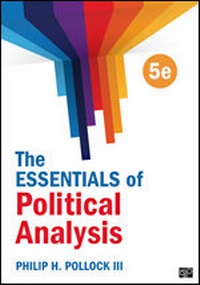
The Essentials of Political Analysis
5th Edition
Published on 26. November 2015
Book
Paperback/Softback
280 pages
978-1-5063-0583-7 (ISBN)
Description
"Overall, this is the best political science research methods book I've seen."
-William Field, Rutgers University
Building students' analytic abilities and developing their statistical reasoning with new data, fresh exercises, and engaging examples, this accessible introduction to the essential elements of political analysis walks students through the basics-measuring concepts, describing variables, formulating and testing hypotheses, controlling for alternative explanations, and interpreting graphic displays, and nearly 50 practical exercises motivate them to use their new skills with confidence.
New to this edition:
All examples updated with current data sources
Treatment of visual depictions of variables and relationships and enhanced coverage of logistic regression
A total of 48 end-of-chapter exercises, many new or completely revised
More accessible discussion of spurious, additive, and interaction relationships
Coverage of box plots and error bar charts
New discussion of ways to represent probabilities in logistic regression
-William Field, Rutgers University
Building students' analytic abilities and developing their statistical reasoning with new data, fresh exercises, and engaging examples, this accessible introduction to the essential elements of political analysis walks students through the basics-measuring concepts, describing variables, formulating and testing hypotheses, controlling for alternative explanations, and interpreting graphic displays, and nearly 50 practical exercises motivate them to use their new skills with confidence.
New to this edition:
All examples updated with current data sources
Treatment of visual depictions of variables and relationships and enhanced coverage of logistic regression
A total of 48 end-of-chapter exercises, many new or completely revised
More accessible discussion of spurious, additive, and interaction relationships
Coverage of box plots and error bar charts
New discussion of ways to represent probabilities in logistic regression
Reviews / Votes
"With its carefully organized material, hands-on running examples, and accessible writing style, The Essentials of Political Analysis introduces readers to the foundational principles of research in Political Science in a natural and fluid fashion. It effectively conveys to students the idea that the methods we use in Political Science research are crucial in providing answers to real world political and social questions. The chapters on inference in particular are extremely well executed." -- Renato Corbetta "Overall, this is the best political science research methods book I've seen. It is brief yet covers the methodological basics of quantitative research design from concept development to difference of means, chi-square, and linear regression. It is detailed, yet comprehensible. Best of all, the companion text offers quality datasets and walk-throughs of SPSS that bring every concept here to life. Combined, The Essentials of Political Analysis and An SPSS Companion to Political Analysis form the backbone of our undergraduate research methods teaching." -- William FieldMore details
Edition
5th Revised edition
Language
English
Place of publication
Washington
United States
Publishing group
SAGE Publications Inc
Target group
College/higher education
Edition type
Revised edition
Dimensions
Height: 254 mm
Width: 178 mm
Weight
492 gr
ISBN-13
978-1-5063-0583-7 (9781506305837)
Copyright in bibliographic data and cover images is held by Nielsen Book Services Limited or by the publishers or by their respective licensors: all rights reserved.
Schweitzer Classification
Other editions
New editions
Philip H. Pollock | Barry Clayton Edwards
The Essentials of Political Analysis
Book
11/2019
6th Edition
CQ Press
€169.36
Article exhausted; check for reprint
Previous edition
Philip H. Pollock
The Essentials of Political Analysis
Book
09/2011
4th Edition
CQ Press
€84.38
Article exhausted; check for reprint
Person
Philip H. Pollock III is a professor of political science at the University of Central Florida. He has taught courses in research methods at the undergraduate and graduate levels for more than thirty years. His main research interests are American public opinion, voting behavior, techniques of quantitative analysis, and the scholarship of teaching and learning. His recent research has been on the effectiveness of Internet-based instruction. Pollock's research has appeared in the American Journal of Political Science, Social Science Quarterly, and the British Journal of Political Science. Recent scholarly publications include articles in Political Research Quarterly, the Journal of Political Science Education, and PS: Political Science and Politics.
Content
Introduction
What This Book Is About
Facts and Values in Perspective
The Scientific Approach
Conclusion
Chapter 1: The Definition and Measurement of Concepts
Conceptual Definitions
Operational Definitions
Summary
Key Terms
Exercises
Chapter 2: Measuring and Describing Variables
Measuring Variables
Describing Variables
Summary
Key Terms
Exercises
Chapter 3: Proposing Explanations, Framing Hypotheses, and Making Comparisons
Proposing Explanations
Framing Hypotheses
Making Comparisons
Graphing Relationships and Describing Patterns
Summary
Key Terms
Exercises
Chapter 4: Research Design and the Logic of Control
Experimental Designs
Controlled Comparisons
Three Scenarios
Summary
Key Terms
Exercises
Chapter 5: Making Controlled Comparisons
Cross-tabulation Analysis
Graphing Controlled Comparisons
An Example of Interaction
Mean Comparison Analysis
Summary
Key Terms
Exercises
Chapter 6: Foundations of Statistical Inference
Population Parameters and Sample Statistics
Random Sampling
The Standard Error of a Sample Mean
Inference Using the Normal Distribution
Inference Using the Student's t-Distribution
What About Sample Proportions?
Summary
Key Terms
Exercises
Chapter 7: Tests of Significance and Measures of Association
Statistical Significance
Measures of Association
Summary
Key Terms
Exercises
Chapter 8: Correlation and Linear Regression
Correlation
Bivariate Regression
R-square
Dummy Variable Regression
Multiple Regression
Summary
Key Terms
Exercises
Chapter 9: Logistic Regression
The Logistic Regression Approach
Finding the Best Fit: Maximum Likelihood Estimation
Logistic Regression with Multiple Independent Variables
Working with Probabilities: MEMs and MERs
Summary
Key Terms
Exercises
Chapter 10: Thinking Empirically, Thinking Probabilistically
Thinking Empirically
Thinking Probabilistically
What This Book Is About
Facts and Values in Perspective
The Scientific Approach
Conclusion
Chapter 1: The Definition and Measurement of Concepts
Conceptual Definitions
Operational Definitions
Summary
Key Terms
Exercises
Chapter 2: Measuring and Describing Variables
Measuring Variables
Describing Variables
Summary
Key Terms
Exercises
Chapter 3: Proposing Explanations, Framing Hypotheses, and Making Comparisons
Proposing Explanations
Framing Hypotheses
Making Comparisons
Graphing Relationships and Describing Patterns
Summary
Key Terms
Exercises
Chapter 4: Research Design and the Logic of Control
Experimental Designs
Controlled Comparisons
Three Scenarios
Summary
Key Terms
Exercises
Chapter 5: Making Controlled Comparisons
Cross-tabulation Analysis
Graphing Controlled Comparisons
An Example of Interaction
Mean Comparison Analysis
Summary
Key Terms
Exercises
Chapter 6: Foundations of Statistical Inference
Population Parameters and Sample Statistics
Random Sampling
The Standard Error of a Sample Mean
Inference Using the Normal Distribution
Inference Using the Student's t-Distribution
What About Sample Proportions?
Summary
Key Terms
Exercises
Chapter 7: Tests of Significance and Measures of Association
Statistical Significance
Measures of Association
Summary
Key Terms
Exercises
Chapter 8: Correlation and Linear Regression
Correlation
Bivariate Regression
R-square
Dummy Variable Regression
Multiple Regression
Summary
Key Terms
Exercises
Chapter 9: Logistic Regression
The Logistic Regression Approach
Finding the Best Fit: Maximum Likelihood Estimation
Logistic Regression with Multiple Independent Variables
Working with Probabilities: MEMs and MERs
Summary
Key Terms
Exercises
Chapter 10: Thinking Empirically, Thinking Probabilistically
Thinking Empirically
Thinking Probabilistically