

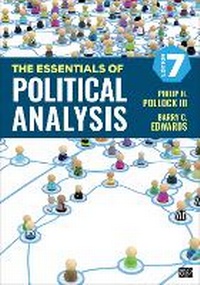
The Essentials of Political Analysis
7th Edition
Published on 15. April 2025
Book
Paperback/Softback
512 pages
978-1-0718-6146-2 (ISBN)
Description
Equip students with the skills and confidence they need to conduct political analyses and critically assess statistical research. In the Seventh Edition of The Essentials of Political Science, bestselling authors Philip H. Pollock III and Barry C. Edwards build students' analytic abilities and develop their statistical reasoning with new data, fresh exercises, and clear examples. This brief and reader-friendly guide walks students through the essentials- defining measurement, formulating and testing hypotheses, measuring variables-while using key terms, chapter-opening objectives, over 80 tables and figures, and practical exercises to get them using and applying their new skills.
Using Excel, R, SPSS, or STATA? Companion workbooks featuring statistical software instructions and exercises help your students apply their knowledge.
Using Excel, R, SPSS, or STATA? Companion workbooks featuring statistical software instructions and exercises help your students apply their knowledge.
Reviews / Votes
An approachable and lucidly written text that provides students with the essential knowledge and tools for conducting empirical political science research. -- Yi Yang An excellent introduction on how to carry out social scientific research. Highly recommended for undergraduate courses on research design and the basics of statistical analysis. -- David Dreyer An excellent textbook to use for scope and methods and undergraduate statistics courses. -- Maurice Mangum A great book that introduces students to the basic elements of research, data, and data analysis. Students don't necessarily need to start the class with a working knowledge of statistics to be successful. -- Brian Crisher A well-written undergraduate methods textbook that even the most apprehensive student can understand. -- Nadine Gibson Foundations of statistics for poli sci major in plain language with easy to comprehend exercises. -- Volodymyr Guptan Straightforward with good resources. -- Youssef Chouhoud This is a thorough and understandable introduction to research methods that can easily be adapted to your classroom preferences and needs. -- Scott LeibertzMore details
Edition
7th Revised edition
Language
English
Place of publication
Washington
United States
Publishing group
SAGE Publications Inc
Target group
College/higher education
Edition type
Revised edition
Dimensions
Height: 254 mm
Width: 178 mm
Weight
1018 gr
ISBN-13
978-1-0718-6146-2 (9781071861462)
Copyright in bibliographic data and cover images is held by Nielsen Book Services Limited or by the publishers or by their respective licensors: all rights reserved.
Schweitzer Classification
Other editions
Previous edition
Philip H. Pollock | Barry Clayton Edwards
The Essentials of Political Analysis
Book
11/2019
6th Edition
CQ Press
€169.36
Article exhausted; check for reprint
Persons
Philip H. Pollock III is a professor of political science at the University of Central Florida. He has taught courses in research methods at the undergraduate and graduate levels for more than thirty years. His main research interests are American public opinion, voting behavior, techniques of quantitative analysis, and the scholarship of teaching and learning. His recent research has been on the effectiveness of Internet-based instruction. Pollock's research has appeared in the American Journal of Political Science, Social Science Quarterly, and the British Journal of Political Science. Recent scholarly publications include articles in Political Research Quarterly, the Journal of Political Science Education, and PS: Political Science and Politics.
Barry C. Edwards writes textbooks and works for Fair Trial Analysis, LLC, a company that conducts research on juries and jurors for civil and criminal litigation. He received his B.A. from Stanford University, a J.D. from New York University, and a Ph.D. from the University of Georgia. He taught survey design and analysis, research methods, and prelaw courses at the University of Central Florida and continues to teach occasional courses for the University of Georgia. His political science interests include American politics, public law, and research methods. He founded the Political Science Data Group and created the PoliSciData.com website. His research has been published in American Politics Research, Congress & the Presidency, Election Law Journal, Emory Law Journal, Georgia Bar Journal, Harvard Negotiation Law Review, Journal of Politics, NYU Journal of Legislation and Public Policy, Political Research Quarterly, Presidential Studies Quarterly, Public Management Review, State Politics and Policy Quarterly, and UCLA Criminal Justice Law Review.
Barry C. Edwards writes textbooks and works for Fair Trial Analysis, LLC, a company that conducts research on juries and jurors for civil and criminal litigation. He received his B.A. from Stanford University, a J.D. from New York University, and a Ph.D. from the University of Georgia. He taught survey design and analysis, research methods, and prelaw courses at the University of Central Florida and continues to teach occasional courses for the University of Georgia. His political science interests include American politics, public law, and research methods. He founded the Political Science Data Group and created the PoliSciData.com website. His research has been published in American Politics Research, Congress & the Presidency, Election Law Journal, Emory Law Journal, Georgia Bar Journal, Harvard Negotiation Law Review, Journal of Politics, NYU Journal of Legislation and Public Policy, Political Research Quarterly, Presidential Studies Quarterly, Public Management Review, State Politics and Policy Quarterly, and UCLA Criminal Justice Law Review.
Content
List of Tables
List of Boxes
Preface
Acknowledgments
About the Authors
Chapter 1 The Definition and Measurement of Concepts
1.1 Conceptual Definitions
1.2 Operational Definitions
1.3 Measurement Error
1.4 Reliability and Validity
1.5 Working With Datasets, Codebooks, and Software
Summary
Key Terms
Exercises
Chapter 2 Measuring and Describing Variables
2.1 Essential Features
2.2 Levels of Measurement
2.3 Central Tendency and Dispersion of Variables
2.4 Describing Nominal-Level Variables
2.5 Describing Ordinal-Level Variables
2.6 Describing Interval-Level Variables
Summary
Key Terms
Exercises
Chapter 3 Creating and Transforming Variables
3.1 Transforming Interval-Level Variables With Math Functions
3.2 Sometimes, Less Is More: Simplifying Variables
3.3 Managing Data and Metadata
3.4 Additive Indexes and Measurement Scales
3.5 Advanced Data Transformation Methods
Summary
Key Terms
Exercises
Chapter 4 Proposing Explanations, Framing Hypotheses, and Making Comparisons
4.1 "All Models Are Wrong, but Some Are Useful"
4.2 Proposing Explanations
4.3 Framing Hypotheses
4.4 Making Comparisons
Summary
Key Terms
Exercises
Chapter 5 Graphing Relationships and Describing Patterns
5.1 Historic Examples of Data Visualization
5.2 Levels of Measurement and Choice of Graph Types
5.3 Visualizing Relationships With Categorical Variables
5.4 Describing Patterns
5.5 Graphing Relationship Between Interval-Level Variables
5.6 Challenges of Visualizing Data
Summary
Key Terms
Exercises
Chapter 6 Research Design, Research Ethics, and Evidence of Causation
6.1 Establishing Causation
6.2 Experimental Designs
6.3 Selecting Cases for Analysis
6.4 Conducting Research Ethically
Summary
Key Terms
Exercises
Chapter 7 Making Controlled Comparisons
7.1 The Logic of Controlled Comparisons
7.2 Essential Terms and Concepts
7.3 Effect of Partisanship on Gun Control Vote, Controlling for Gender: An Illustrative Example
7.4 Controlled Mean Comparisons
7.5 Identifying Patterns
7.6 Advanced Methods of Making Controlled Comparisons
Summary
Key Terms
Exercises
Chapter 8 Foundations of Statistical Inference
8.1 Population Parameters and Sample Statistics
8.2 The Central Limit Theorem and the Normal Distribution
8.3 Quantifying Standard Errors
8.4 Confidence Intervals
8.5 Sample Size and the Margin of Error of a Poll
8.6 Inferences With Small Batches: The Student's t-Distribution
Summary
Key Terms
Exercises
Chapter 9 Hypothesis Tests With One or Two Samples
9.1 Statistical Significance and Null Hypothesis Testing
9.2 One-Sample Significance Tests
9.3 Two-Sample Significance Tests
9.4 Criticisms of Null Hypothesis Testing
Summary
Key Terms
Exercises
Chapter 10 Chi-Square Test and Analysis of Variance
10.1 Null Hypothesis Tests With More than Two Groups
10.2 The Chi-Square Test of Independence
10.3 Measures of Association
10.4 Analysis of Variance (ANOVA)
Summary
Key Terms
Exercises
Chapter 11 Correlation and Bivariate Regression
11.1 Correlation
11.2 Bivariate Regression
11.3 Educational Attainment and Voter Turnout in States Example
11.4 R-Square and Adjusted R-Square
11.5 All Models Are Still Wrong, but Some Are Useful
Summary
Key Terms
Exercises
Chapter 12 Multiple Regression
12.1 Multiple Regression Equation
12.2 Educational Attainment and Voter Turnout in States Revisited
12.3 Regression With Multiple Dummy Variables
12.4 Interaction Effects in Multiple Regression
12.5 Some Practical Issues in Multiple Regression Analysis
Summary
Key Terms
Exercises
Chapter 13 Analyzing Regression Residuals
13.1 What Are Regression Residuals?
13.2 Assumptions About Regression Residuals
13.3 Diagnostic Graphs of Regression Residuals
13.4 Testing Assumptions About Regression Residuals
13.5 What If Assumptions Are Violated?
Summary
Key Terms
Exercises
Chapter 14 Logistic Regression
14.1 The Logistic Regression Approach
14.2 Logistic Regression Analysis of Vote Choice in the 2020 Presidential Election
14.3 Finding the Best Fit: Maximum Likelihood Estimation
14.4 Logistic Regression With Multiple Independent Variables
14.5 Graphing Predicted Probabilities With Multiple Independent Variables
Summary
Key Terms
Exercises
Chapter 15 Conducting Your Own Political Analysis
15.1 Picking a Good Topic
15.2 Getting Focused and Staying Motivated
15.3 Reviewing Prior Literature
15.4 Collecting Data
15.5 Writing It Up
15.6 Maintain a Scientific Mindset
Summary
Key Terms
Exercises
Glossary
Endnotes
Index
List of Boxes
Preface
Acknowledgments
About the Authors
Chapter 1 The Definition and Measurement of Concepts
1.1 Conceptual Definitions
1.2 Operational Definitions
1.3 Measurement Error
1.4 Reliability and Validity
1.5 Working With Datasets, Codebooks, and Software
Summary
Key Terms
Exercises
Chapter 2 Measuring and Describing Variables
2.1 Essential Features
2.2 Levels of Measurement
2.3 Central Tendency and Dispersion of Variables
2.4 Describing Nominal-Level Variables
2.5 Describing Ordinal-Level Variables
2.6 Describing Interval-Level Variables
Summary
Key Terms
Exercises
Chapter 3 Creating and Transforming Variables
3.1 Transforming Interval-Level Variables With Math Functions
3.2 Sometimes, Less Is More: Simplifying Variables
3.3 Managing Data and Metadata
3.4 Additive Indexes and Measurement Scales
3.5 Advanced Data Transformation Methods
Summary
Key Terms
Exercises
Chapter 4 Proposing Explanations, Framing Hypotheses, and Making Comparisons
4.1 "All Models Are Wrong, but Some Are Useful"
4.2 Proposing Explanations
4.3 Framing Hypotheses
4.4 Making Comparisons
Summary
Key Terms
Exercises
Chapter 5 Graphing Relationships and Describing Patterns
5.1 Historic Examples of Data Visualization
5.2 Levels of Measurement and Choice of Graph Types
5.3 Visualizing Relationships With Categorical Variables
5.4 Describing Patterns
5.5 Graphing Relationship Between Interval-Level Variables
5.6 Challenges of Visualizing Data
Summary
Key Terms
Exercises
Chapter 6 Research Design, Research Ethics, and Evidence of Causation
6.1 Establishing Causation
6.2 Experimental Designs
6.3 Selecting Cases for Analysis
6.4 Conducting Research Ethically
Summary
Key Terms
Exercises
Chapter 7 Making Controlled Comparisons
7.1 The Logic of Controlled Comparisons
7.2 Essential Terms and Concepts
7.3 Effect of Partisanship on Gun Control Vote, Controlling for Gender: An Illustrative Example
7.4 Controlled Mean Comparisons
7.5 Identifying Patterns
7.6 Advanced Methods of Making Controlled Comparisons
Summary
Key Terms
Exercises
Chapter 8 Foundations of Statistical Inference
8.1 Population Parameters and Sample Statistics
8.2 The Central Limit Theorem and the Normal Distribution
8.3 Quantifying Standard Errors
8.4 Confidence Intervals
8.5 Sample Size and the Margin of Error of a Poll
8.6 Inferences With Small Batches: The Student's t-Distribution
Summary
Key Terms
Exercises
Chapter 9 Hypothesis Tests With One or Two Samples
9.1 Statistical Significance and Null Hypothesis Testing
9.2 One-Sample Significance Tests
9.3 Two-Sample Significance Tests
9.4 Criticisms of Null Hypothesis Testing
Summary
Key Terms
Exercises
Chapter 10 Chi-Square Test and Analysis of Variance
10.1 Null Hypothesis Tests With More than Two Groups
10.2 The Chi-Square Test of Independence
10.3 Measures of Association
10.4 Analysis of Variance (ANOVA)
Summary
Key Terms
Exercises
Chapter 11 Correlation and Bivariate Regression
11.1 Correlation
11.2 Bivariate Regression
11.3 Educational Attainment and Voter Turnout in States Example
11.4 R-Square and Adjusted R-Square
11.5 All Models Are Still Wrong, but Some Are Useful
Summary
Key Terms
Exercises
Chapter 12 Multiple Regression
12.1 Multiple Regression Equation
12.2 Educational Attainment and Voter Turnout in States Revisited
12.3 Regression With Multiple Dummy Variables
12.4 Interaction Effects in Multiple Regression
12.5 Some Practical Issues in Multiple Regression Analysis
Summary
Key Terms
Exercises
Chapter 13 Analyzing Regression Residuals
13.1 What Are Regression Residuals?
13.2 Assumptions About Regression Residuals
13.3 Diagnostic Graphs of Regression Residuals
13.4 Testing Assumptions About Regression Residuals
13.5 What If Assumptions Are Violated?
Summary
Key Terms
Exercises
Chapter 14 Logistic Regression
14.1 The Logistic Regression Approach
14.2 Logistic Regression Analysis of Vote Choice in the 2020 Presidential Election
14.3 Finding the Best Fit: Maximum Likelihood Estimation
14.4 Logistic Regression With Multiple Independent Variables
14.5 Graphing Predicted Probabilities With Multiple Independent Variables
Summary
Key Terms
Exercises
Chapter 15 Conducting Your Own Political Analysis
15.1 Picking a Good Topic
15.2 Getting Focused and Staying Motivated
15.3 Reviewing Prior Literature
15.4 Collecting Data
15.5 Writing It Up
15.6 Maintain a Scientific Mindset
Summary
Key Terms
Exercises
Glossary
Endnotes
Index