

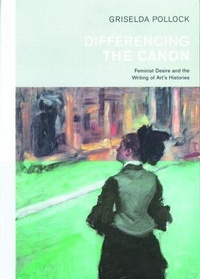
Differencing the Canon
Feminism and the Writing of Art's Histories
1st Edition
Published on 4. February 1999
Book
Paperback/Softback
364 pages
978-0-415-06700-3 (ISBN)
Description
In this major book, Griselda Pollock engages boldly in the culture wars over `what is the canon?` and `what difference can feminism make?` Do we simply reject the all-male line-up and satisfy our need for ideal egos with an all women litany of artistic heroines? Or is the question a chance to resist the phallocentric binary and allow the ambiguities and complexities of desire - subjectivity and sexuality - to shape the readings of art that constantly displace the present gender demarcations?
Reviews / Votes
'The flow of the book is wondrous, as Pollock buils each new idea onto the next, rounded out with rigorous research.' - Elizabeth Millard, ForeWardo'If you like psychoanalytic feminism accompanied by committed, sensitive writing, then you will enjoy this read.' - Professor Gen Doy, The Art Book
More details
Language
English
Place of publication
London
United Kingdom
Publishing group
Taylor & Francis Ltd
Target group
College/higher education
Professional and scholarly
Postgraduate
Dimensions
Height: 245 mm
Width: 175 mm
Thickness: 27 mm
Weight
943 gr
ISBN-13
978-0-415-06700-3 (9780415067003)
Copyright in bibliographic data and cover images is held by Nielsen Book Services Limited or by the publishers or by their respective licensors: all rights reserved.
Schweitzer Classification
Other editions
Additional editions
E-Book
04/2013
1st Edition
Routledge
€53.99
Available for download
E-Book
04/2013
1st Edition
Routledge
€53.99
Available for download
Book
02/1999
1st Edition
Routledge
€230.27
Shipment within 15-20 days
Person
Griselda Pollock
Content
Preface PART I Firing the canon 1 About canons and culture wars 2 Differencing: feminism's encounter with the canon PART II Reading against the grain: reading for ... 3 The ambivalence of the maternal body: re/drawing Van Gogh 4 Fathers of modern art: mothers of invention: cocking a leg at Toulouse-Lautrec PART III Heroines: setting women in the canon 5 The female hero and the making of a feminist canon: Artemisia 6 Feminist mythologies and missing mothers: Virginia Woolf, Charlotte Bronte, Artemisia Gentileschi and Cleopatra 7 Revenge: Lubaina Himid and the making of new narratives for new histories PART IV Who is the other? 8 Some letters on feminism, politics and modern art: when Edgar Degas shared a space with Mary Cassatt at the Suffrage Benefit Exhibition, New York 1915 9 A tale of three women: seeing in the dark, seeing double, at least, with Manet