

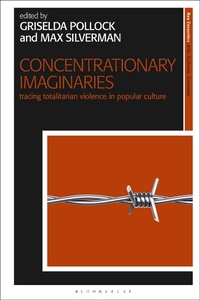
Concentrationary Imaginaries
Tracing Totalitarian Violence in Popular Culture
Published on 25. August 2015
Book
Hardback
320 pages
978-1-78453-409-7 (ISBN)
Description
In 1945, French political prisoners returning from the concentration camps of Germany coined the phrase 'the concentrationary universe' to describe the camps as a terrible political experiment in the destruction of the human. This book shows how the unacknowledged legacy of a totalitarian mentality has seeped into the deepest recesses of everyday popular culture. It asks if the concentrationary now infests our cultural imaginary, normalizing what was once considered horrific and exceptional by transforming into entertainment violations of human life. Drawing on the political philosophy of Hannah Arendt and the analyses of violence by Agamben, Virilio, Lacoue-Labarthe and Nancy, it also offers close readings of films by Cavani and Haneke that identify and critically expose such an imaginary and, hence, contest its lingering force.
More details
Series
Language
English
Place of publication
United Kingdom
Publishing group
Bloomsbury Publishing PLC
Target group
College/higher education
Product notice
Laminated cover
Illustrations
49 bw illus
Dimensions
Height: 234 mm
Width: 156 mm
Thickness: 19 mm
Weight
629 gr
ISBN-13
978-1-78453-409-7 (9781784534097)
Copyright in bibliographic data and cover images is held by Nielsen Book Services Limited or by the publishers or by their respective licensors: all rights reserved.
Schweitzer Classification
Other editions
Additional editions
Griselda Pollock | Max Silverman
Concentrationary Imaginaries
Tracing Totalitarian Violence in Popular Culture
E-Book
11/2015
1st Edition
I.B. Tauris
€30.99
Available for download
Griselda Pollock | Max Silverman
Concentrationary Imaginaries
Tracing Totalitarian Violence in Popular Culture
E-Book
11/2015
I.B. Tauris
€30.99
Available for download
Griselda Pollock | Max Silverman
Concentrationary Memories
Totalitarian Terror and Cultural Resistance
E-Book
08/2015
1st Edition
I.B. Tauris
€30.99
Available for download
Persons
Griselda Pollock is Professor of Social and Critical Histories of Art and Director of the Centre for Cultural Analysis, Theory and History at the University of Leeds. Her publications include Visual Politics of Psychoanalysis: Art and the Image in Post-Traumatic Cultures (2013). Pollock is Series Editor of Bloomsbury's New Encounters Series.
Max Silverman is Professor of Modern French Studies at the University of Leeds. His publications include Palimpsestic Memory: the Holocaust and Colonialism in French and Francophone Fiction and Film (2013).
Griselda Pollock and Max Silverman are joint authors of Concentrationary Cinema: Aesthetics as Political Resistance in Alain Resnais's 'Night and Fog', which won the Kraszna-Krausz Award for Best Book on the Moving Image, 2011. They are also joint editors of Concentrationary Memories: Totalitarian Terror and Cultural Resistance, the first of three volumes on the Concentrationary in New Encounters Series, of which Concentrationary Imaginaries is the second to be published.
Max Silverman is Professor of Modern French Studies at the University of Leeds. His publications include Palimpsestic Memory: the Holocaust and Colonialism in French and Francophone Fiction and Film (2013).
Griselda Pollock and Max Silverman are joint authors of Concentrationary Cinema: Aesthetics as Political Resistance in Alain Resnais's 'Night and Fog', which won the Kraszna-Krausz Award for Best Book on the Moving Image, 2011. They are also joint editors of Concentrationary Memories: Totalitarian Terror and Cultural Resistance, the first of three volumes on the Concentrationary in New Encounters Series, of which Concentrationary Imaginaries is the second to be published.
Content
List of Illustrations
Acknowledgements
Series Preface: Concentrationary Memories: The Politics of Representation, Griselda Pollock and Max Silverman
Introduction
A Concentrationary Imaginary?, Griselda Pollock
Part I. Thinking
1. Framing Horror, Adriana Cavarero
2. Between Realism and Fiction: Arendt and Levi on Concentrationary Imaginaries, Olivia Guaraldo
3. Totality, Convergence, Synchronization, Ian James
Part II. Desire
4. Wrap me up in Sadist Knots: Representations of Sadism-From Naziploitation to Torture Porn, Aaron Kerner
5. Redemption or Transformation: Blasphemy and the Concentrationary Imaginary in Liliana Cavani's The Night Porter (1974), Griselda Pollock
Part III. Camp
6. Seep and Creep: the Concentrationary Imaginary in Martin Scorsese's Shutter Island (2010), Benjamin Hannavy Cousen
7. Haneke and the Camps, Max Silverman
8. Spec(tac)ularizing 'Campness': Nikita and La Femme Nikita the Series, Brenda Hollweg
Notes
Bibliography
Notes on Contributors
Index
Acknowledgements
Series Preface: Concentrationary Memories: The Politics of Representation, Griselda Pollock and Max Silverman
Introduction
A Concentrationary Imaginary?, Griselda Pollock
Part I. Thinking
1. Framing Horror, Adriana Cavarero
2. Between Realism and Fiction: Arendt and Levi on Concentrationary Imaginaries, Olivia Guaraldo
3. Totality, Convergence, Synchronization, Ian James
Part II. Desire
4. Wrap me up in Sadist Knots: Representations of Sadism-From Naziploitation to Torture Porn, Aaron Kerner
5. Redemption or Transformation: Blasphemy and the Concentrationary Imaginary in Liliana Cavani's The Night Porter (1974), Griselda Pollock
Part III. Camp
6. Seep and Creep: the Concentrationary Imaginary in Martin Scorsese's Shutter Island (2010), Benjamin Hannavy Cousen
7. Haneke and the Camps, Max Silverman
8. Spec(tac)ularizing 'Campness': Nikita and La Femme Nikita the Series, Brenda Hollweg
Notes
Bibliography
Notes on Contributors
Index