

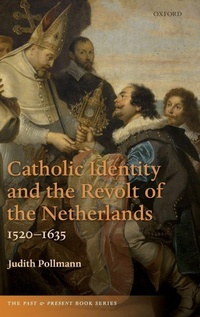
Catholic Identity and the Revolt of the Netherlands, 1520-1635
Published on 8. September 2011
Book
Hardback
272 pages
978-0-19-960991-8 (ISBN)
Description
The Revolt that ripped apart the sixteenth-century Netherlands began as a rebellion against Habsburg authority but it eventually became a war of religion that resulted in the formation of two new states. Although the Southern Netherlands ultimately witnessed the triumph of the militant Catholicism of the Baroque, Catholics throughout the Low Countries found that the Revolt had changed their lives forever. Mining the unusually rich diaries, memoirs, and poems written by Netherlandish Catholics, Judith Pollmann explores how Catholic believers experienced religious and political turmoil in the generations between Erasmus and Rubens. She investigates the initial passivity of Catholics in the face of Calvinist aggression, and asks why they actively supported a Catholic revival after 1585. By listening to the voices of individual Catholics, lay and clerical, Judith Pollmann offers a new perspective both on the Revolt of the Netherlands and on the formation of early modern Catholic identity. Exploring what it took to turn traditional Christians into the agents of their own Counter-Reformation, she sees the dynamic relationship between priests and people as a catalyst for religious change in the sixteenth and seventeenth centuries.
Reviews / Votes
a fascinating amount of detail * Times Literary Supplement * Professor Pollman's book redefines our understanding both of Catholic Reform and the Dutch Revolt. The work, implicitly and explicitly, maps out a research agenda that will engage historians for a long time to come. * Jan Machielsen, English Historical Review * a powerful contribution to the historiography of Catholicism. * Marc R. Forster, Low Countries Historical Review * This is an excellent study of the impact of the Revolt on Catholic laypeople living in the Habsburg Netherlands from the beginning of the Reformation until 1635. This book's unique contribution to the historiography is its illumination of lay Catholic activism and the collaboration of laity and clergy specifically in the Spanish Netherlands. ... one of the clearest and most readable narratives of the complex series of events referred to as the "Revolt". * Amanda Pipkin, The Sixteenth Century Journal *More details
Series
Language
English
Place of publication
Oxford
United Kingdom
Target group
College/higher education
Professional and scholarly
Illustrations
5 maps and 9 black and white images
Dimensions
Height: 240 mm
Width: 161 mm
Thickness: 19 mm
Weight
555 gr
ISBN-13
978-0-19-960991-8 (9780199609918)
Copyright in bibliographic data and cover images is held by Nielsen Book Services Limited or by the publishers or by their respective licensors: all rights reserved.
Schweitzer Classification
Person
Judith Pollmann was educated at the University of Amsterdam and the Warburg Institute in London. From 1995-2005 she taught early modern European history at Oxford University, before relocating to the University of Leiden in the Netherlands, where she is currently Professor of the History and Culture of the Dutch Republic. Pollmann has published widely on the cultural and religious history of the early modern Low Countries and on the Dutch Revolt. She is currently directing a research project entitled Memory, oblivion and identity in the early modern Low Countries, 1566-1700.
Content
Introduction ; 1. A pious people ; 2. Each should tend his own garden. Strategies, 1520-1566 ; 3. Retribution and reform, 1567-1571 ; 4. Catholics were not asked. Rebellion, 1572-1585 ; 5. Reconciliation and atonement, 1585-1597 ; 6. Marshalling the sacred, 1598-1621 ; Epilogue. Tilburg, 1633 ; Appendix. The principal Catholic diarists and memoirists discussed in the text ; Bibliography ; Index