

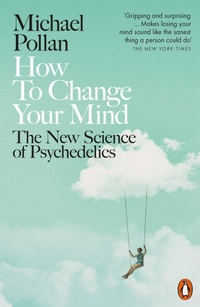
How to Change Your Mind
The New Science of Psychedelics
Published on 30. May 2019
Book
Paperback/Softback
480 pages
978-0-14-198513-8 (ISBN)
Description
THE NO. 1 NEW YORK TIMES BESTSELLER, NOW A MAJOR NEW NETFLIX SERIES
'Reminds us that the mind is the greatest mystery in the universe' Yuval Noah Harari, Guardian, Books of the Year
Could psychedelic drugs change our worldview? Join Michael Pollan on a journey to the frontiers of the human mind.
Diving deep into an extraordinary world - from shamans and magic mushroom hunts to the pioneering labs mapping our brains - and putting himself forward as a guinea-pig, Michael Pollan has written a remarkable history of psychedelics and a compelling portrait of the new generation of scientists fascinated by the implications of these drugs. How to Change Your Mind is a report from what could very well be the future of consciousness.
'A sweeping and often thrilling chronicle of the history of psychedelics, all interwoven with Pollan's adventures as a psychedelic novice. This is a serious work of history and science, but also one in which the author, under the influence of toad venom, becomes convinced he's giving birth to himself' Oliver Burkeman, Guardian
'A mind-altering book ... full of transformations' Richard Godwin, Evening Standard
'An irresistible blend of history, research and personal experience. In terms of the psychedelic wave, the book is the big kahuna, the Big Bang moment for a movement that is gathering force' John McKenna, Irish Times
'Entertaining and engrossing' Paul Laity, Financial Times
'Deeply absorbing, wise and beautifully written' Mick Brown, Literary Review
'An astounding book' Andrew Sullivan, New York Magazine
'Reminds us that the mind is the greatest mystery in the universe' Yuval Noah Harari, Guardian, Books of the Year
Could psychedelic drugs change our worldview? Join Michael Pollan on a journey to the frontiers of the human mind.
Diving deep into an extraordinary world - from shamans and magic mushroom hunts to the pioneering labs mapping our brains - and putting himself forward as a guinea-pig, Michael Pollan has written a remarkable history of psychedelics and a compelling portrait of the new generation of scientists fascinated by the implications of these drugs. How to Change Your Mind is a report from what could very well be the future of consciousness.
'A sweeping and often thrilling chronicle of the history of psychedelics, all interwoven with Pollan's adventures as a psychedelic novice. This is a serious work of history and science, but also one in which the author, under the influence of toad venom, becomes convinced he's giving birth to himself' Oliver Burkeman, Guardian
'A mind-altering book ... full of transformations' Richard Godwin, Evening Standard
'An irresistible blend of history, research and personal experience. In terms of the psychedelic wave, the book is the big kahuna, the Big Bang moment for a movement that is gathering force' John McKenna, Irish Times
'Entertaining and engrossing' Paul Laity, Financial Times
'Deeply absorbing, wise and beautifully written' Mick Brown, Literary Review
'An astounding book' Andrew Sullivan, New York Magazine
More details
Language
English
Place of publication
London
United Kingdom
Target group
Professional and scholarly
College/higher education
Product notice
Paperback (UK-B)
Dimensions
Height: 198 mm
Width: 128 mm
Thickness: 25 mm
Weight
333 gr
ISBN-13
978-0-14-198513-8 (9780141985138)
Copyright in bibliographic data and cover images is held by Nielsen Book Services Limited or by the publishers or by their respective licensors: all rights reserved.
Schweitzer Classification
Other editions
Additional editions
E-Book
05/2018
1st Edition
Penguin Books Ltd
€9.49
Available for download
Person
Michael Pollan is an award-winning author, activist and journalist. His international best-selling books about the way we live today -including How to Change Your Mind, This Is Your Mind on Plants, In Defence of Food and The Omnivore's Dilemma- - combine meticulous reporting with anthropology, philosophy, culture, health and natural history. Time Magazine has named him one of the hundred most influential people in the world. He lives in the Bay Area of California with his wife.