

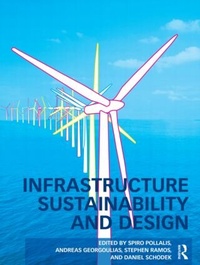
Infrastructure Sustainability and Design
1st Edition
Published on 23. January 2012
Book
Hardback
350 pages
978-0-415-89316-9 (ISBN)
Description
You're overseeing a large-scale project, but you're not an engineering or construction specialist, and so you need an overview of the related sustainability concerns and processes. To introduce you to the main issues, experts from the fields of engineering, planning, public health, environmental design, architecture, and landscape architecture review current sustainable large-scale projects, the roles team members hold, and design approaches, including alternative development and financing structures. They also discuss the challenges and opportunities of sustainability within infrastructural systems, such as those for energy, water, and waste, so that you know what's possible. And best of all, they present here for the first time the Zofnass Environmental Evaluation Methodology guidelines, which will help you and your team improve infrastructure design, engineering, and construction.
Reviews / Votes
"This book is brilliantly conceived and well needed internationally. Up to now the focus has been on individual sustainable building - a book of this scope dealing with the infrastructure on which most of them will depend for the foreseeable future is long overdue."George Baird, professor, Victoria University of Wellington, New Zealand
"This book is a comprehensive guide to the unique challenges associated with planning, design, construction, operation, and eventual decommissioning of the complex infrastructure systems that are essential to sustaining civilization. It is a useful reference for industry professionals and government officials, as well as a valuable framework for continued academic research."
Thomas Vautin, associate vice president for Facilities and Environmental Services, Harvard University "This book is brilliantly conceived and well needed internationally. Up to now the focus has been on individual sustainable building - a book of this scope dealing with the infrastructure on which most of them will depend for the foreseeable future is long overdue." - George Baird, Professor, Victoria University of Wellington, New Zealand
"This book is a comprehensive guide to the unique challenges associated with planning, design, construction, operation, and eventual decommissioning of the complex infrastructure systems that are essential to sustaining civilization. It is a useful reference for industry professionals and government officials, as well as a valuable framework for continued academic research." - Thomas Vautin, Associate Vice President for Facilities and Environmental Services, Harvard University, USA
More details
Language
English
Place of publication
London
United Kingdom
Publishing group
Taylor & Francis Ltd
Target group
College/higher education
Professional and scholarly
Professional, Professional Practice & Development, and Undergraduate
Illustrations
107 Farbfotos bzw. farbige Rasterbilder, 30 farbige Zeichnungen, 41 farbige Tabellen
41 Tables, color; 30 Line drawings, color; 107 Halftones, color
Dimensions
Height: 280 mm
Width: 210 mm
Weight
1080 gr
ISBN-13
978-0-415-89316-9 (9780415893169)
Copyright in bibliographic data and cover images is held by Nielsen Book Services Limited or by the publishers or by their respective licensors: all rights reserved.
Schweitzer Classification
Other editions
Additional editions
Spiro Pollalis | Andreas Georgoulias | Stephen Ramos
Infrastructure Sustainability and Design
E-Book
06/2013
1st Edition
Routledge
€165.99
Available for download
Spiro Pollalis | Andreas Georgoulias | Stephen Ramos
Infrastructure Sustainability and Design
E-Book
06/2013
1st Edition
Routledge
€165.99
Available for download
Persons
Spiro N. Pollalis is Professor of Design, Technology and Management at the Harvard Design School, practices as urban planner, and is the Chairman of the public company for the redevelopment of the site of the old Athens Airport in Greece.
Andreas Georgoulias is Lecturer at the Harvard Design School, where he teaches and researches sustainable development.
Stephen J. Ramos is an Assistant Professor in the College of Environment and Design at the University of Georgia.
Daniel L. Schodek is the Kumagai Research Professor of Architectural Technology at the Harvard Design School, where he taught from 1969 until 2008.
Andreas Georgoulias is Lecturer at the Harvard Design School, where he teaches and researches sustainable development.
Stephen J. Ramos is an Assistant Professor in the College of Environment and Design at the University of Georgia.
Daniel L. Schodek is the Kumagai Research Professor of Architectural Technology at the Harvard Design School, where he taught from 1969 until 2008.
Content
Introduction: Sustainability: A Broad Perspective Part 1: Dimensions of Sustainability 1. Climate Change and Infrastructure 2. Resource Allocation 3. Infrastructure and Nature: Reciprocal Effects and Patterns for our Future 4. Quality of Life 5. Sustainable Wellness: The Convergence of Social and Ecological Wellbeing Part 2: Sustainable Practices in Infrastructure Systems 6. Water Infrastructure and Sustainability Systems 7. The Evolution of Urban Water and Energy Infrastructure Systems 8. Sustainability Aspects of Large-Scale Wind Power Development 9. Sustainable Solid Waste Infrastructure 10. Sustainable Transportation Infrastructure 11. Transportation: Aviation/Airports 12. Sustainability in Ports, Freights and Logistics 13. Ecological Infrastructure Part 3: Assessing Urban Infrastructures 14. Issues in Assessing Urban Infrastructures 15. Current Environmental Evaluation Approaches 16. The Zofnass Rating System for Infrastructure Sustainability and Decision-Making 17. Economic Assessments of the Value of Sustainability Part 4: Design and Planning for Infrastructure Sustainability 18. Sustainable Cities: Oxymoron or the Shape of the Future? 19. Intelligent Infrastructures 20. Landscape Infrastructure: Urbanism Beyond Engineering 21. Shaping the Built Environment and Infrastructure to Improve our Quality of Life 22. Why Ecological Urbanism? Why Now?