

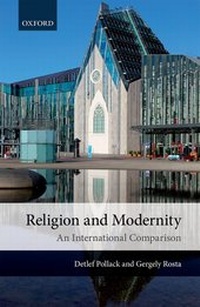
Religion and Modernity
An International Comparison
Published on 14. December 2017
Book
Hardback
506 pages
978-0-19-880166-5 (ISBN)
Description
This is not a book that provides a new integrated theory of religious change in modern societies, but rather one that develops theoretical elements that contribute to the understanding of some contemporary religious developments. Most of the approaches in sociology of religion are prone to emphasise either processes of religious decline or of religious upswing. For example, secularization theory usually includes a couple of relevant factors--such as functional differentiation, economic affluence or social equality--in order to account for religious change. However, the result of such a theory's empirical analyses seems to be certain in advance, namely that the social relevance of religion is decreasing. In contrast, the religious market model devised by sociologists of religion in the US is inclined to detect everywhere processes of religious upsurge. Religion and Modernity: An International Comparison avoids a purely theoretically based perspective on religious changes. For this reason, Detlef Pollack and Gergely Rosta do not begin with theoretical propositions but with questions. The authors raise the question of how the social significance of religion in its various facets has changed in modern societies, and explain what factors and conditions have contributed to these changes.
Reviews / Votes
this book is a jolting "must-read" for all students of religion, especially Religious Studies scholars. The broad lesson gleaned from Pollack and Rosta's multi-layered study is that while we can and should subject theories of secularization to critical examination, findings on the ground keep suggesting that modernity brings with it great challenges to the relevance and vitality of religious life. * Shifa Amina Noor, Reading Religion *More details
Language
English
Place of publication
Oxford
United Kingdom
Target group
College/higher education
Dimensions
Height: 236 mm
Width: 165 mm
Thickness: 36 mm
Weight
910 gr
ISBN-13
978-0-19-880166-5 (9780198801665)
Copyright in bibliographic data and cover images is held by Nielsen Book Services Limited or by the publishers or by their respective licensors: all rights reserved.
Schweitzer Classification
Other editions
Additional editions
E-Book
12/2017
1st Edition
OUP eBook
€68.99
Available for download
E-Book
11/2017
1st Edition
OUP eBook
€83.99
Available for download
Persons
Detlef Pollack is Professor of Sociology of Religion at Muenster University. He is speaker of the Cluster of Excellence "Religion and Politics in Modern und Premodern Cultures" at Muenster University. His research focuses on religious change in Western and Eastern Europe and in the US and political culture in Eastern and Central East Europe. His publications include The Role of Religion in Modern Societies (co-edited with Daniel V. A. Olson; Routledge, 2011) and Handbuch Religionssoziologie (Springer, 2017).
Gergely Rosta was Research Fellow at Muenster University from 2009 to 2017. He is currently Associate Professor in Sociology at the Pazmany Peter Catholic University in Budapest. His research interests include religious change in Central and Eastern Europe, youth religiosity, and quantitative research methods.
Gergely Rosta was Research Fellow at Muenster University from 2009 to 2017. He is currently Associate Professor in Sociology at the Pazmany Peter Catholic University in Budapest. His research interests include religious change in Central and Eastern Europe, youth religiosity, and quantitative research methods.
Content
PART I: THEORETICAL REFLECTIONS; PART II: RELIGIOUS DECLINE IN WESTERN EUROPE?; PART III: RELIGIOUS RENAISSANCE IN EASTERN EUROPE?; PART IV: RELIGIOUS CHANGE OUTSIDE EUROPE: THREE CASE STUDIES; PART V: SYSTEMATIC PERSPECTIVES