

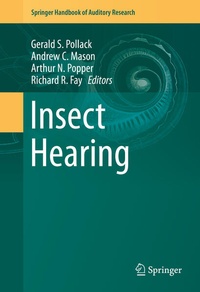
Insect Hearing
Published on 14. June 2016
Book
Hardback
XIII, 262 pages
978-3-319-28888-8 (ISBN)
Description
Insect Hearing provides a broadly based view of the functions, mechanisms, and evolution of hearing in insects. With a single exception, the chapters focus on problems of hearing and their solutions, rather than being focused on particular taxa. The exception, hearing in Drosophila, is justified because, due to its ever growing toolbox of genetic and optical techniques, Drosophila is rapidly becoming one of the most important model systems in neurobiology, including the neurobiology of hearing.
Auditory systems, whether insectan or vertebrate, must perform a number of basic tasks: capturing mechanical stimuli and transducing these into neural activity, representing the timing and frequency of sound signals, distinguishing between behaviorally relevant signals and other sounds and localizing sound sources. Studying how these are accomplished in insects offers a valuable comparative view that helps to reveal general principles of auditory function.
More details
Series
Edition
2016 ed.
Language
English
Place of publication
Cham
Switzerland
Publishing group
Springer International Publishing
Target group
Professional and scholarly
Research
Illustrations
21 farbige Abbildungen, 32 s/w Abbildungen
XIII, 262 p. 53 illus., 21 illus. in color.
Dimensions
Height: 241 mm
Width: 160 mm
Thickness: 21 mm
Weight
582 gr
ISBN-13
978-3-319-28888-8 (9783319288888)
DOI
10.1007/978-3-319-28890-1
Schweitzer Classification
Other editions
Additional editions
Gerald S. Pollack | Andrew C. Mason | Arthur N. Popper
Insect Hearing
Book
05/2018
Springer
€106.99
Shipment within 10-15 days
Gerald S. Pollack | Andrew C. Mason | Arthur N. Popper
Insect Hearing
E-Book
06/2016
1st Edition
Springer
€96.29
Available for download
Persons
Gerald Pollack is a Professor in the Department of Biology, McGill University, which he joined in 1979. He is internationally recognized for his work on the auditory neuroethology of insects, a topic about which he has authored several important invited reviews and book chapters. His own research concerns the auditory behavior and neurophysiology of crickets, where he has examined problems such as the neural mechanisms underlying sound localization, predator detection, and encoding of species-specific communication signals. His body of work has garnered >1500 citations.
Andrew Mason's research is in acoustic communication and sensory biology of insects and spiders. His work on sound localization and auditory processing in the tachinid fly Ormia ochracea has documented hyper-acute directional acuity and source-segregation based on a precedence effect in the periphery of this micro-scale auditory system. Other work, on sound generation and signal function in orthopteran insects and substrate-borne vibration signals in in spiders, has addressed the evolution of communication and the role of signal complexity.
Content
Preface.- Introduction to Insect Acoustics.- Evolution of Acoustic Communication in Insects.- Behavioral Ecology of Insect Acoustic Communication.- Hearing for Defense.- Vibrational Signaling.- Mechanical Specializations of Insect Ears.- Auditory Transduction.- Central Neural Processing of Sound Signals in Insects.- Information Processing in the Auditory Pathway of Insects.- Hearing in Drosophila.- Index.