

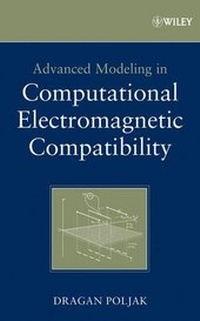
Advanced Modeling in Computational Electromagnetic Compatibility
1st Edition
Published on 5. April 2007
Book
Hardback
496 pages
978-0-470-03665-5 (ISBN)
Description
Learn the latest numerical methods to solve complex electromagnetic compatibility problems
This text combines the fundamentals of electromagnetics with numerical modeling to tackle a broad range of current electromagnetic compatibility (EMC) problems, including problems dealing with lightning, transmission lines, and grounding systems. The author sets forth a solid foundation in the basics before advancing to specialized topics. Not only do readers learn to solve EMC problems, they also learn to develop their own EMC computational models for applications in both research and industry.
Advanced Modeling in Computational Electromagnetic Compatibility is divided into three complementary parts:
*
Part One, Fundamental Concepts in Computational Electromagnetic Compatibility, provides readers with all the fundamentals of electromagnetic theory. Next, the author introduces the basics of numerical modeling, including the design and use of computational models for the analysis of static, quasi-static, and scattering problems.
*
Part Two, Analysis of Thin Wire Antennas and Scatterers, analyzes wire antennas using the frequency domain and the time domain integral equation formulation. The author demonstrates the advantage of the Boundary Element Method for handling EMC problems that involve analysis of wire configurations of arbitrary shapes.
*
Part Three, Computational Models in Electromagnetic Compatibility, sets forth the solutions of specific EMC problems using the wire antenna theory presented in Part Two. The final chapter examines the growing controversy surrounding the potential health risks associated with exposure to low frequency and transient electromagnetic fields.
Throughout the text, numerical examples taken from both academia and industry are provided. References at the end of each chapter guide readers to additional information for each topic. In short, with this text, readers can fully leverage antenna theory and numerical methods for the solution of EMC problems.
More details
Product info
GB
Edition
1., Auflage
Language
English
Place of publication
United States
Publishing group
John Wiley & Sons Inc
Target group
Professional and scholarly
Product notice
sewn/stitched
Paper over boards
Illustrations
Drawings: 289 B&W, 0 Color; Tables: 12 B&W, 0 Color
Dimensions
Height: 240 mm
Width: 161 mm
Thickness: 32 mm
Weight
935 gr
ISBN-13
978-0-470-03665-5 (9780470036655)
Schweitzer Classification
Other editions
Additional editions
E-Book
08/2007
Wiley
€170.99
Available for download
Person
DRAGAN POLJAK, PhD, is Professor in the Department of Electronics at the University of Split, Croatia, and Adjunct Professor at Wessex Institute of Technology, United Kingdom. He has developed more than 60,000 lines of research code for the solution of many electromagnetic compatibility problems, with an emphasis on problems involving modeling of wire structures. Dr. Poljak has also written over 200 journal and conference papers.
Content
PART I: FUNDAMENTAL CONCEPTS IN COMPUTATIONAL ELECTROMAGNETIC COMPATIBILITY.
1. Introduction to Computational Electromagnetics and Electromagnetic Compatibility.
2. Fundamentals of Electromagnetic Theory.
3 Introduction to Numerical Methods in Electromagnetics.
4 Static Field Analysis.
5 Quasistatic Field Analysis.
6 Electromagnetic Scattering Analysis.
PART II: ANALYSIS OF THIN WIRE ANTENNAS AND SCATTERERS.
7 Wire Antennas and Scatterers: General Considerations.
8 Wire Antennas and Scatterers: Frequency Domain Analysis.
9 Wire Antennas and Scatterers: Time Domain Analysis.
PART III: COMPUTATIONAL MODELS IN ELECTROMAGNETIC COMPATIBILITY.
10 Transmission Lines of Finite Length: General Considerations.
11 Electromagnetic Field Coupling to Overhead Lines: Frequency Domain and Time Domain Analysis.
12 The Electromagnetic Field Coupling to Buried Cables: Frequency- and Time-Domain Analysis.
13 Simple Grounding Systems.
14 Human Exposure to Electromagnetic Fields.
Index.