

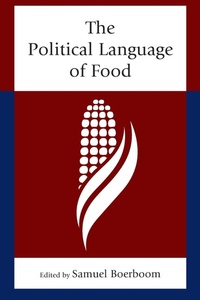
The Political Language of Food
Lexington Books (Publisher)
Published on 14. April 2017
Book
Paperback/Softback
282 pages
978-1-4985-0557-4 (ISBN)
Description
The Political Language of Food addresses why the language used in the production, marketing, selling, and consumption of food is inherently political. Food language is rarely neutral and is often strategically vague, which tends to serve the interests of powerful entities.Boerboom and his contributors critique the language of food-based messages and examine how such language-including idioms, tropes, euphemisms, invented terms, etc.-serves to both mislead and obscure relationships between food and the resulting community, health, labor, and environmental impacts. Employing diverse methodologies, the contributors examine on a micro-level the textual and rhetorical elements of food-based language itself. The Political Language of Food is both timely and important and will appeal to scholars of media studies, political communication, and rhetoric.
Reviews / Votes
This collection of 12 essays focuses on the political contexts of producing, marketing, selling, and consuming food, as well as producing 'food language.' Each author approaches a major food-based issue, such as vegetarianism, obesity, or organic foods, by analyzing and deconstructing the language of food as the basis for his or her research methodology. Essays are organized into four sections: 'The Language of Food-Based Social Movements,' 'Food Language and Social Class,' 'The Language of Food Labeling,' and 'Critiques of Corporate Bureaucratic Language.' All contributors are communications, media, or rhetoric professors; though authors from a narrow range of disciplines may support the editor's thematic emphasis, their homogeneity may prove a weakness when they write about the interdisciplinary field of food studies. . . .Readers will enjoy the provocative essay 'Exoticizing Poverty in Bizarre Foods America.' This anthology can serve classes in sociology, anthropology, geography, marketing, communications, and food studies. For university libraries or large public libraries. Summing Up: Highly recommended. Upper-division undergraduates, graduate students, researchers/faculty, and professionals/practitioners. * Choice Reviews * This book is extremely clear and will prove helpful for people interested in any subject relating to the (political) language involving food. It would work well for a classroom setting because it covers so many different perspectives. It is great for people to know about the discrepancies involving the food industry, with examples and individual stories. I recommend this book to anyone who is looking for new perspectives on this concept. * Communication Research Trends * The Political Language of Food delights readers with a bountiful harvest of perspectives, theories, and problematics. No doubt, it will be mandatory reading for those interested in the intersection of food and language. -- Justin Eckstein, Pacific Lutheran University The Political Language of Food is a comprehensive collection of essays, with a variety of foci and approaches, which all reinforce the central tenet that if we truly want to understand how food functions politically, socially, culturally, and materially, we must begin by examining the murky depths of language, by dissecting the very words that we use to discuss it, and by interrogating the key meanings surrounding it -- Carlnita P. Greene, University of Oregon, author of Gourmands and Gluttons: The Rhetoric of Food Excess Emphasizing the political nature of food marketing and consumption, as well as the rhetorical construction of food language, The Political Language of Food...offers a multitude of methodological approaches to topics such as back-to-the-land food movements, culinary slumming, and the greenwashing of food discourse. -- Laura K. Hahn, Humboldt State UniversityMore details
Language
English
Place of publication
United States
Publishing group
Bloomsbury Publishing Plc
Target group
Professional and scholarly
Dimensions
Height: 229 mm
Width: 152 mm
Thickness: 17 mm
Weight
471 gr
ISBN-13
978-1-4985-0557-4 (9781498505574)
Copyright in bibliographic data and cover images is held by Nielsen Book Services Limited or by the publishers or by their respective licensors: all rights reserved.
Schweitzer Classification
Other editions
Additional editions
Person
Samuel Boerboom is assistant professor of media studies in the Department of Communication and Theatre at Montana State University Billings.
Content
Introduction: How does food language function politically?
Samuel Boerboom
Chapter 1Tracing the "Back to the Land" Trope: Self-Sufficiency, Counterculture, and Community
Jessica M. Prody
Chapter 2 Vegetariens Radicaux: John Oswald and the Trope of Sympathy in Revolutionary Paris
Justin Killian
Chapter 3 The Revolution Will Not Be (Food) Reviewed: Politics of Agitation and Control of Occupy Kitchen
Amy Pason
Chapter 4 Haute Colonialism: Exocitizing Povery in Bizarre Foods America
Casey Ryan Kelly
Chapter 5 Pungent Yet Problematic: The Class-Based Framing of Ramps in the New York Times and the Charleston Gazette
Melissa Boehm
Chapter 6Constructing Taste and Waste as Habitus: Food and Matters of Access and In/Security
Leda Cooks
Chapter 7Tying the Knot: How Industry and Advocacy Organizations Market Language as Humane
Joseph L. Abisaid
Chapter 8Corn Allergy: Public Policy, Private Devastation
Kathy Brady
Chapter 9 Family Farms with Happy Cows: A Narrative Analysis of Horizon Organic Dairy Packaging Labels
Jennifer L. Adams
Chapter 10Chipotle Mexican Grill's Meatwashing Propaganda: Corporate-Speak Hiding Suffering of "Commodity" Animals
Ellen W. Gorsevski
Chapter 11Corporate Colonization in the Market: Discursive Closures and the Greenwashing
of Food Discourse
Megan A. Koch and Cristin A. Compton
Chapter 12Mistaken Consensus and the Body-as-Machine Analogy
Samuel Boerboom
Samuel Boerboom
Chapter 1Tracing the "Back to the Land" Trope: Self-Sufficiency, Counterculture, and Community
Jessica M. Prody
Chapter 2 Vegetariens Radicaux: John Oswald and the Trope of Sympathy in Revolutionary Paris
Justin Killian
Chapter 3 The Revolution Will Not Be (Food) Reviewed: Politics of Agitation and Control of Occupy Kitchen
Amy Pason
Chapter 4 Haute Colonialism: Exocitizing Povery in Bizarre Foods America
Casey Ryan Kelly
Chapter 5 Pungent Yet Problematic: The Class-Based Framing of Ramps in the New York Times and the Charleston Gazette
Melissa Boehm
Chapter 6Constructing Taste and Waste as Habitus: Food and Matters of Access and In/Security
Leda Cooks
Chapter 7Tying the Knot: How Industry and Advocacy Organizations Market Language as Humane
Joseph L. Abisaid
Chapter 8Corn Allergy: Public Policy, Private Devastation
Kathy Brady
Chapter 9 Family Farms with Happy Cows: A Narrative Analysis of Horizon Organic Dairy Packaging Labels
Jennifer L. Adams
Chapter 10Chipotle Mexican Grill's Meatwashing Propaganda: Corporate-Speak Hiding Suffering of "Commodity" Animals
Ellen W. Gorsevski
Chapter 11Corporate Colonization in the Market: Discursive Closures and the Greenwashing
of Food Discourse
Megan A. Koch and Cristin A. Compton
Chapter 12Mistaken Consensus and the Body-as-Machine Analogy
Samuel Boerboom