

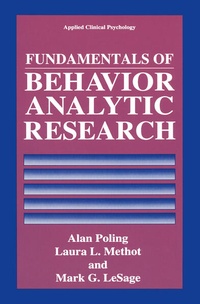
Fundamentals of Behavior Analytic Research
Published on 5. June 2013
Book
Paperback/Softback
XII, 222 pages
978-1-4899-1438-5 (ISBN)
Description
By the end of his long life, B. F. Skinner (1904-1990) had become one of the most influential and best known of psychologists (Gilgen, 1982; Heyduke & Fenigstein, 1984). An important feature of the approach to the study of behavior that he championed, behavior analysis, is the intensive study of individual subjects over time. This approach, which is characterized by the use of within-subject experimental designs, repeated and direct measures of behavior, and graphic analysis of data, stands in marked contrast to the research methods favored by many nonbehavioral psychologists. Skinner discussed the advantages of his approach in a number of books (e.g., Skinner, 1938, 1953, 1979), but never devoted a book to methodology. Sidman (1960) and Johnson and Pennypack (1993b) did devote books to behavior analytic research methodology. These books are of excep tionally high quality and should be read carefully by anyone interested in behavior analysis. They are sophisticated, however, and are not easy reads for most neophyte behaviorists. Introductory-level books devoted entirely to methods of applied behavior analysis (e.g., Kazdin, 1982; Barlow & Hersen, 1984) are easier to understand, but somewhat limited in coverage.
More details
Series
Edition
Softcover reprint of the original 1st ed. 1995
Language
English
Place of publication
New York
United States
Target group
Professional and scholarly
Research
Illustrations
XII, 222 p.
Dimensions
Height: 235 mm
Width: 155 mm
Thickness: 13 mm
Weight
365 gr
ISBN-13
978-1-4899-1438-5 (9781489914385)
DOI
10.1007/978-1-4899-1436-1
Schweitzer Classification
Other editions
Additional editions
Alan Poling | Laura L. Methot | Mark G. LeSage
Fundamentals of Behavior Analytic Research
Book
10/1995
Plenum Publishing Co.,N.Y.
€213.99
Shipment within 10-15 days
Content
1. Science and the Analysis of Behavior.- 2. Designing Experiments.- 3. Conducting and Socially Validating Experiments.- 4. Data Collection.- 5. Within-Subject Experimental Designs.- 6. Between-Subjects Designs and Nonexperimental Methods.- 7. Graphic Analysis of Data.- 8. Statistical Analysis of Data.- 9. Disseminating Research Findings.- References.