

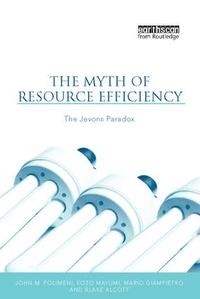
The Myth of Resource Efficiency
The Jevons Paradox
1st Edition
Published on 30. June 2017
Book
Hardback
200 pages
978-1-138-42297-1 (ISBN)
Description
The Jevons Paradox', which was first expressed in 1865 by William Stanley Jevons in relation to use of coal, states that an increase in efficiency in using a resource leads to increased use of that resource rather than to a reduction. This has subsequently been proved to apply not just to fossil fuels, but other resource use scenarios. For example, doubling the efficiency of food production per hectare over the last 50 years (due to the Green Revolution) did not solve the problem of hunger. The increase in efficiency increased production and worsened hunger because of the resulting increase in population. The implications of this in today's world are substantial. Many scientists and policymakers argue that future technological innovations will reduce consumption of resources; the Jevons Paradox explains why this may be a false hope.
This is the first book to provide a historical overview of the Jevons Paradox, provide evidence for its existence and apply it to complex systems. Written and edited by world experts in the fields of economics, ecological economics, technology and the environment, it explains the myth of efficiency and explores its implications for resource usage (particularly oil). It is a must-read for policymakers, natural resource managers, academics and students concerned with the effects of efficiency on resource use.
This is the first book to provide a historical overview of the Jevons Paradox, provide evidence for its existence and apply it to complex systems. Written and edited by world experts in the fields of economics, ecological economics, technology and the environment, it explains the myth of efficiency and explores its implications for resource usage (particularly oil). It is a must-read for policymakers, natural resource managers, academics and students concerned with the effects of efficiency on resource use.
Reviews / Votes
'Given both the importance of the topic and the analytical and policy vacuum that surrounds it, a book devoted to Jevons Paradox is both timely and welcome ... [it] contain(s) a great deal of valuable material.' - Steve Sorrell, Science Policy Research Unit, University of Sussex'This extraordinary and timely book focuses on a basic problem involved in achieving major energy conservation. As the authors explain, the Jevons Paradox emphasizes that simply reducing energy use in one system actually often results in increasing energy use in another system. The issue of sustainability cannot be handled just by looking for silver bullets ...' -David Pimentel, Professor Emeritus, Department of Ecology and Evolutionary Biology, Cornell University
'Efficiency first does not give frugality second; it makes frugality less necessary. But if we seek frugality first we get efficiency second as an adaptation to scarcity. Recognizing the Jevons Paradox, this book cogently argues, is the major key to a rational energy policy. Highly recommended!' -Herman E. Daly, Professor at the School Of Public Affairs, University Of Maryland, and former senior economist in the Environment Department of the World Bank
'This book is the most comprehensive attempt at dismantling the efficiency myth: it examines the subject from a variety of practical and theoretical perspectives, and while it may leave an unsuspecting reader rather depressed it leaves all of us better prepared to face the reality.' -Vaclav Smil, FRSC, Distinguished Professor, University Of Manitoba, Canada
'A thoughtful compilation of the best multidisciplinary approaches to modeling energy and resource use, looking at the extent to which energy efficiency leads to increased consumption and if so, how this price-determined effect can be mitigated.'- Hazel Henderson, Ethical Markets
'A remarkable and unsettling critique of energy policy.' - Crosslands Bulletin
'In this thought provoking book , the authors follow the Jevrons Paradox from its originator through time to our current debate on resource use and sustainability.'-Clean Technologies and Environmental Policy
More details
Series
Language
English
Place of publication
London
United Kingdom
Publishing group
Taylor & Francis Ltd
Target group
College/higher education
Dimensions
Height: 234 mm
Width: 156 mm
Weight
430 gr
ISBN-13
978-1-138-42297-1 (9781138422971)
Copyright in bibliographic data and cover images is held by Nielsen Book Services Limited or by the publishers or by their respective licensors: all rights reserved.
Schweitzer Classification
Other editions
Additional editions
E-Book
12/2015
Routledge
€67.49
Available for download
E-Book
12/2015
Routledge
€67.49
Available for download
Book
06/2009
1st Edition
Earthscan Ltd
€73.10
Shipment within 3-4 weeks
Person
John M. Polimeni is assistant professor of economics at Albany College of Pharmacy, US. Kozo Mayumi is professor at Faculty of Integrated Arts and Sciences, the University of Tokushima, Japan. Mario Giampietro is an ICREA research professor in the Institute of Environmental Science and Technology at the Universitat Aut noma de Barcelona in Spain. Blake Alcott received his MPhil in the Department of Land Economy, Cambridge University, in 2006 and is now working as an unaffiliated scholar in Z rich.
Content
Foreword by Joseph A. Tainter * Introduction * Historical Overview of the Jevons Paradox in the Literature * The Jevons Paradox: The Evolution of Complex Adaptive Systems and the Challenge for Scientific Analysis * Empirical Evidence for the Jevons Paradox * Conclusion * Index