

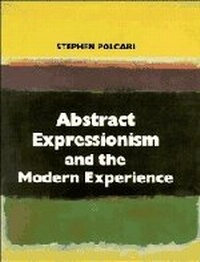
Abstract Expressionism and the Modern Experience
Published on 26. March 1993
Book
Paperback/Softback
432 pages
978-0-521-44826-0 (ISBN)
Description
A major revisionist study of the art and artists who participated in what is now regarded as the first American style of international consequence. Based on examinations of new archival material and many unknown paintings, this study relates Abstract Expressionism to the actual historical circumstances, as well as intellectual and cultural milieu, of America from the 1930s to the 1950s. Stephen Polcari reverses the traditional perspective of Abstract Expressionism as an abstract art inspired by issues of the postwar period. Examining its roots in the art of the 1930s and 1940s, he contends that Abstract Expressionism emerges as a public art that actively engaged in the social, economic, and political crises of the 1930s, and, more significantly, the experience of World War II. Polcari provides an account of the contemporary artistic, intellectual and cultural history to establish a macro-history of human beings under the pressures of war, fear, torment, and hope. Within this context, he convincingly presents Abstract Expressionism as a mode of modern, metaphysical 'history' painting that uses the forms and devices of modern art to come to terms with the brutality of contemporary history.
More details
Language
English
Place of publication
Cambridge
United Kingdom
Target group
College/higher education
Professional and scholarly
Product notice
Paperback (trade)
Illustrations
32 Plates, color; 290 Halftones, unspecified
Dimensions
Height: 279 mm
Width: 216 mm
Thickness: 24 mm
Weight
1400 gr
ISBN-13
978-0-521-44826-0 (9780521448260)
Copyright in bibliographic data and cover images is held by Nielsen Book Services Limited or by the publishers or by their respective licensors: all rights reserved.
Schweitzer Classification
Content
List of illustrations; Acknowledgments; Introduction; Part I. The History and Culture of Abstract Expressionism: 1. The psychology of crisis: historical roots; 2. Propaedeutics: intellectual roots; Part II. The Artists: 3. Clyfford Still: of plenitude and power; 4. Mark Rothko: 'In My Beginning is My End'; 5. Adolph Gottlieb: the allegorical epic; 6. Barnett Newman: new beginnings; 7. William Baziotes: tremors of history; 8. Jackson Pollock: ancient energies; 9. Willem de Kooning: a fever of matter; 10. Robert Motherwell: the school of Paris meets New York; 11. The expansiveness of abstract expressionism Conclusion; 12. Vernacular abstraction: the domestication of abstract expressionism in the 1950s; Epilogue.