

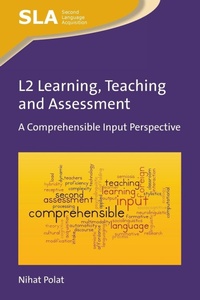
L2 Learning, Teaching and Assessment
A Comprehensible Input Perspective
Published on 15. September 2016
Book
Paperback/Softback
256 pages
978-1-78309-633-6 (ISBN)
Description
This book explores second language (L2) learning, teaching and assessment from a comprehensible input (CI) perspective. This focus on the role of input is important for deepening our understanding of interactions between the learner, teacher and the environment as well as of the nature of the learning, teaching and assessment processes. The book takes a blended approach that promotes the intertwining of theory, research and practice in L2 pedagogy and assessment and aims to address the commonly used concept of CI and its role in L2 education. Content includes a comprehensive discussion of the conceptual foundation of CI; a multimodal and dynamic interpretation of CI from numerous perspectives; a critical discussion of well-known L2 acquisition theories and research; a practical examination of the role of multimodal forms of CI in L2 pedagogy; an analytical review of factors to be considered when modifying CI for pedagogical purposes in different settings and an overview of CI in L2 assessment. It will be of interest to students in the fields of L2 learning, teaching and assessment, teachers in second/foreign language settings and researchers of SLA and teacher education.
Reviews / Votes
'Input' or more appropriately 'comprehensible input' is now recognized as an indispensable component of state-of-the-art second language instruction. Language teachers are regularly reminded that processing oral and written input is fundamental to building the learner's underlying language capacity. Professor Nihat Polat has produced a remarkable volume explaining and contextualizing the theoretical and practical aspects of using input effectively and meaningfully in the language classroom. -- Elaine K. Horwitz, The University of Texas at Austin, USA Nihat Polat has created a significant update to the concept of comprehensible input. The text provides a systematic, well-organized, wide-ranging, and nuanced overview of the topic. The breadth of information and incorporation of multiple perspectives will guide readers toward a deeper understanding of complex, intertwined teaching and learning processes. -- Peter D. MacIntyre, Cape Breton University, CanadaMore details
Series
Language
English
Place of publication
Bristol
United Kingdom
Publishing group
Channel View Publications Ltd
Target group
Professional and scholarly
Dimensions
Height: 234 mm
Width: 156 mm
Thickness: 14 mm
Weight
398 gr
ISBN-13
978-1-78309-633-6 (9781783096336)
Copyright in bibliographic data and cover images is held by Nielsen Book Services Limited or by the publishers or by their respective licensors: all rights reserved.
Schweitzer Classification
Other editions
Additional editions
E-Book
09/2016
Multilingual Matters
€24.49
Available for download
Complete work / Part of the work

David Singleton | Simone E. Pfenninger
Second Language Acquisition (Vols 101-110)
Book
Multilingual Matters
€1,032.48
The article will not be published
Person
Nihat Polat is an Associate Professor and Associate Dean for Graduate Studies and Research in the School of Education, Duquesne University, USA. He teaches courses on L2 learning and teaching, and curriculum and assessment. He researches in the areas of L2 learning and teaching and L2 teacher education. He has published in numerous peer-reviewed journals and is the Chair of TESOL Applied Linguistics Interest Section (2015-2016).
Content
Introduction
Acknowledgements
PART I: Encountering Comprehensible Input: Conceptual Foundation
Chapter 1. Comprehensible Input Defined
Chapter 2. Theoretical Foundation of Input and Comprehensibility
Chapter 3. Linguistic Perspectives on Input
PART II: Comprehensible Input: Second Language Acquisition
Chapter 4. Input in Cognitive Processing-Oriented Theories
Chapter 5. Input in Learner and Interaction-Oriented Theories
Chapter 6. Input in Socially-Oriented Theories
Chapter 7. Input in Alternative SLA Theories
PART III: Comprehensibility-Related Factors in L2 Teaching and Assessment
Chapter 8. Input Related Factors
Chapter 9. Learner Related Factors
Chapter 10. Culture and Context Related Factors
Chapter 11. Interaction and Discourse Related Factors
Chapter 12. Modifications in Assessment-Related Factors
Chapter 13. Conclusions
Acknowledgements
PART I: Encountering Comprehensible Input: Conceptual Foundation
Chapter 1. Comprehensible Input Defined
Chapter 2. Theoretical Foundation of Input and Comprehensibility
Chapter 3. Linguistic Perspectives on Input
PART II: Comprehensible Input: Second Language Acquisition
Chapter 4. Input in Cognitive Processing-Oriented Theories
Chapter 5. Input in Learner and Interaction-Oriented Theories
Chapter 6. Input in Socially-Oriented Theories
Chapter 7. Input in Alternative SLA Theories
PART III: Comprehensibility-Related Factors in L2 Teaching and Assessment
Chapter 8. Input Related Factors
Chapter 9. Learner Related Factors
Chapter 10. Culture and Context Related Factors
Chapter 11. Interaction and Discourse Related Factors
Chapter 12. Modifications in Assessment-Related Factors
Chapter 13. Conclusions