

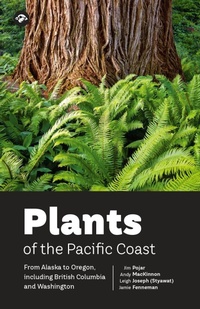
Plants of the Pacific Coast
Description
This long-awaited successor to the bestselling Plants of Coastal British Columbia and the Pacific Northwest features over 700 trees, shrubs, wildflowers, ferns, horsetails and lycopods of the north Pacific coast of North America.
The region, stretching from southeast Alaska to northwest Oregon, is characterized by humid forests, imposing mountains, muscular rivers, serene and stormy seas, and myriad islands, beaches, wetlands, and meadows.
Authors Jim Pojar and Andy MacKinnon, field botanists and forest ecologists who each have 50 years of experience in the region, are joined for this brand-new, fully updated field guide by two colleagues: ethnobotanist Leigh Joseph (Styawat), of the Skwxwú7mesh (Squamish) Nation, and plant taxonomist Jamie Fenneman.
This user-friendly book focuses on the vascular plants-their identification, description, ecology, and traditional uses-of the coastal ecosystems of northwest North America. It describes the plants of the region's temperate rainforests, dry-belt lowland forests, cool subalpine forests, and non-forested habitats from tidewater to alpine, including some common introduced species. The species descriptions are packed with colour photos, range maps, and illustrations.
Plants of the Pacific Coast is organized by life form so that species that resemble one another appear in the same group. Within the major sections-Trees, Shrubs, Wildflowers, Aquatics, Graminoids (grasses and grass-like plants), Ferns and Relatives-plants are organized by family. The field guide's opening section includes an introduction to the region's physical environment; a description of its plant cover; an overview of regional biodiversity, ecological resilience, and climate change; and an exploration of regional ethnobotany, with insights into Indigenous plant knowledge, uses, and ecosystem management.
This comprehensive guide includes up-to-date taxonomy, keys, hundreds of colour photos, ethnobotanical essays, and engaging notes. It will appeal to anyone interested in the region's rich and diverse plant life.
More details
Persons
Jim Pojar is a botanist, senior ecologist, and forester who has worked for the BC Ecological Reserves Program, the BC Forest Service, and the Canadian Parks and Wilderness Society-Yukon. He is the author or co-author of eight books, including Alpine Plants of British Columbia, Alberta and Northwest North America.
Content
List of Keys
List of Abbreviations and Symbols
INTRODUCTION
About This Guide
How to Use This Guide
The Region
Physical Environment
Forest Vegetation
Non-Forest Vegetation
Biodiversity, Ecological Resilience and Climate Change
Plants and People
Ethnobotany
Indigenous Plant-Based Teachings
Indigenous Ecosystem Management
TREES
Big Trees, Old Trees
Cedars: Trees of Life
Evergreen Habit
SHRUBS AND SMALL TREES
False Berries: Is a Berry, or Not
Heather Family
Willow Family
WILDFLOWERS
Arum Family
Lily Family and Related Families
Restoration of lhásem
Pit cooking Spánanexw
Iris Family
Orchid Family
Sandalwood Family
Buckwheat Family
Amaranth Family
Miner's-Lettuce Family
Stonecrop and Cactus Families
Pink and Sundew Families
Saxifrage and Bittersweet Families
St. John's Wort and Other Small Families
Rose Family
Buttercup Family
Mustard Family
Evening-Primrose Family
Pea Family
Violet Family
Dogwood, Ginseng and Dogbane Families
Carrot Family
Primrose and Nightshade Families
Morning-Glory Family
Phlox Family
Buckbean Family
Gentian Family
Heather Family
Mycoheterotrophs
Waterleaf and Meadowfoam Families
Borage Family
Mint Family
Nettle Family
Leadwort Family
Plantain and False-Pimpernel Families
Collateral Invasive Damage
Monkey-Flower Family
Figwort Family
Bladderwort Family
Broomrape Family
Pollination in Castilleja and Pedicularis
Harebell Family
Madder Family
Valerian Family
Aster Family
Apomixis and Taxonomy
Glacial Refugia and Endemism
What Happened to Aster?
AQUATICS
GRAMINOIDS (GRASSLIKE FAMILIES)
Rush Family
Sedge Family
Grass Family
All Flesh Is Grass?
FERNS AND RELATIVES
Ferns
Horsetail Family
Clubmosses and Spikemosses
Acknowledgements
Glossary
Photo Credits
Illustration Credits
References
Literature Cited
Additional Reading
Index
Authors