

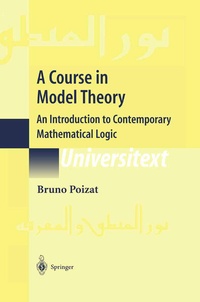
A Course in Model Theory
An Introduction to Contemporary Mathematical Logic
Published on 25. May 2000
Book
Hardback
XXXI, 443 pages
978-0-387-98655-5 (ISBN)
Description
Can we reproduce the inimitable, or give a new life to what has been af fected by the weariness of existence? Folks, what you have in your hands is a translation into English of a book that was first published in 1985 by its author, that is, myself, at the end of an editorial adventure about which you will find some details later. It was written in a dialect of Latin that is spoken as a native language in some parts of Europe, Canada, the U. S. A. , the West Indies, and is used as a language of communication between several countries in Africa. It is also sometimes used as a lan guage of communication between the members of a much more restricted community: mathematicians. This translation is indeed quite a faithful rendering of the original: Only a final section, on the reals, has been added to Chapter 6, plus a few notes now and then. On the title page you see an inscription in Arabic letters, with a transcription in the Latin (some poorly informed people say English!) alphabet below; I designed the calligraphy myself.
Reviews / Votes
"It is with great satisfaction that I welcome the English translation of Poizat's Cours de théorie des modèles . ." (Frank Wagner, zbMATH 0951.03002, 2022)More details
Series
Edition
2000 ed.
Language
English
Place of publication
New York
United States
Target group
Primary & secondary/elementary & high school
Graduate
Illustrations
XXXI, 443 p.
Dimensions
Height: 241 mm
Width: 160 mm
Thickness: 31 mm
Weight
887 gr
ISBN-13
978-0-387-98655-5 (9780387986555)
DOI
10.1007/978-1-4419-8622-1
Schweitzer Classification
Other editions
Additional editions
Book
10/2012
Springer
€69.54
Shipment within 15-20 days
Persons
Content
1 Elementary Classes of Relations.- The Language Associated with a Relation.- 3 Extensions of the Language: Structures.- 4 Compactness.- 5 The Back-and-Forth Method in ?-Saturated Models.- 6 Examples Illustrating the Back-and-Forth Method.- 7 Arithmetic.- 8 Ordinals and Cardinals.- 9 Saturated Models.- 10 Prime Models.- 11 Heirs.- 12 Special Sons, Morley Sequences.- 13 The Fundamental Order.- 14 Stability and Saturated Models.- 15 Forking.- 16 Strong Types.- 17 Notions of Rank.- 18 Stability and Prime Models.- 19 Stability, Indiscernible Sequences and Weights.- 20 Dimension in Models of a Totally Transcendental Theory.- Index of Notation.