

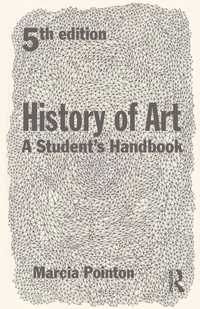
History of Art
A Student's Handbook
5th Edition
Published on 10. March 2014
Book
Paperback/Softback
164 pages
978-0-415-63924-8 (ISBN)
Description
This fully revised edition of the History of Art: A Student's Handbook introduces students to the kinds of practices, challenges, questions and writings they will encounter in studying the history of art.
Marcia Pointon conveys the excitement of Art History as a multi-faceted discipline addressing all aspects of the study of media, communication and representation. She describes and analyses different methods and approaches to the discipline, explaining their history and their effects on the day-to-day learning process. She also discusses the relationship of Art History to related disciplines including film, literature, design history and anthropology.
The fifth edition of this classic text includes:
* information on why Art History is important and relevant in today's world
guidance on choosing a degree course
case studies of careers pursued by Art History graduates
advice on study skills and reading methods
a bibliography and further reading
detailed up to date advice on electronic resources and links to essential websites
History of Art covers academic, training and vocational aspects of Art History, providing a wealth of information on the characteristics of courses available and on the relationship between Art History and the world of museums and heritage.
Marcia Pointon conveys the excitement of Art History as a multi-faceted discipline addressing all aspects of the study of media, communication and representation. She describes and analyses different methods and approaches to the discipline, explaining their history and their effects on the day-to-day learning process. She also discusses the relationship of Art History to related disciplines including film, literature, design history and anthropology.
The fifth edition of this classic text includes:
* information on why Art History is important and relevant in today's world
guidance on choosing a degree course
case studies of careers pursued by Art History graduates
advice on study skills and reading methods
a bibliography and further reading
detailed up to date advice on electronic resources and links to essential websites
History of Art covers academic, training and vocational aspects of Art History, providing a wealth of information on the characteristics of courses available and on the relationship between Art History and the world of museums and heritage.
More details
Edition
5th edition
Language
English
Place of publication
London
United Kingdom
Publishing group
Taylor & Francis Ltd
Target group
College/higher education
AS/A2, General, and Undergraduate
Illustrations
27 s/w Abbildungen
27 Illustrations, black and white
Dimensions
Height: 216 mm
Width: 140 mm
Thickness: 10 mm
Weight
237 gr
ISBN-13
978-0-415-63924-8 (9780415639248)
Copyright in bibliographic data and cover images is held by Nielsen Book Services Limited or by the publishers or by their respective licensors: all rights reserved.
Schweitzer Classification
Other editions
Additional editions
E-Book
03/2014
5th Edition
Routledge
€52.99
Available for download
E-Book
03/2014
5th Edition
Routledge
€52.99
Available for download
Book
03/2014
5th Edition
Routledge
€204.90
Shipment within 15-20 days
Previous edition
Book
07/1997
4th Edition
Routledge
€43.55
Article exhausted; check for reprint
Person
Marcia Pointon is Senior Research Professor at Norwich University of the Arts, Professor Emeritus in History of Art at the University of Manchester and Research Fellow at the Courtauld Institute of Art. Her latest books include Brilliant Effects: A Cultural History of Gem Stones and Jewellery (Yale University Press, 2009), which was awarded the Historians of British Art Book Prize in 2011, and Portrayal: and the Search for Identity (Reaktion Books, 2012).
Content
1. Engaging with Art 2. How art historians work: training and practice 3. Art History as a Discipline 4. The language of Art History 5. Reading Art History 6. And what are you going to do now?