

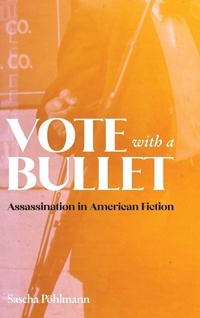
Vote with a Bullet
Assassination in American Fiction
Published on 19. August 2021
Book
Hardback
206 pages
978-1-64014-113-1 (ISBN)
Description
Conceptualizes the genre of American assassination fiction as a dramatization of the tension between individualism and mass society in US culture.
Vote with a Bullet is the first systematic study of assassination in American fiction. It proffers not only a fundamental overview of the genre but also an argument about its larger cultural, aesthetic, and political significance in the present moment as well as in the respective historical contexts of the works themselves.
The study argues that American assassination fiction is a symbolic condensation of the larger conflict between individual and society that is at the heart of modern democracy, and that has been especially contested in the democratic culture of the US. Starting with Henry James's The Princess Casamassima (1886) and ending with Noah Hawley's The Good Father (2012), the chapters analyze twelve works ranging from canonical classics to popular genre fiction. A conclusion considers Thomas Pynchon's Against the Day (2006). The book describes the loose continuum of assassination fiction as an imaginary laboratory in which fantasies of individual empowerment and social unity play out in different ways, negotiating the tension between individualism and mass society in a democracy that is based on the former but must restrict it to preserve the latter. Furthermore, the study connects the imaginary of assassination with a variety of related themes such as hegemonic masculinity and whiteness, electoral and non-electoral political choice, agency panic, subjectivity, as well as conspiracies and conspiracy theory.
Vote with a Bullet is the first systematic study of assassination in American fiction. It proffers not only a fundamental overview of the genre but also an argument about its larger cultural, aesthetic, and political significance in the present moment as well as in the respective historical contexts of the works themselves.
The study argues that American assassination fiction is a symbolic condensation of the larger conflict between individual and society that is at the heart of modern democracy, and that has been especially contested in the democratic culture of the US. Starting with Henry James's The Princess Casamassima (1886) and ending with Noah Hawley's The Good Father (2012), the chapters analyze twelve works ranging from canonical classics to popular genre fiction. A conclusion considers Thomas Pynchon's Against the Day (2006). The book describes the loose continuum of assassination fiction as an imaginary laboratory in which fantasies of individual empowerment and social unity play out in different ways, negotiating the tension between individualism and mass society in a democracy that is based on the former but must restrict it to preserve the latter. Furthermore, the study connects the imaginary of assassination with a variety of related themes such as hegemonic masculinity and whiteness, electoral and non-electoral political choice, agency panic, subjectivity, as well as conspiracies and conspiracy theory.
More details
Series
Language
English
Place of publication
Columbia, MD
United States
Publishing group
Boydell & Brewer Ltd
Target group
Professional and scholarly
Product notice
Cloth over boards
Dimensions
Height: 235 mm
Width: 157 mm
Thickness: 16 mm
Weight
459 gr
ISBN-13
978-1-64014-113-1 (9781640141131)
Copyright in bibliographic data and cover images is held by Nielsen Book Services Limited or by the publishers or by their respective licensors: all rights reserved.
Schweitzer Classification
Other editions
Additional editions
E-Book
08/2021
1st Edition
Boydell & Brewer
€48.99
Available for download
E-Book
08/2021
1st Edition
De Gruyter
€48.99
Available for download
Person
SASCHA POEHLMANN is Professor of North American Literature and Culture at TU Dortmund University, Germany.
Content
Introduction: The Individual and Society
1. Henry James, The Princess Casamassima (1886)
2. Jack London, The Assassination Bureau, Ltd. (1910/63)
3. Robert Penn Warren, All the King's Men (1946)
4. Philip K. Dick, Solar Lottery (1955)
5. Richard Condon, The Manchurian Candidate (1959)
6. Loren Singer, The Parallax View (1970)
7. Don DeLillo, Libra (1988)
8. Stephen King, The Dead Zone (1979)
9. Stephen King, 11/22/63 (2011)
10. Mark Costello, Big If (2002)
11. Nicholson Baker, Checkpoint (2004)
12. Noah Hawley, The Good Father (2012)
Conclusion
Works Cited
Index
1. Henry James, The Princess Casamassima (1886)
2. Jack London, The Assassination Bureau, Ltd. (1910/63)
3. Robert Penn Warren, All the King's Men (1946)
4. Philip K. Dick, Solar Lottery (1955)
5. Richard Condon, The Manchurian Candidate (1959)
6. Loren Singer, The Parallax View (1970)
7. Don DeLillo, Libra (1988)
8. Stephen King, The Dead Zone (1979)
9. Stephen King, 11/22/63 (2011)
10. Mark Costello, Big If (2002)
11. Nicholson Baker, Checkpoint (2004)
12. Noah Hawley, The Good Father (2012)
Conclusion
Works Cited
Index