

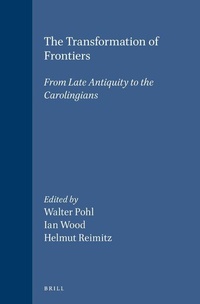
The Transformation of Frontiers
From Late Antiquity to the Carolingians
Published on 28. November 2000
Book
Hardback
VII, 301 pages
978-90-04-11115-8 (ISBN)
Description
The definition and notion of frontiers changed in the process of the transformation of the Roman world. This volume goes beyond topography to explore the meaning and impact of new frontiers as they were establised. It becomes clear that the transformation of frontiers was not a linear process in which the imperial frontiers were abandoned and the means of controlling them declined, but depended on specific circumstances.
Four of the contributions deal with the frontiers of the Carolingian Empire in their political and military aspects, as well as in the context of Christian conversion and missions. Three of the contributions discuss Roman frontiers and their perception in late antiquity, demonstrating that they were not simply defence lines, but also a basis for offensive operations, a focus in elaborate exchange networks and a means of internal control. Other papers describe the frontiers of early medieval kingdoms, two of which propose theoretical models, whereas others analyse the construction and the blurring of frontiers between the empire and the kingdoms of the Visigoths, Lombards and Avars.
Four of the contributions deal with the frontiers of the Carolingian Empire in their political and military aspects, as well as in the context of Christian conversion and missions. Three of the contributions discuss Roman frontiers and their perception in late antiquity, demonstrating that they were not simply defence lines, but also a basis for offensive operations, a focus in elaborate exchange networks and a means of internal control. Other papers describe the frontiers of early medieval kingdoms, two of which propose theoretical models, whereas others analyse the construction and the blurring of frontiers between the empire and the kingdoms of the Visigoths, Lombards and Avars.
More details
Series
Language
English
Place of publication
Leiden
Netherlands
Target group
College/higher education
Professional and scholarly
Product notice
Cloth
With dust jacket
Illustrations
18 Graf.
Dimensions
Height: 247 mm
Width: 162 mm
Thickness: 23 mm
Weight
640 gr
ISBN-13
978-90-04-11115-8 (9789004111158)
Schweitzer Classification
Persons
Walter Pohl, Ph.D. (1984), University of Vienna, is Director of the Medieval History Research Unit of the Austrian Academy of Sciences and teaches medieval history at the University of Vienna. He has published extensively on early medieval peoples, e.g. on Die Awaren (1988) and Die Germanen (2000).
Ian Wood is Professor of Early Medieval History at the University of Leeds and Coordinator of the ESF scientific programme on the Transformation of the Roman World. He has written numerous articles and has edited a number of collections of essays. His recent books include The Merovingian Kingdom 450-751 (Longman, 1994) and Gregory of Tours (Headstart History, 1994).
Helmut Reimitz, Ph.D. (1999) in Medieval History, University of Vienna, is Researcher at the Medieval History Research Unit of the Austrian Academy of Sciences and works on Frankish history and historiography.
Ian Wood is Professor of Early Medieval History at the University of Leeds and Coordinator of the ESF scientific programme on the Transformation of the Roman World. He has written numerous articles and has edited a number of collections of essays. His recent books include The Merovingian Kingdom 450-751 (Longman, 1994) and Gregory of Tours (Headstart History, 1994).
Helmut Reimitz, Ph.D. (1999) in Medieval History, University of Vienna, is Researcher at the Medieval History Research Unit of the Austrian Academy of Sciences and works on Frankish history and historiography.