

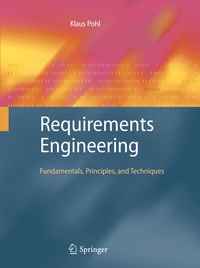
Requirements Engineering
Fundamentals, Principles, and Techniques
Published on 23. August 2016
Book
Paperback/Softback
XVII, 813 pages
978-3-662-51888-5 (ISBN)
Description
Requirements engineering is the process of eliciting individual stakeholder requirements and needs and developing them into detailed, agreed requirements documented and specified in such a way that they can serve as the basis for all other system development activities. In this textbook, Klaus Pohl provides a comprehensive and well-structured introduction to the fundamentals, principles, and techniques of requirements engineering. He presents approved techniques for eliciting, negotiating and documenting as well as validating, and managing requirements for software-intensive systems. The various aspects of the process and the techniques are illustrated using numerous examples based on his extensive teaching experience and his work in industrial collaborations. His presentation aims at professionals, students, and lecturers in systems and software engineering or business applications development. Professionals such as project managers, software architects, systems analysts, and softwareengineers will benefit in their daily work from the didactically well-presented combination of validated procedures and industrial experience. Students and lecturers will appreciate the comprehensive description of sound fundamentals, principles, and techniques, which is completed by a huge commented list of references for further reading. Lecturers will find additional teaching material on the book's website, www.requirements-book.com.
More details
Edition
Softcover Reprint of the Original 1st 2010 ed.
Language
English
Place of publication
Berlin
Germany
Publishing group
Springer Berlin
Target group
Professional and scholarly
Illustrations
XVII, 813 p.
Dimensions
Height: 260 mm
Width: 193 mm
Thickness: 45 mm
Weight
1701 gr
ISBN-13
978-3-662-51888-5 (9783662518885)
DOI
10.1007/978-3-642-12578-2
Schweitzer Classification
Other editions
Additional editions
Book
07/2010
1st Edition
Springer
€139.09
Article exhausted; check for reprint
Person
Klaus Pohl is Professor for Software Systems Engineering at the University of Duisburg-Essen, Germany, director of paluno - The Ruhr Institute for Software Technology - and served as scientific founding director of Lero, the Irish Software Engineering Research Centre. Klaus is founding member of IREB (Intl. Requirements Engineering Board), and key contributor to the CPRE certification for requirements engineering professionals. Among others, he was PC (Co-)Chair of ICSE (ACM/IEEE Intl. Conference on Software Engineering), RE (ACM/IEEE Intl. Conf. on Requirements Engineering), REFSQ (Requirements Engineering: Foundation for Software Quality), and CAiSE (Intl. Conference on Advanced Information Systems Engineering). Klaus is (co-)author of more than 300 peer-reviewed publications and several text books. As a consultant, advisor, and expert he supports national and international companies, research associations and research programs.
Content
Fundamentals and Framework..- Motivation.- Requirements.- Continuous Requirements Engineering.- The Requirements Engineering Framework.- System Context,Recommended Literature for Part II..- System and Context Boundaries.- Structuring the System Context.- Requirements Artefacts.- Goals.- Scenarios.- Solution-Oriented Requirements.- Core Activities.- Documentation.- Elicitation.- Negotiation.- Validation,Recommended Literature for Part V.- Fundamentals of Requirements Validation.- Validation Techniques.- Assistance Techniques for Validation.- Management,Recommended Literature for Part VI..- Fundamentals of Requirements Management.- Requirements Traceability.- Prioritising Requirements.- Change Management for Requirements.- COSMOD-RE: the Goal- and Scenario-Based RE Method.- Fundamentals.- The COSMOD-RE Method.- Applying COSMOD-RE: an Example.- Software Product Lines and Requirements-Based Testing.- Requirements Engineering for Software Product Lines.- Requirements-Based Testing: the ScenTED Approach.