

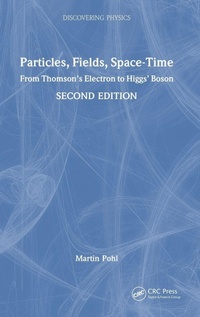
Particles, Fields, Space-Time
From Thomson's Electron to Higgs' Boson
2nd Edition
Published on 26. June 2025
Book
Hardback
306 pages
978-1-032-85958-3 (ISBN)
Description
Particles, Fields, Space-Time: From Thomson's Electron to Higgs' Boson explores the concepts, ideas, and experimental results that brought us from the discovery of the first elementary particle in the end of the 19th century to the completion of the Standard Model of particle physics in the early 21st century. The book concentrates on disruptive events and unexpected results that fundamentally changed our view of particles and how they move through space-time. It separates the mathematical and technical details from the narrative into focus boxes, so that it remains accessible to non-scientists, yet interesting for those with a scientific background who wish to further their understanding. The text presents and explains experiments and their results wherever appropriate. This book is of interest to a general audience but also to students studying particle physics, physics teachers at all levels, and scientists with a recreational curiosity towards the subject.
For this second edition, the complete text has been thoroughly revised. A description of plans for new accelerator facilities has been added, as well as new results on cosmic ray physics, dark matter and dark energy. The usage of natural units has been abandoned in favour of SI units throughout the text.
Key Features:
Short, comprehensive overview concentrating on major breakthroughs, disruptive ideas, and unexpected results
Accessible to all interested in subatomic physics with little prior knowledge required
Contains the latest developments in this exciting field
For this second edition, the complete text has been thoroughly revised. A description of plans for new accelerator facilities has been added, as well as new results on cosmic ray physics, dark matter and dark energy. The usage of natural units has been abandoned in favour of SI units throughout the text.
Key Features:
Short, comprehensive overview concentrating on major breakthroughs, disruptive ideas, and unexpected results
Accessible to all interested in subatomic physics with little prior knowledge required
Contains the latest developments in this exciting field
More details
Series
Edition
2nd edition
Language
English
Place of publication
London
United Kingdom
Publishing group
Taylor & Francis Ltd
Target group
College/higher education
General, Postgraduate, Undergraduate Advanced, and Undergraduate Core
Illustrations
120 s/w Abbildungen, 24 s/w Photographien bzw. Rasterbilder, 96 s/w Zeichnungen
96 Line drawings, black and white; 24 Halftones, black and white; 120 Illustrations, black and white
Dimensions
Height: 240 mm
Width: 161 mm
Thickness: 22 mm
Weight
643 gr
ISBN-13
978-1-032-85958-3 (9781032859583)
Copyright in bibliographic data and cover images is held by Nielsen Book Services Limited or by the publishers or by their respective licensors: all rights reserved.
Schweitzer Classification
Other editions
Additional editions
Book
06/2025
2nd Edition
CRC Press
€77.40
Shipment within 10-20 days
E-Book
06/2025
2nd Edition
CRC Press
€69.99
Available for download
E-Book
06/2025
2nd Edition
CRC Press
€69.99
Available for download
Previous edition
Book
09/2020
1st Edition
CRC Press
€222.84
Article exhausted; check for reprint
Person
Martin Pohl is a professor emeritus at University of Geneva. He started working on particle physics with the Gargamelle neutrino experiment at CERN in the 1970s. Later, he experimented at the colliders PETRA (DESY, Hamburg Germany), LEP and LHC (CERN, Geneva Switzerland), before turning to astroparticle physics in space. He has been the director of the department for nuclear and particle physics (DPNC) at University of Geneva and head of the physics department. Until his retirement in 2017, he led the Geneva team working on the cosmic ray observatory AMS installed on the International Space Station since 2011. He is the author of a textbook on particle physics, as well as the main author of two introductory online courses on the same subject.
Content
Chapter 1: Introduction. Chapter 2: The First Particles. Chapter 3: Relativity. Chapter 4: Atoms and Nuclei. Chapter 5: Quanta. Chapter 6: War Time Physics. Chapter 7: Quantum Fields. Chapter 8: Enabling Technologies. Chapter 9: The Standard Model of Matter and Forces. Chapter 10: Pushing the Boundaries. Bibliography. Index.