

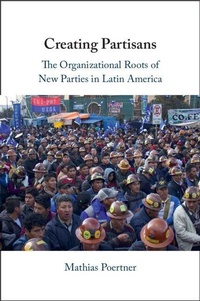
Creating Partisans
The Organizational Roots of New Parties in Latin America
Published on 28. November 2024
Book
Paperback/Softback
272 pages
978-1-009-44628-0 (ISBN)
Description
Why are some new political parties successful at creating mass partisanship and engendering stable electoral support, while most fail to take root in society and disappear quickly? Creating Partisans unveils the secrets behind successful political parties, taking a deep dive into the formation and success of new political parties in Latin America. Based on extensive fieldwork and using a multi-method approach, the book explores how different mobilization strategies sway voters to support new parties. While prior studies have focused on the various types of direct appeals parties make to voters, Creating Partisans reveals that it is organizationally mediated appeals - those that engage voters through locally-based civil society organizations - that can secure electoral support more effectively and can create lasting partisan attachments. From indigenous organizations to informal sector unions, new types of societal organizations play a critical mediating role in shaping electoral outcomes and fostering long-term partisan loyalties in young democracies.
Reviews / Votes
'How do some new parties gain support and endure? This innovative and rigorous analysis argues that, surprisingly, civil society organizations reassure and guide voters, communicating party messages, persuading potential voters, and building lasting partisan attachments. An indispensable book for scholars of party politics and representation.' Anna Grzymala-Busse, Michelle and Kevin Douglas Professor of International Studies, Stanford University 'Run-of-the-mill research on political parties pays too little attention to the hard work of setting up and sustaining electorally successful political parties by creating strong bonds between voters and politicians. This book makes a major contribution to fill that void and explain how new parties can become electorally successful if they build organizational capacities that tie them to the communities from which they draw their voters. It develops an innovative theoretical argument focusing on the infrastructure of local civic associations as critical catalysts to familiarize voters with and connect them to new political parties. Such associational ties build durable party identification in the electorate, thereby improving the upstarts' prospects of lasting electoral viability. The book employs state-of-the-art empirical research designs and data generation techniques to identify the role of civic associations and their ties to emerging parties as causally consequential for the electoral careers of the new party competitors.' Herbert Kitschelt, George V. Allen Distinguished Professor of International Relations, Duke University 'As political parties weaken across the world, identifying viable paths to party-building has become an essential task. Creating Partisans does precisely that. Challenging the widely held view that strong partisan attachments are a thing of the past, the book makes a compelling case that robust mass parties can still emerge - if they are linked to societal organizations. Drawing on impressive research in Bolivia, Ecuador, and Mexico, Poertner shows how indigenous, neighborhood-based, informal workers and other civil society organizations help new parties cultivate durable voter attachments, much as trade unions did in the past. And through careful historical institutionalist analysis, he identifies the conditions under which strong party-organizational ties emerge. Creating Partisans is one of the most important books on Latin American party-building published in the twenty-first century. Anyone interested in the fate of contemporary political parties should read it.' Steven Levitsky, David Rockefeller Professor of Latin American Studies and Professor of Government, Harvard University 'How do new parties engender mass support? Received wisdom, including theories of childhood partisan socialization, cannot tell us the answer. Poertner develops a rich and highly convincing account of the effectiveness of voter appeals that are mediated by societal organizations. Leveraging comparative case studies of new parties in Bolivia, Ecuador, and Mexico, and highly original survey and natural experiments, Poertner provides striking new answers to a critical question for democratic politics.' Thad Dunning, Robson Professor of Political Science, University of California, BerkeleyMore details
Language
English
Place of publication
Cambridge
United Kingdom
Target group
College/higher education
Product notice
Paperback (trade)
Illustrations
Worked examples or Exercises
Dimensions
Height: 229 mm
Width: 152 mm
Thickness: 17 mm
Weight
443 gr
ISBN-13
978-1-009-44628-0 (9781009446280)
Copyright in bibliographic data and cover images is held by Nielsen Book Services Limited or by the publishers or by their respective licensors: all rights reserved.
Schweitzer Classification
Other editions
Additional editions
Book
11/2024
Cambridge University Press
€102.70
Shipment within 15-20 days
Person
Mathias Poertner is Assistant Professor of Political Science at the London School of Economics and Political Science. His research on social identities and political participation lies at the intersection of political behavior, comparative politics, and political methodology. Mathias is co-author of Native Bias: Overcoming Discrimination Against Immigrants (2022).
Content
List of figures; List of tables; Acknowledgments; 1. Introduction: the organizational roots of new parties; 2. Explaining mass support for new parties; Part I. Development of Mobilization Strategies: 3. Mediated appeals through peak associations: MAS in Bolivia; 4. Direct appeals: Alianza PAIS in Ecuador; 5. Mediated appeals through local associations: MORENA in Mexico; Part II. Implications for Mass Support: 6. Mechanisms of electoral support: Bolivia and Ecuador; 7. Resulting electoral support: Mexico; 8. Resulting party identification: Bolivia, Ecuador, and Mexico; 9. Conclusion: New parties, Societal organizations, and democracy; Bibliography.