

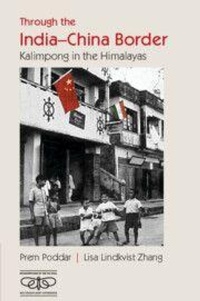
Through the India-China Border
Kalimpong in the Himalayas
Will be published approx. on 1. October 2026
Book
Paperback/Softback
312 pages
978-1-009-49932-3 (ISBN)
Description
Through the India-China Border mobilizes rarely used documentary material from British, Chinese and Indian archives to shed new light on our understanding of the 'Tibet Question' in China-India relations. Focused on the Himalayan border town of Kalimpong from the 1920s to 1962, it unearths a history of espionage and political intrigue that challenges the way that remote peripheries are seen from the 'centres' of nations. The innovative use of postcolonial and transcultural theory demonstrates how a multidisciplinary framework augments our reading of imperial histories, postwar politics, decolonisation and frontier cultures. Kalimpong emerges from this analysis as a key node in Himalayan history and in the mid-century fashioning of India-China relations.
Reviews / Votes
This book is a model of international scholarship, instructive and a delight to read. Variously a booming border town, a strategic asset, a listening post, a 'nest of spies', an ideological flashpoint and a cosmopolitan retreat, topsy-turvy Kalimpong amply merits the story told here. Through the India-China Border will be of absorbing interest to Himalayanists and to anyone concerned with the interplay of external expectations and internal realities within a contested border region. John Keay, Author of Himalaya: Exploring the Roof of the World (2022) 'A rare, original and inimitable academic performance in Sino-Indian Studies. Stylish, engaging and seminal in its historical and theoretical reach.' Xi Lin, Professor and Dean of the Fudan Institute for Advanced Study in Social Sciences, Fudan University 'Poddar and Zhang, in this engaging and erudite volume, bring a slice of colonial and postcolonial history to life through colourful and fascinating stories of events and characters shaping, and shaped by, the play of political and economic forces. Kalimpong emerges in this narrative as a protagonist in its own right, unique in its identity, yet emblematic of wider clashes and negotiations of empires, nations, peoples, authorities and individuals.' Chris Sinha, Distinguished Professor, University of East Anglia 'The newest must-read on the perennial topic of Sino-Indian geopolitics, Through the India-China Border lucidly and vividly recounts how Kalimpong, a British colonial hill station in the early twentieth century, emerged as an interface between China and India. The book illuminates how the colonial legacy cartographically sets the tone for relations between the two most populous nations on earth and their respective claims on territorial sovereignties in the Himalayas.' Dan Smyer Yue, Kuige Professor of Ethnology, Yunnan University, Kunming 'Poddar and Zhang provide a very interesting and rich analysis of the Chinese presence in Kalimpong until the 1960s. ... what makes the book most interesting is the detailed narrativization of specific ways in which Chinese presence as well as absence came to mark Kalimpong.' Dibyesh Anand, The China Quarterly 'An incisive and thought-provoking work ... It will be of great interest to historians of borderlands in East and South Asia, as well as readers who want to know more about Chinese attitudes towards 'diasporic' communities outside of more well-studied locations in Southeast Asia or North America.' Yasser Ali Nasser, Journal of Chinese HistoryMore details
Series
Language
English
Place of publication
Cambridge
United Kingdom
Target group
College/higher education
Product notice
Paperback (trade)
Illustrations
Worked examples or Exercises
ISBN-13
978-1-009-49932-3 (9781009499323)
Copyright in bibliographic data and cover images is held by Nielsen Book Services Limited or by the publishers or by their respective licensors: all rights reserved.
Schweitzer Classification
Persons
Prem Poddar is Professor in Cultural Encounters at Roskilde University in Denmark and Alexander von Humboldt Senior Fellow in Germany. He is former and founding Vice-Chancellor of Darjeeling Hills University, India. He is currently ICAS:MP Senior Fellow. His research interests include cultural theory, nationalisms, and the politics of the passport. Lisa Lindkvist Zhang is Postdoctoral Fellow at Tohoku University and Analyst at the Swedish National China Centre. She defended her PhD dissertation Re-thinking Indian Philosophy in Early Twentieth-Century China at Heidelberg University in 2023. Her research focuses on philosophy and history in light of Chinese politics and China-India relations.
Content
Preface; Acknowledgments; Glossary; 1. Introduction: Kalimpong as Interface - Post/colonial and Transcultural; 2. Kalimpong as Metonym: India-China Correlation; 3. Chinese (and Tibetan) Certification in Himalayan India: Foreigner Registration Files 1940s-1960s; 4. Espionage, Intrigues and Politics: Kalimpong Chung Hwa School as International Playhouse; 5. Shangri-la (Gyalthang) to Kalimpong: The Road of Trade, Transculture and Conflict; 6. Inconclusion: Not The Last Word; Bibliography; Index.