

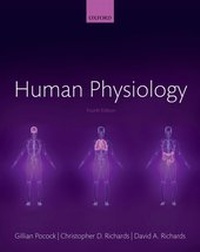
Human Physiology
4th Edition
Published on 7. February 2013
Book
Paperback/Softback
848 pages
978-0-19-957493-3 (ISBN)
Description
The human body is a complicated and beautiful machine, governed by the laws of physics and chemistry. By understanding its physiology - how it performs its varied functions - it is possible to build strategies for diagnosis, treatment, and prevention of disease.
In this extensively-revised edition, a new structure, additional learning features, and an expanded use of artwork, make Human Physiology even more student-friendly than its predecessors.
Human Physiology provides clear explanations of the principles that govern the body's physiological processes and shows how these can be applied. This is the ideal course companion for any student needing a solid foundation in the subject for a future career in human biology, biomedical science, or medicine.
In this extensively-revised edition, a new structure, additional learning features, and an expanded use of artwork, make Human Physiology even more student-friendly than its predecessors.
Human Physiology provides clear explanations of the principles that govern the body's physiological processes and shows how these can be applied. This is the ideal course companion for any student needing a solid foundation in the subject for a future career in human biology, biomedical science, or medicine.
Reviews / Votes
This welcomed fourth edition builds upon the positive aspects of previous editions and provides a fresh perspective to a complex area of study. Ease of reading and understanding is a key strength for this text and students will obtain detailed content, balanced with key effective learning tools to enhance knowledge exchange. * Dr Jamie O'Driscoll, Department of Sport Science, Tourism and Leisure, Canterbury Christ Church University * (About the previous edition) Loads of detail, easy to read and useful summaries at the end of topics. Also laid out in a really comprehensive way. * From Amazon UK *More details
Edition
4th Revised edition
Language
English
Place of publication
Oxford
United Kingdom
Target group
College/higher education
Edition type
Revised edition
Illustrations
700 colour line drawings
Dimensions
Height: 276 mm
Width: 218 mm
Thickness: 35 mm
Weight
2066 gr
ISBN-13
978-0-19-957493-3 (9780199574933)
Copyright in bibliographic data and cover images is held by Nielsen Book Services Limited or by the publishers or by their respective licensors: all rights reserved.
Schweitzer Classification
Other editions
Previous edition
Book
02/2006
3rd Edition
Oxford University Press
€54.46
Article exhausted; check for reprint
Persons
Gillian Pocock read Physiology at the University of Oxford before moving to Kings' College London to study for her PhD under the supervision of P.F. Baker. She held a post-doctoral position at Kings' College before taking up an appointment in the Department of Physiology, Royal Free Hospital School of Medicine. She is now Senior Lecturer in Clinical Science in The Department of Health, Wellbeing and Family, Canterbury Christ Church University, UK. Her research
interests have focussed on the role of calcium in secretion and pH regulation in neurons.
Christopher Richards read Biological Chemistry at the University of Bristol. He completed his PhD in the Department of Zoology, University of Bristol, under the supervision of P.C. Caldwell before taking up a position at the Institute of Psychiatry in London. He subsequently moved to the National Institute for Medical Research where he was a member of the scientific staff. He later held posts in the Departments of Physiology at the Royal Free Hospital School of Medicine and University College
London where he is currently Emeritus Professor of Experimental Physiology. He has published over 100 scientific articles, chiefly on the physiology and pharmacology of nerve cells.
David Richards studied biochemistry at the University of Bristol before beginning
his PhD at the National Institute for Medical Research and University College,
London under the supervision of T.V.P. Bliss. He has held postdoctoral positions at the University of Colorado Medical Center, the University of Zurich Brain Research Institute, and the University of Wisconsin Medical School. He has held faculty positions at the University of Cincinnati Medical School, and is currently Assistant Professor at Cincinnati Children's Hospital Medical Center. His research focuses on the cell biology that supports synaptic transmission.
interests have focussed on the role of calcium in secretion and pH regulation in neurons.
Christopher Richards read Biological Chemistry at the University of Bristol. He completed his PhD in the Department of Zoology, University of Bristol, under the supervision of P.C. Caldwell before taking up a position at the Institute of Psychiatry in London. He subsequently moved to the National Institute for Medical Research where he was a member of the scientific staff. He later held posts in the Departments of Physiology at the Royal Free Hospital School of Medicine and University College
London where he is currently Emeritus Professor of Experimental Physiology. He has published over 100 scientific articles, chiefly on the physiology and pharmacology of nerve cells.
David Richards studied biochemistry at the University of Bristol before beginning
his PhD at the National Institute for Medical Research and University College,
London under the supervision of T.V.P. Bliss. He has held postdoctoral positions at the University of Colorado Medical Center, the University of Zurich Brain Research Institute, and the University of Wisconsin Medical School. He has held faculty positions at the University of Cincinnati Medical School, and is currently Assistant Professor at Cincinnati Children's Hospital Medical Center. His research focuses on the cell biology that supports synaptic transmission.
Content
SECTION 1 BASIC CONCEPTS IN PHYSIOLOGY; SECTION 2 THE ORGANIZATION AND BASIC FUNCTIONS OF CELLS; SECTION 3 THE EXCITABLE TISSUES - NERVE AND MUSCLE; SECTION 4 THE NERVOUS SYSTEM AND SPECIAL SENSES; SECTION 5 THE ENDOCRINE SYSTEM; SECTION 6 BLOOD AND THE IMMUNE SYSTEM; SECTION 7 THE CARDIOVASCULAR SYSTEM; SECTION 8 THE RESPIRATORY SYSTEM; SECTION 9 THE URINARY SYSTEM AND THE REGULATION OF THE INTERNAL ENVIRONMENT; SECTION 10 THE GASTROINTESTINAL SYSTEM; SECTION 11 REPRODUCTION AND GROWTH; SECTION 12 APPLIED PHYSIOLOGY