

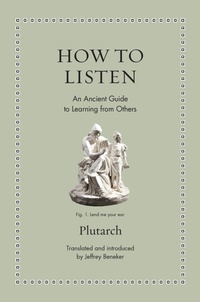
How to Listen
An Ancient Guide to Learning from Others
Published on 24. February 2026
Book
Hardback
152 pages
978-0-691-26558-2 (ISBN)
Description
A lively new translation of Plutarch's charming and timeless essay on how to be a good listener-and why listening is essential to learning and living well
Listening is a skill-even an art-and it's essential to learning and to life. Indeed, as Plutarch writes in How to Listen, "listening well is the foundation for living well." In this volume, Jeffrey Beneker presents a vivid and accessible new translation of Plutarch's classic essay about how to become a skilled listener, complete with an inviting introduction and the original Greek on facing pages.
Plutarch is most famous as the author of Parallel Lives, a series of biographies of Greek and Roman statesmen. But he was also an expert on teaching and learning and How to Listen is arguably one of his best pedagogical works. A proponent of active listening well before its time, Plutarch explains the skills we need-and the obstacles and distractions we must overcome-to become effective listeners. Good listening requires, above all, an acknowledgement of our own ignorance in certain subjects and a commitment to gaining knowledge. We must set aside pride and envy so we can respect the expertise of others. We must also train ourselves to see through style and focus on substance, to discriminate between weak and strong arguments, and to criticize ideas fairly and accurately.
Filled with shrewd insights and advice, How to Listen shows how to cultivate a skill that everyone who wants to learn and live well must master.
Listening is a skill-even an art-and it's essential to learning and to life. Indeed, as Plutarch writes in How to Listen, "listening well is the foundation for living well." In this volume, Jeffrey Beneker presents a vivid and accessible new translation of Plutarch's classic essay about how to become a skilled listener, complete with an inviting introduction and the original Greek on facing pages.
Plutarch is most famous as the author of Parallel Lives, a series of biographies of Greek and Roman statesmen. But he was also an expert on teaching and learning and How to Listen is arguably one of his best pedagogical works. A proponent of active listening well before its time, Plutarch explains the skills we need-and the obstacles and distractions we must overcome-to become effective listeners. Good listening requires, above all, an acknowledgement of our own ignorance in certain subjects and a commitment to gaining knowledge. We must set aside pride and envy so we can respect the expertise of others. We must also train ourselves to see through style and focus on substance, to discriminate between weak and strong arguments, and to criticize ideas fairly and accurately.
Filled with shrewd insights and advice, How to Listen shows how to cultivate a skill that everyone who wants to learn and live well must master.
More details
Series
Language
English
Place of publication
New Jersey
United States
Product notice
Trade binding
Dimensions
Height: 176 mm
Width: 118 mm
Thickness: 20 mm
Weight
194 gr
ISBN-13
978-0-691-26558-2 (9780691265582)
Copyright in bibliographic data and cover images is held by Nielsen Book Services Limited or by the publishers or by their respective licensors: all rights reserved.
Schweitzer Classification
Other editions
Additional editions
E-Book
02/2026
University of Pittsburgh Press
€18.49
Available for download
Persons
Plutarch (c. AD 40-120), a native of Greece and a citizen of Rome, was a philosopher, writer, lecturer, and an expert on teaching and learning. He wrote many essays on ethics, history, science, and culture, in addition to Parallel Lives, his famous biographies of Greek and Roman statesmen. Jeffrey Beneker is professor of classics at the University of Wisconsin-Madison. He is the editor and translator of Plutarch's How to Be a Leader (Princeton) and the author of The Passionate Statesman: Eros and Politics in Plutarch's Lives.