

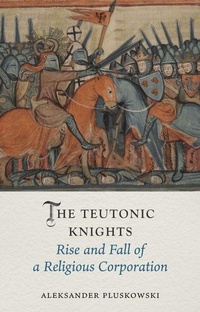
The Teutonic Knights
Rise and Fall of a Religious Corporation
Will be published approx. on 13. May 2024
Book
Paperback/Softback
216 pages
978-1-78914-868-8 (ISBN)
Description
This book provides a concise and incisive introduction to the Teutonic Knights, or Teutonic Order, the last of the great military orders established in the twelfth century. Evolving into a powerful religious institution, the Knights left a profound and enduring legacy. Aleksander Pluskowski traces the Order's journey from a field hospital outside the walls of Acre during the Third Crusade to its remarkable rise as a major territorial ruler and power in northeastern Europe. He charts the three centuries of theocratic rule by this remarkable religious corporation and examines the Order's notable accomplishments, as well as its failures.
From constructing distinctive fortified convents, including the largest castle in Western Christendom as its headquarters, to the Order's decline in the fifteenth century due to a devastating war with Poland-Lithuania and the secularization of its Prussian and Livonian branches during the Reformation, The Teutonic Knights is a compelling look at a pivotal force in European history.
From constructing distinctive fortified convents, including the largest castle in Western Christendom as its headquarters, to the Order's decline in the fifteenth century due to a devastating war with Poland-Lithuania and the secularization of its Prussian and Livonian branches during the Reformation, The Teutonic Knights is a compelling look at a pivotal force in European history.
Reviews / Votes
Pluskowski's The Teutonic Knights is a concise, soberly written and authoritative survey of the military order that fought in both the Holy Land and Europe's eastern borderlands, becoming in the process one of the continent's most powerful religious institutions . . . Pluskowski is especially good at describing the scores of castles that the Teutonic Knights built across north-eastern Europe. -- Tony Barber * Financial Times * This book provides a narrative account of the Teutonic Knights, a religious order created in 1190 for hospital work during the Crusades . . . The theocratic rule of the Teutonic Knights ended after 325 years, but they remain a significant factor in late medieval European history. Recommended. * Choice * Aleksander Pluskowski has pulled off a remarkable feat. Combining up-to-date international scholarship, detailed narrative and shrewd assessment of complex evidence with close analysis of the full range of economic, political, environmental, ideological, artistic and architectural contexts, his succinct account of the Teutonic Order provides a comprehensive new standard reference. * Christopher Tyerman, Professor Emeritus of the History of the Crusades, University of Oxford, and Emeritus Fellow, Hertford College * Fluent, fresh and confident, this clever blend of history and archaeology brings the story of the Teutonic Knights sharply into focus. Pluskowski incisively steers us through the emergence, expansion and decline of this mighty organization, enabling us to appreciate its profound influence on the faith, politics and landscape of northeastern Europe. * Jonathan Phillips, Professor of the History of the Crusades, Royal Holloway, University of London * Aleksander Pluskowski has provided a concise, well-researched and highly readable account of the vicissitudes of the Teutonic Knights, from their establishment as a hospitaller military order in the Holy Land during the Third Crusade, through its meteoric rise as a major political and military power in Prussia and Livonia, to its transformation and decline during the Reformation and eventual conversion into a religious, charitable organisation under the Holy Roman Empire. This book is a welcome addition to the limited English-language library on the Teutonic Order. * Adrian J. Boas, Professor Emeritus of Medieval Archaeology, University of Haifa, Israel *More details
Series
Language
English
Place of publication
London
United Kingdom
Illustrations
38 illustrations, 26 in colour
Dimensions
Height: 218 mm
Width: 144 mm
Thickness: 23 mm
Weight
532 gr
ISBN-13
978-1-78914-868-8 (9781789148688)
Copyright in bibliographic data and cover images is held by Nielsen Book Services Limited or by the publishers or by their respective licensors: all rights reserved.
Schweitzer Classification
Person
Aleksander Pluskowski is Professor of Medieval Archaeology at the University of Reading. His publications include Environment, Colonization, and the Baltic Crusader States (2019) and The Archaeology of the Prussian Crusade: Holy War and Colonisation (2nd edn, 2022).
Content
Introduction
1 The German Hospital of the Third Crusade: The Origins of the Teutonic Order
2 Expansion and Loss in the Thirteenth Century: The Teutonic Order in the Holy Land
3 A New Frontier: The Teutonic Order in Transylvania
4 Holy War and Conquest: The Teutonic Order's Crusades in Prussia and Livonia
5 Territorial Lords: The Teutonic Order's Rule in the Baltic
6 Power and Faith: The Teutonic Order's Fortified Convents
7 Crusading in the Wilderness: The Teutonic Order's Wars against Lithuania
8 Defeat and Decline in the Fifteenth Century
9 The Reformation and the End of the Teutonic Order's Rule in the Baltic
10 The Rise and Fall of a Medieval Religious Corporation
References
Bibliography
Acknowledgements
Photo Acknowledgements
Index
1 The German Hospital of the Third Crusade: The Origins of the Teutonic Order
2 Expansion and Loss in the Thirteenth Century: The Teutonic Order in the Holy Land
3 A New Frontier: The Teutonic Order in Transylvania
4 Holy War and Conquest: The Teutonic Order's Crusades in Prussia and Livonia
5 Territorial Lords: The Teutonic Order's Rule in the Baltic
6 Power and Faith: The Teutonic Order's Fortified Convents
7 Crusading in the Wilderness: The Teutonic Order's Wars against Lithuania
8 Defeat and Decline in the Fifteenth Century
9 The Reformation and the End of the Teutonic Order's Rule in the Baltic
10 The Rise and Fall of a Medieval Religious Corporation
References
Bibliography
Acknowledgements
Photo Acknowledgements
Index