

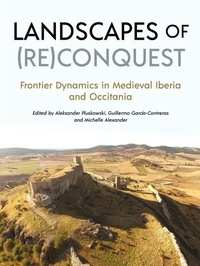
Landscapes of (Re)Conquest
Frontier Dynamics in Medieval Iberia and Occitania
Published on 15. November 2025
Book
Hardback
352 pages
979-8-88857-069-2 (ISBN)
Description
Frontiers were an integral feature of every medieval polity, and their spaces were defined by opposing spheres of influence, contact and connectivity. As these polities expanded and contracted, often as a result of military conquest and territorial annexation, their permeable edges became defined by transformative cultural landscapes. Here, the encounters between native or resident and incoming populations, from small elite groups through to larger numbers of migrants from diverse social backgrounds, resulted in varying degrees of cultural hybridity. This came to define frontier societies, and left an enduring impact even as borderlands continued to move. They also saw the reconfiguration of political, economic and religious landscapes as frontier authorities invested in both old and new centers, with varying degrees of continuity. Today, the remains of their fortified residences represent the most striking monuments associated with former frontiers. They remain at the center of public narratives regarding state formation and cultural conflict.
Adopting the definition of frontiers as both the spaces at the edges of polities and the composite societies resulting from their territorial expansion, this book presents a multi-disciplinary study of their dynamics. Focusing on the western Mediterranean, it draws on case studies of cultural landscapes shaped by two contrasting periods of conquest, regime change and state formation: the Castilian and Aragonese conquests of al-Andalus (Islamic Iberia) and the French annexation of Occitania following the Albigensian Crusade. Integrating perspectives from settlement and landscape archaeology, geoarchaeology, zooarchaeology, archaeobotany, archaeometallurgy and isotopic analyses, this book provides a new framework for the study of the transformative spaces of medieval frontier societies.
Adopting the definition of frontiers as both the spaces at the edges of polities and the composite societies resulting from their territorial expansion, this book presents a multi-disciplinary study of their dynamics. Focusing on the western Mediterranean, it draws on case studies of cultural landscapes shaped by two contrasting periods of conquest, regime change and state formation: the Castilian and Aragonese conquests of al-Andalus (Islamic Iberia) and the French annexation of Occitania following the Albigensian Crusade. Integrating perspectives from settlement and landscape archaeology, geoarchaeology, zooarchaeology, archaeobotany, archaeometallurgy and isotopic analyses, this book provides a new framework for the study of the transformative spaces of medieval frontier societies.
More details
Language
English
Place of publication
United States
Target group
College/higher education
Product notice
sewn/stitched
Cloth over boards
Illustrations
250 B/W and color illustrations
Dimensions
Height: 278 mm
Width: 216 mm
Thickness: 28 mm
Weight
1429 gr
ISBN-13
979-8-88857-069-2 (9798888570692)
Copyright in bibliographic data and cover images is held by Nielsen Book Services Limited or by the publishers or by their respective licensors: all rights reserved.
Schweitzer Classification
Persons
Aleksander Pluskowski is Professor of Medieval Archaeology at the University of Reading, UK. He completed his PhD at the University of Cambridge in 2003. His main research interests include environmental archaeology, frontier societies and religious transformation in medieval Europe.
Content
List of contributors
Acknowledgements
PART 1: INTRODUCTION
1. Frontier societies in the medieval western Mediterranean: Historical framework and concepts
Guillermo Garcia-Contreras, Michelle Alexander and Aleksander Pluskowski
2. Studying frontier societies: Theory, scales, methods and chronology
Aleksander Pluskowski, Guillermo Garcia-Contreras, Michelle Alexander
PART 2: IBERIA
3. Sites in Iberia: The historical and archaeological data
Guillermo Garcia-Contreras, Luca Mattei and Aleksander Pluskowski
4. The cultural landscapes of medieval Iberian frontiers
Luca Mattei and Guillermo Garcia-Contreras
5. Land use in medieval Iberian frontier societies
Rowena Banerjea, Luca Mattei, Alex Brown, Lionello Morandi and Phillip Toms
6. Towards a narrative change? New archaeobotanical research on the 'Green Revolution' at the heartlands and frontiers of Al-Andalus
Jerome Ros, Nicolas Losilla, Thierry Pastor and Camille Hervy
7. The zooarchaeology of frontiers in late medieval Iberia
Marcos Garcia Garcia
8. Diet and animal husbandry on an Iberian frontier: biomolecular perspectives from Guadalajara
Michelle Alexander, Maite I. Garcia-Collado, Samantha Greeves and Marcos Garcia Garcia
9. Metal production after the Christian conquests in Iberia (12th-15th centuries): the lordship of Molina de Aragon (Guadalajara, Spain)
Yaiza Hernandez-Casas, Mercedes Murillo-Barroso, Jesus Alberto Arenas Esteban and Guillermo Garcia-Contreras Ruiz
10. Mortar composition and technology in Islamic and Christian fortifications: Case studies from Guadalajara and Andalusia
Kevin M. J. Hayward
11. The upper frontier (a?-?agr al-a ?la) of al-Andalus and the Catalan comital conquest
Jesus Brufal, Helena Kirchner and Antoni Virgili
PART 3: OCCITANIA
12. Sites in Occitania: The historical and archaeological data
Carole Puig, David Maso, Margot Hoffelt, Jean-Michel Carozza and Aleksander Pluskowski
13. The impact of the Albigensian Crusade on the cultural landscapes of the eastern Pyrenean frontier (Pyrenees Audoises)
Carole Puig, Margot Hoffelt and Jean-Michel Carozza
14. Beyond borders and politics: the resilience of human-animal interactions after the Albigensian crusade
Dianne Unsain, Tatiana Andre and Audrey Roussel
PART 4: SYNTHESIS
15. The impact of shifting frontiers, conquest and cultural transformation in medieval Iberia and Occitania
Aleksander Pluskowski, Michelle Alexander, Guillermo Garcia-Contreras
Acknowledgements
PART 1: INTRODUCTION
1. Frontier societies in the medieval western Mediterranean: Historical framework and concepts
Guillermo Garcia-Contreras, Michelle Alexander and Aleksander Pluskowski
2. Studying frontier societies: Theory, scales, methods and chronology
Aleksander Pluskowski, Guillermo Garcia-Contreras, Michelle Alexander
PART 2: IBERIA
3. Sites in Iberia: The historical and archaeological data
Guillermo Garcia-Contreras, Luca Mattei and Aleksander Pluskowski
4. The cultural landscapes of medieval Iberian frontiers
Luca Mattei and Guillermo Garcia-Contreras
5. Land use in medieval Iberian frontier societies
Rowena Banerjea, Luca Mattei, Alex Brown, Lionello Morandi and Phillip Toms
6. Towards a narrative change? New archaeobotanical research on the 'Green Revolution' at the heartlands and frontiers of Al-Andalus
Jerome Ros, Nicolas Losilla, Thierry Pastor and Camille Hervy
7. The zooarchaeology of frontiers in late medieval Iberia
Marcos Garcia Garcia
8. Diet and animal husbandry on an Iberian frontier: biomolecular perspectives from Guadalajara
Michelle Alexander, Maite I. Garcia-Collado, Samantha Greeves and Marcos Garcia Garcia
9. Metal production after the Christian conquests in Iberia (12th-15th centuries): the lordship of Molina de Aragon (Guadalajara, Spain)
Yaiza Hernandez-Casas, Mercedes Murillo-Barroso, Jesus Alberto Arenas Esteban and Guillermo Garcia-Contreras Ruiz
10. Mortar composition and technology in Islamic and Christian fortifications: Case studies from Guadalajara and Andalusia
Kevin M. J. Hayward
11. The upper frontier (a?-?agr al-a ?la) of al-Andalus and the Catalan comital conquest
Jesus Brufal, Helena Kirchner and Antoni Virgili
PART 3: OCCITANIA
12. Sites in Occitania: The historical and archaeological data
Carole Puig, David Maso, Margot Hoffelt, Jean-Michel Carozza and Aleksander Pluskowski
13. The impact of the Albigensian Crusade on the cultural landscapes of the eastern Pyrenean frontier (Pyrenees Audoises)
Carole Puig, Margot Hoffelt and Jean-Michel Carozza
14. Beyond borders and politics: the resilience of human-animal interactions after the Albigensian crusade
Dianne Unsain, Tatiana Andre and Audrey Roussel
PART 4: SYNTHESIS
15. The impact of shifting frontiers, conquest and cultural transformation in medieval Iberia and Occitania
Aleksander Pluskowski, Michelle Alexander, Guillermo Garcia-Contreras